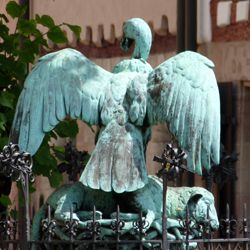
Memorial to King Ludwig´s Railway (Ludwigseisenbahn)
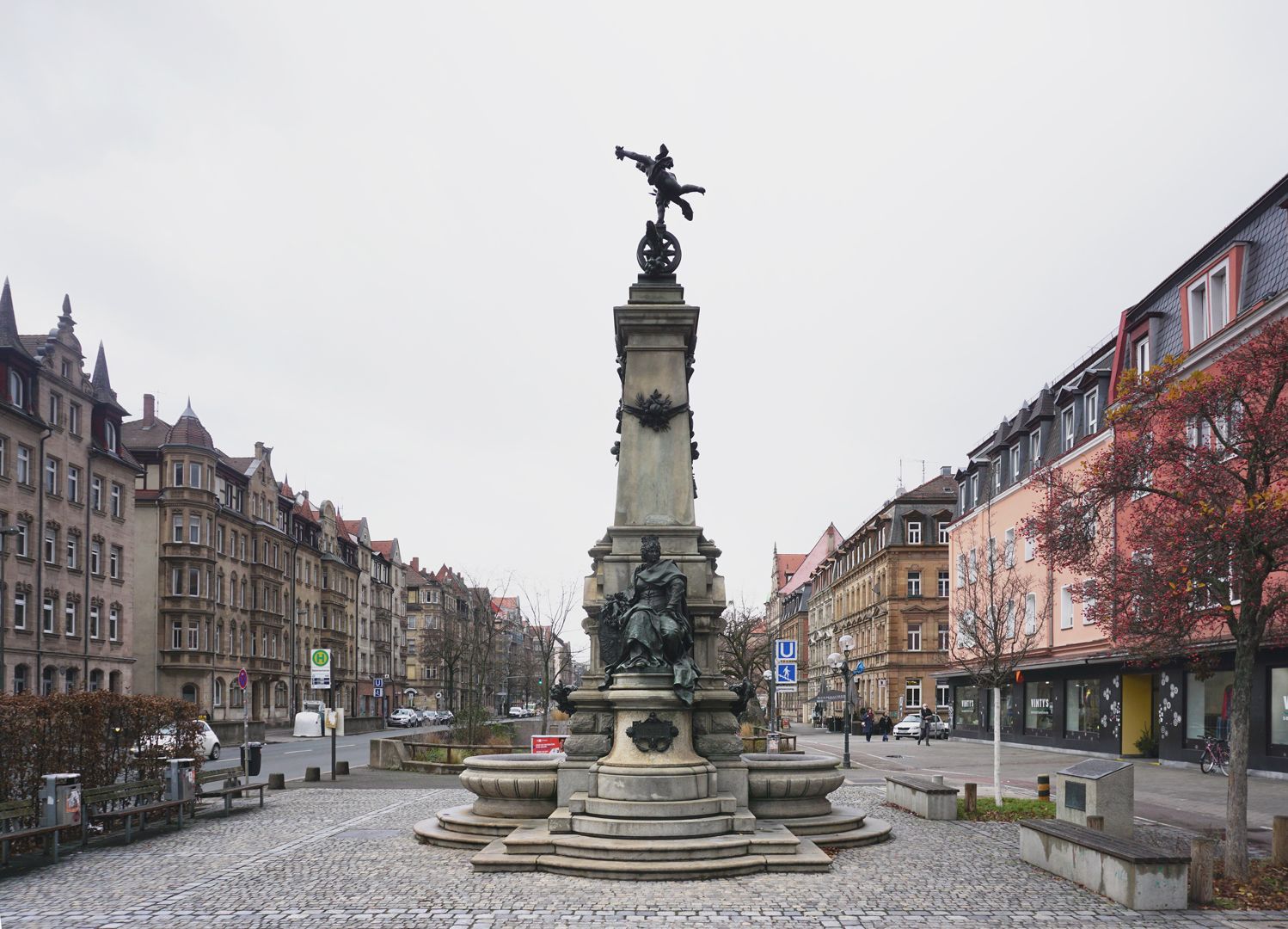
Memorial to King Ludwig´s Railway (Ludwigseisenbahn)
1890
East side
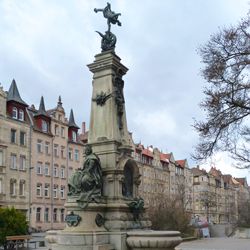
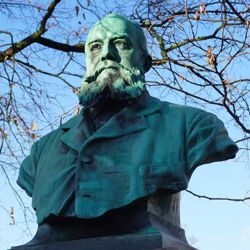
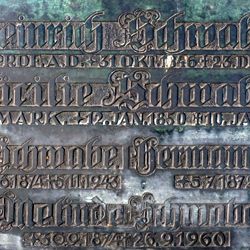
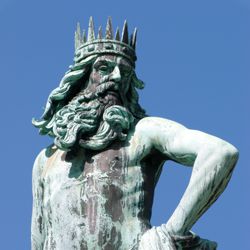
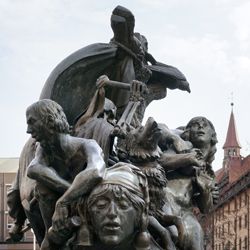
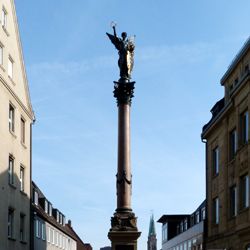
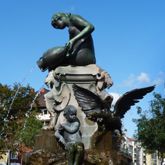
On October 16, 1890, an art fountain by Heinrich Schwabe was unveiled at Plärrer. After stops at the city limits (1930; 1981), it has been at its current location since 1993. The small bronze sculpture that decorates the approximately 10 m high granite obelisk glorifies the first German railway journey as a triumph of technology and comes - like the flanking personifications of Noris and Furthia - from the Lenz art foundry. The foundation stone was laid on December 7th, 1885, the 50th anniversary of the Adler voyage between Nuremberg and Fürth. Schwabe won the competition that was only announced in May 1887, although the jury recognized Rudolf Maison's design "Hercules" - later realized at the Fürth train station - as the best artistic achievement. Half of the costs of 58,500 marks were borne by the Bavarian state. The other half was shared by the Ludwig Railway Company, the city, the suburban association and private patrons, including Ludwig Gerngros. quoted from: Nuremberg City Lexicon, edited by Michael Diefenbacher and Rudolf Endres, Nuremberg, 1999
Location: Nuremberg, Gostenhof, Fürther Straße (Bärenschanze subway station)
Design: Schwabe, Georg Heinrich Joseph
Realization: Lenz, Christoph (I.)
Depicted: Klutentreter, Kurt, Gerngros, Ludwig Ritter von
photo 2023, Theo Noll
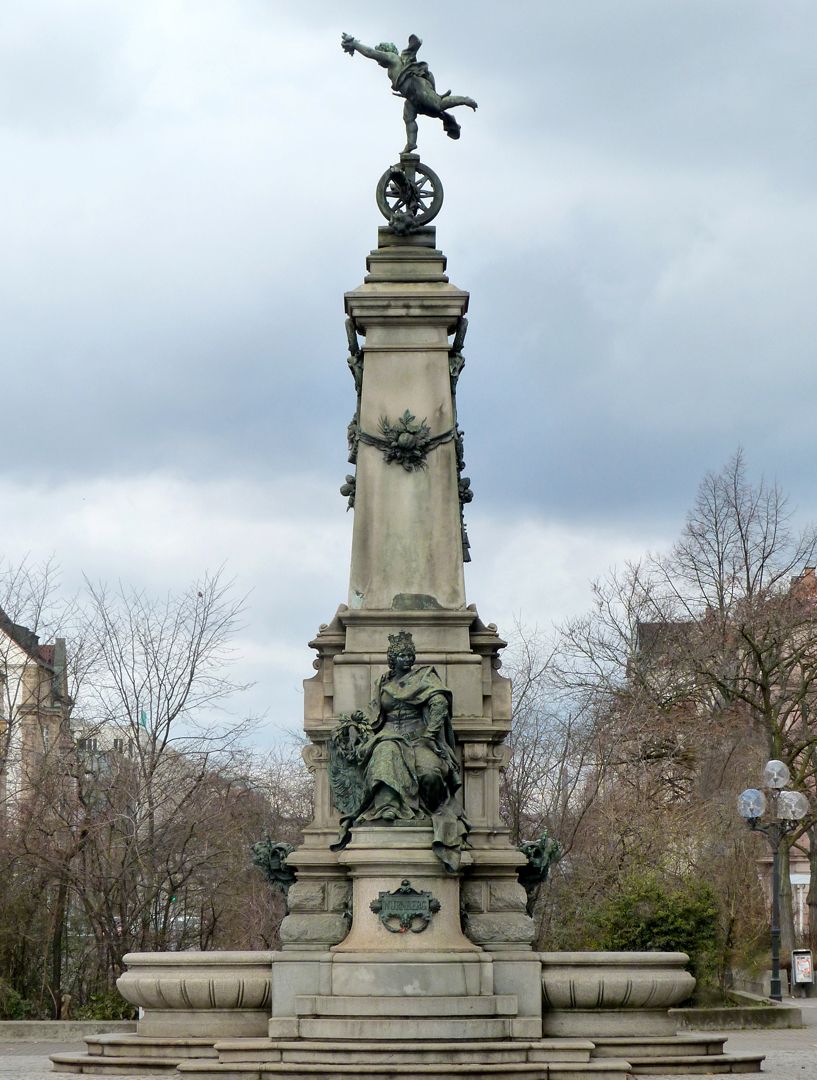
Memorial to King Ludwig´s Railway (Ludwigseisenbahn)
1890
East side
On October 16, 1890, an art fountain by Heinrich Schwabe was unveiled at Plärrer. After stops at the city limits (1930; 1981), it has been at its current location since 1993. The small bronze sculpture that decorates the approximately 10 m high granite obelisk glorifies the first German railway journey as a triumph of technology and comes - like the flanking personifications of Noris and Furthia - from the Lenz art foundry. The foundation stone was laid on December 7th, 1885, the 50th anniversary of the Adler voyage between Nuremberg and Fürth. Schwabe won the competition that was only announced in May 1887, although the jury recognized Rudolf Maison's design "Hercules" - later realized at the Fürth train station - as the best artistic achievement. Half of the costs of 58,500 marks were borne by the Bavarian state. The other half was shared by the Ludwig Railway Company, the city, the suburban association and private patrons, including Ludwig Gerngros. quoted from: Nuremberg City Lexicon, edited by Michael Diefenbacher and Rudolf Endres, Nuremberg, 1999
Location: Nuremberg, Gostenhof, Fürther Straße (Bärenschanze subway station)
Design: Schwabe, Georg Heinrich Joseph
Realization: Lenz, Christoph (I.)
Depicted: Klutentreter, Kurt, Gerngros, Ludwig Ritter von
photo 2023, Theo Noll
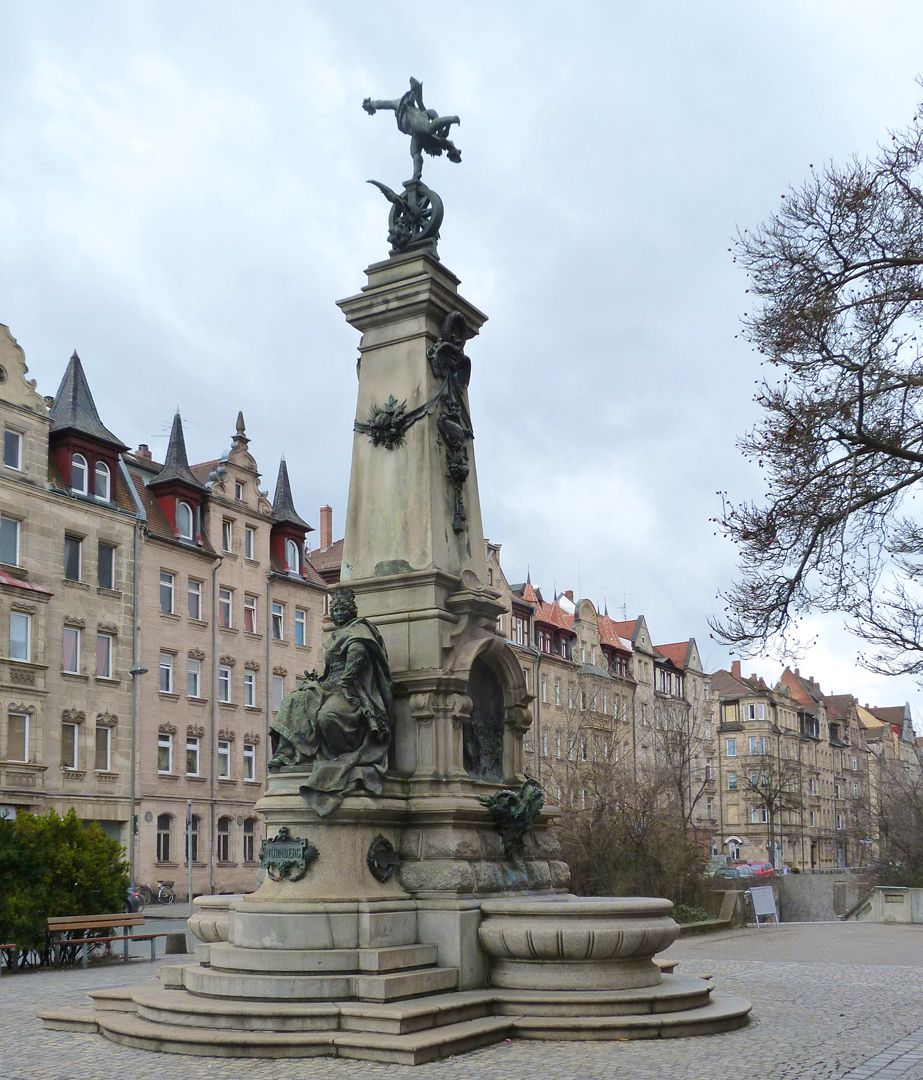
Memorial to King Ludwig´s Railway (Ludwigseisenbahn)
1890
North aest side
On October 16, 1890, an art fountain by Heinrich Schwabe was unveiled at Plärrer. After stops at the city limits (1930; 1981), it has been at its current location since 1993. The small bronze sculpture that decorates the approximately 10 m high granite obelisk glorifies the first German railway journey as a triumph of technology and comes - like the flanking personifications of Noris and Furthia - from the Lenz art foundry. The foundation stone was laid on December 7th, 1885, the 50th anniversary of the Adler voyage between Nuremberg and Fürth. Schwabe won the competition that was only announced in May 1887, although the jury recognized Rudolf Maison's design "Hercules" - later realized at the Fürth train station - as the best artistic achievement. Half of the costs of 58,500 marks were borne by the Bavarian state. The other half was shared by the Ludwig Railway Company, the city, the suburban association and private patrons, including Ludwig Gerngros. quoted from: Nuremberg City Lexicon, edited by Michael Diefenbacher and Rudolf Endres, Nuremberg, 1999
Location: Nuremberg, Gostenhof, Fürther Straße (Bärenschanze subway station)
Design: Schwabe, Georg Heinrich Joseph
Realization: Lenz, Christoph (I.)
Depicted: Klutentreter, Kurt, Gerngros, Ludwig Ritter von
photo 2018, Theo Noll
Memorial to King Ludwig´s Railway (Ludwigseisenbahn)
1890
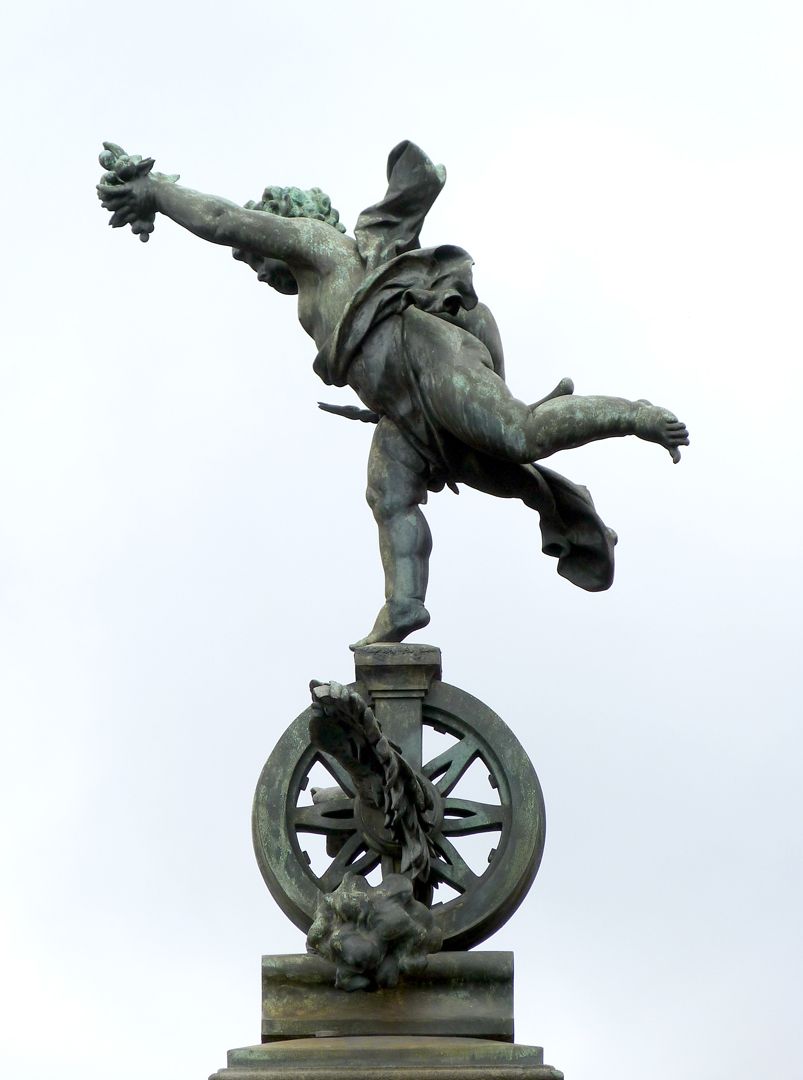
Obelisk crown, putto with fruit on a winged rail wheel, view from the east
On October 16, 1890, an art fountain by Heinrich Schwabe was unveiled at Plärrer. After stops at the city limits (1930; 1981), it has been at its current location since 1993. The small bronze sculpture that decorates the approximately 10 m high granite obelisk glorifies the first German railway journey as a triumph of technology and comes - like the flanking personifications of Noris and Furthia - from the Lenz art foundry. The foundation stone was laid on December 7th, 1885, the 50th anniversary of the Adler voyage between Nuremberg and Fürth. Schwabe won the competition that was only announced in May 1887, although the jury recognized Rudolf Maison's design "Hercules" - later realized at the Fürth train station - as the best artistic achievement. Half of the costs of 58,500 marks were borne by the Bavarian state. The other half was shared by the Ludwig Railway Company, the city, the suburban association and private patrons, including Ludwig Gerngros. quoted from: Nuremberg City Lexicon, edited by Michael Diefenbacher and Rudolf Endres, Nuremberg, 1999
Location: Nuremberg, Gostenhof, Fürther Straße (Bärenschanze subway station)
Design: Schwabe, Georg Heinrich Joseph
Realization: Lenz, Christoph (I.)
Depicted: Klutentreter, Kurt, Gerngros, Ludwig Ritter von
photo 2018, Theo Noll
Memorial to King Ludwig´s Railway (Ludwigseisenbahn)
1890
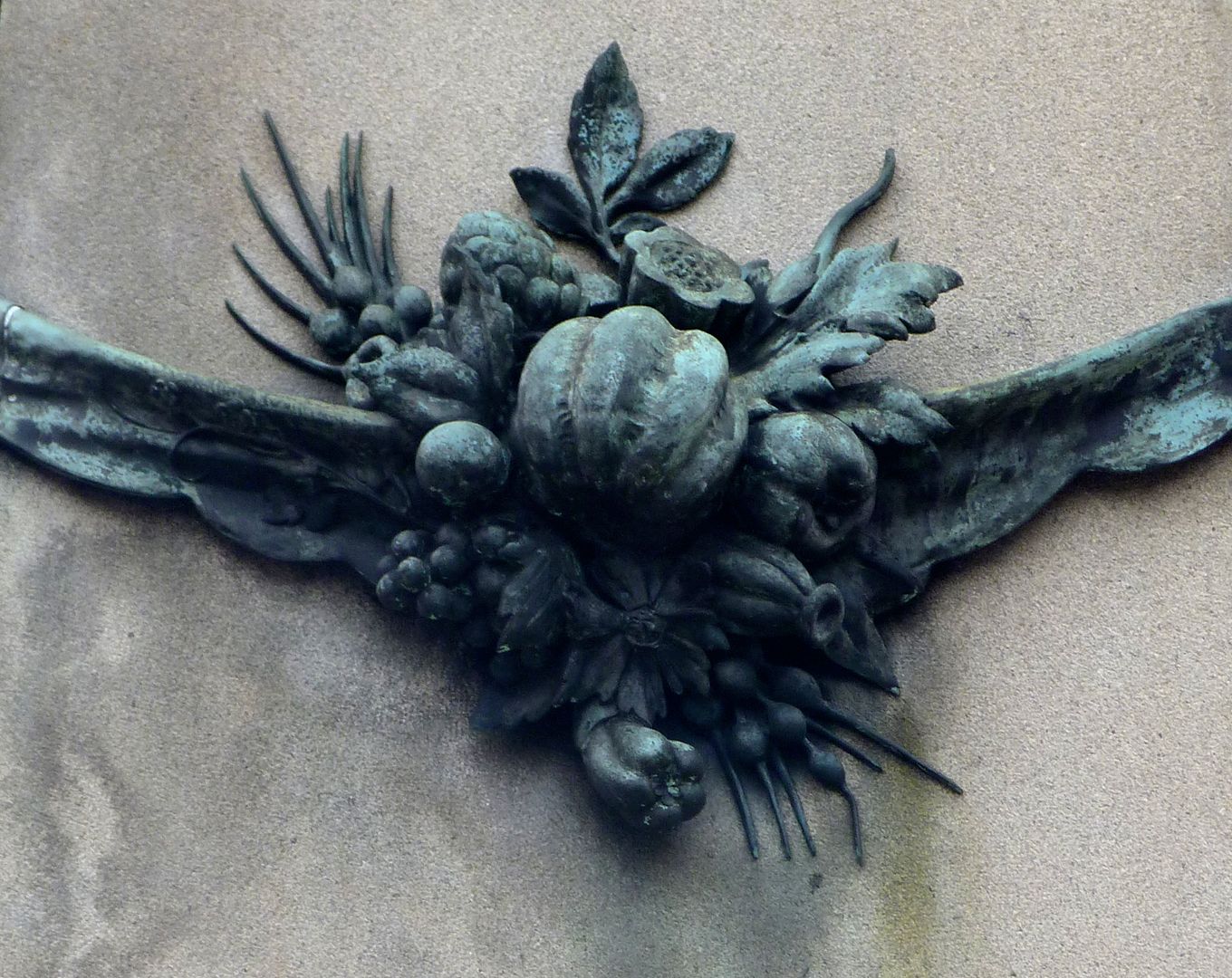
Fruit garland on the obelisk
On October 16, 1890, an art fountain by Heinrich Schwabe was unveiled at Plärrer. After stops at the city limits (1930; 1981), it has been at its current location since 1993. The small bronze sculpture that decorates the approximately 10 m high granite obelisk glorifies the first German railway journey as a triumph of technology and comes - like the flanking personifications of Noris and Furthia - from the Lenz art foundry. The foundation stone was laid on December 7th, 1885, the 50th anniversary of the Adler voyage between Nuremberg and Fürth. Schwabe won the competition that was only announced in May 1887, although the jury recognized Rudolf Maison's design "Hercules" - later realized at the Fürth train station - as the best artistic achievement. Half of the costs of 58,500 marks were borne by the Bavarian state. The other half was shared by the Ludwig Railway Company, the city, the suburban association and private patrons, including Ludwig Gerngros. quoted from: Nuremberg City Lexicon, edited by Michael Diefenbacher and Rudolf Endres, Nuremberg, 1999
Location: Nuremberg, Gostenhof, Fürther Straße (Bärenschanze subway station)
Design: Schwabe, Georg Heinrich Joseph
Realization: Lenz, Christoph (I.)
Depicted: Klutentreter, Kurt, Gerngros, Ludwig Ritter von
photo 2018, Theo Noll
Memorial to King Ludwig´s Railway (Ludwigseisenbahn)
1890
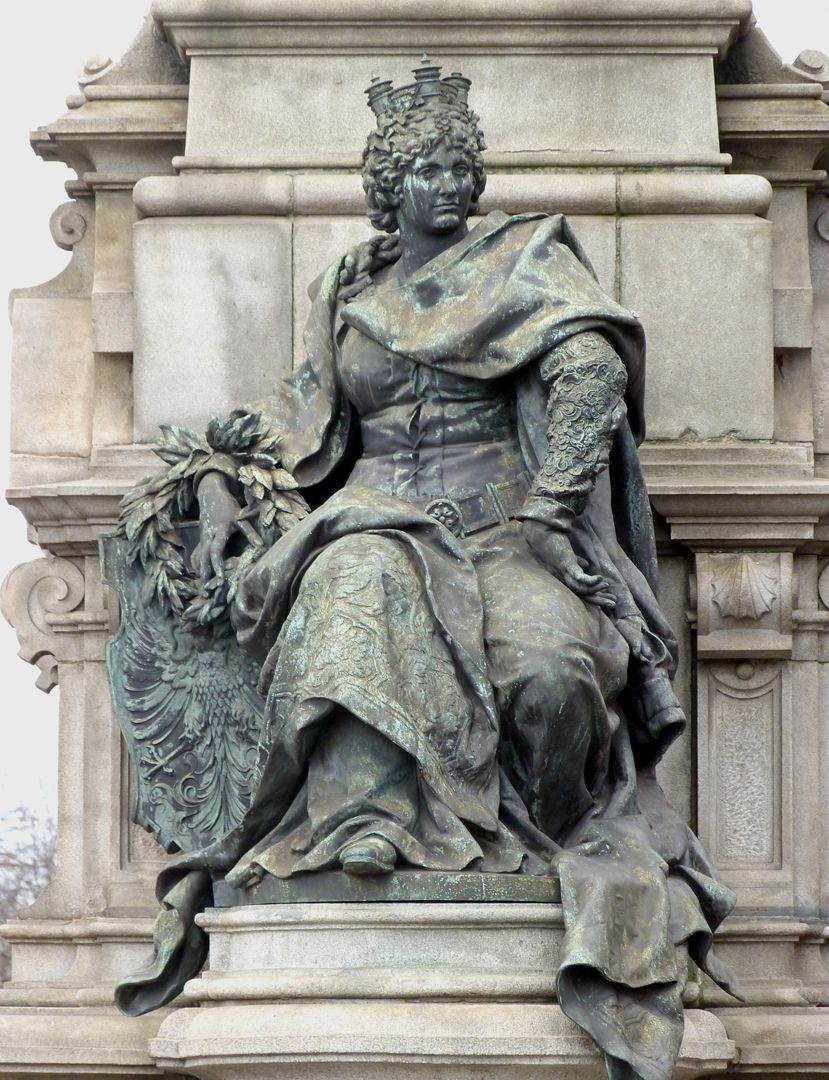
"Noris" with city wall crown and coat of arms
On October 16, 1890, an art fountain by Heinrich Schwabe was unveiled at Plärrer. After stops at the city limits (1930; 1981), it has been at its current location since 1993. The small bronze sculpture that decorates the approximately 10 m high granite obelisk glorifies the first German railway journey as a triumph of technology and comes - like the flanking personifications of Noris and Furthia - from the Lenz art foundry. The foundation stone was laid on December 7th, 1885, the 50th anniversary of the Adler voyage between Nuremberg and Fürth. Schwabe won the competition that was only announced in May 1887, although the jury recognized Rudolf Maison's design "Hercules" - later realized at the Fürth train station - as the best artistic achievement. Half of the costs of 58,500 marks were borne by the Bavarian state. The other half was shared by the Ludwig Railway Company, the city, the suburban association and private patrons, including Ludwig Gerngros. quoted from: Nuremberg City Lexicon, edited by Michael Diefenbacher and Rudolf Endres, Nuremberg, 1999
Location: Nuremberg, Gostenhof, Fürther Straße (Bärenschanze subway station)
Design: Schwabe, Georg Heinrich Joseph
Realization: Lenz, Christoph (I.)
Depicted: Klutentreter, Kurt, Gerngros, Ludwig Ritter von
photo 2018, Theo Noll
Memorial to King Ludwig´s Railway (Ludwigseisenbahn)
1890
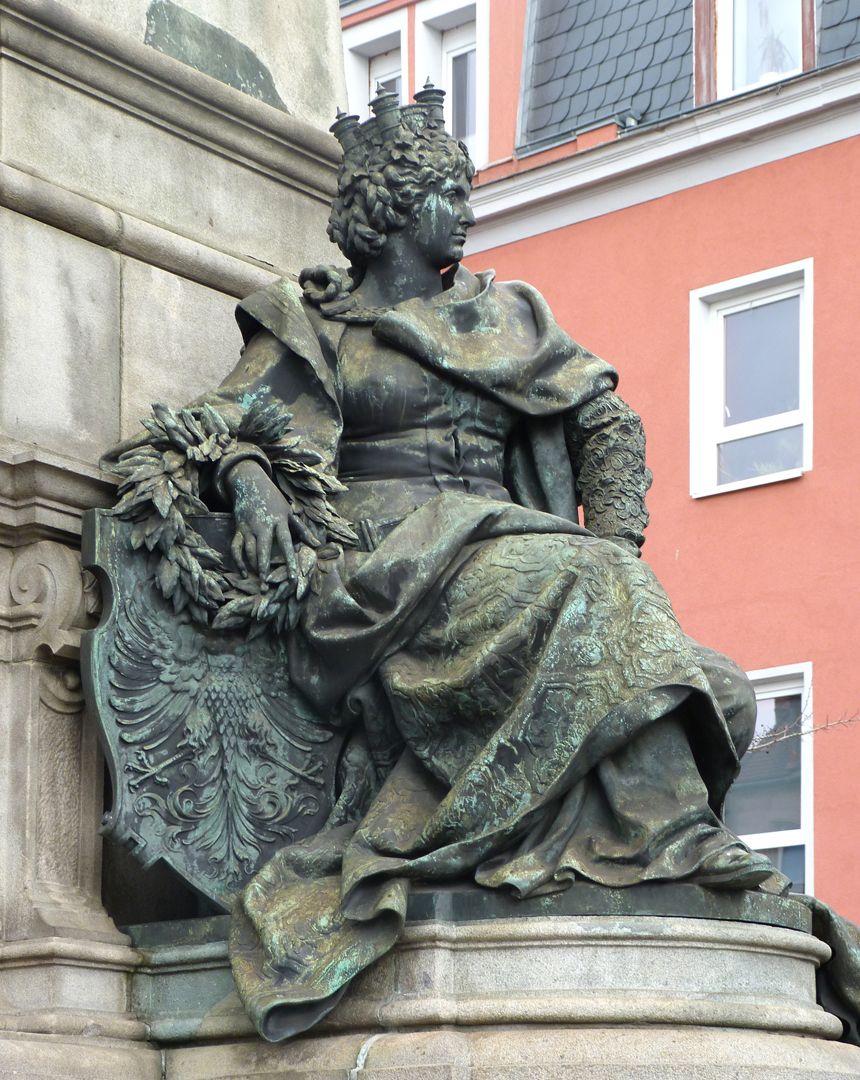
"Noris" with city wall crown and coat of arms
On October 16, 1890, an art fountain by Heinrich Schwabe was unveiled at Plärrer. After stops at the city limits (1930; 1981), it has been at its current location since 1993. The small bronze sculpture that decorates the approximately 10 m high granite obelisk glorifies the first German railway journey as a triumph of technology and comes - like the flanking personifications of Noris and Furthia - from the Lenz art foundry. The foundation stone was laid on December 7th, 1885, the 50th anniversary of the Adler voyage between Nuremberg and Fürth. Schwabe won the competition that was only announced in May 1887, although the jury recognized Rudolf Maison's design "Hercules" - later realized at the Fürth train station - as the best artistic achievement. Half of the costs of 58,500 marks were borne by the Bavarian state. The other half was shared by the Ludwig Railway Company, the city, the suburban association and private patrons, including Ludwig Gerngros. quoted from: Nuremberg City Lexicon, edited by Michael Diefenbacher and Rudolf Endres, Nuremberg, 1999
Location: Nuremberg, Gostenhof, Fürther Straße (Bärenschanze subway station)
Design: Schwabe, Georg Heinrich Joseph
Realization: Lenz, Christoph (I.)
Depicted: Klutentreter, Kurt, Gerngros, Ludwig Ritter von
photo 2018, Theo Noll
Memorial to King Ludwig´s Railway (Ludwigseisenbahn)
1890
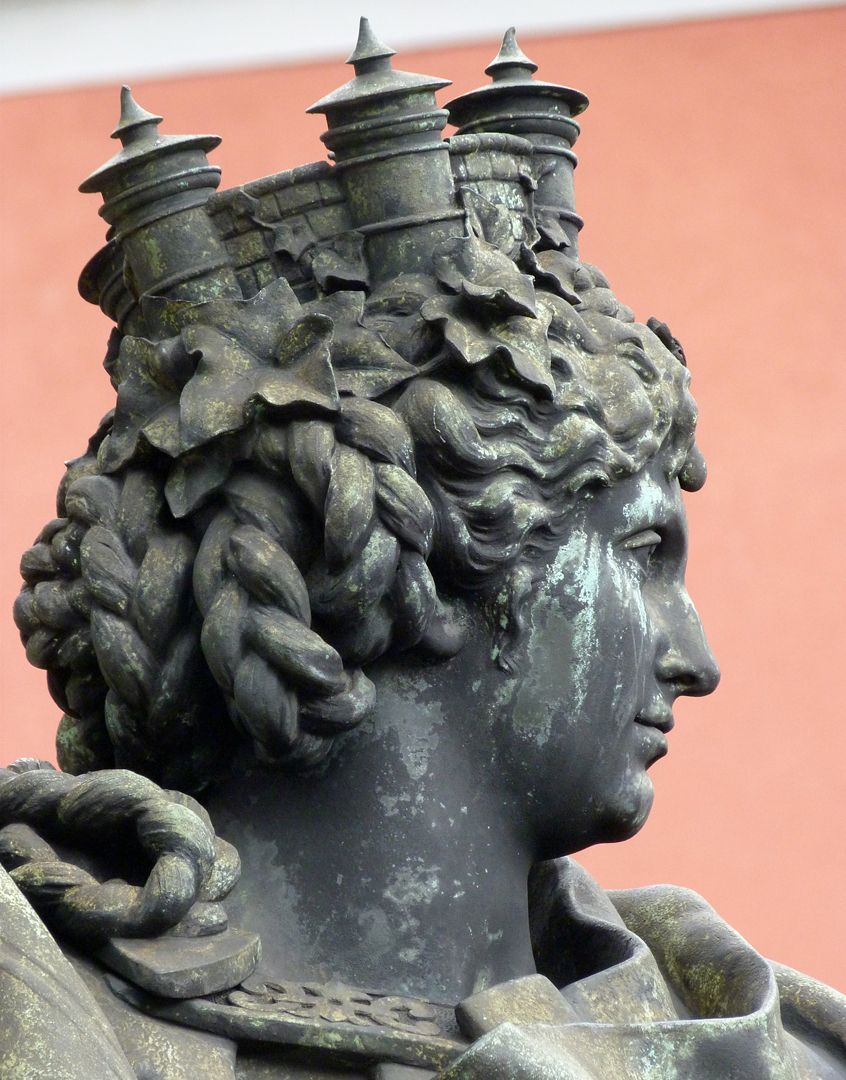
"Noris" with city wall crown
On October 16, 1890, an art fountain by Heinrich Schwabe was unveiled at Plärrer. After stops at the city limits (1930; 1981), it has been at its current location since 1993. The small bronze sculpture that decorates the approximately 10 m high granite obelisk glorifies the first German railway journey as a triumph of technology and comes - like the flanking personifications of Noris and Furthia - from the Lenz art foundry. The foundation stone was laid on December 7th, 1885, the 50th anniversary of the Adler voyage between Nuremberg and Fürth. Schwabe won the competition that was only announced in May 1887, although the jury recognized Rudolf Maison's design "Hercules" - later realized at the Fürth train station - as the best artistic achievement. Half of the costs of 58,500 marks were borne by the Bavarian state. The other half was shared by the Ludwig Railway Company, the city, the suburban association and private patrons, including Ludwig Gerngros. quoted from: Nuremberg City Lexicon, edited by Michael Diefenbacher and Rudolf Endres, Nuremberg, 1999
Location: Nuremberg, Gostenhof, Fürther Straße (Bärenschanze subway station)
Design: Schwabe, Georg Heinrich Joseph
Realization: Lenz, Christoph (I.)
Depicted: Klutentreter, Kurt, Gerngros, Ludwig Ritter von
photo 2018, Theo Noll
Memorial to King Ludwig´s Railway (Ludwigseisenbahn)
1890
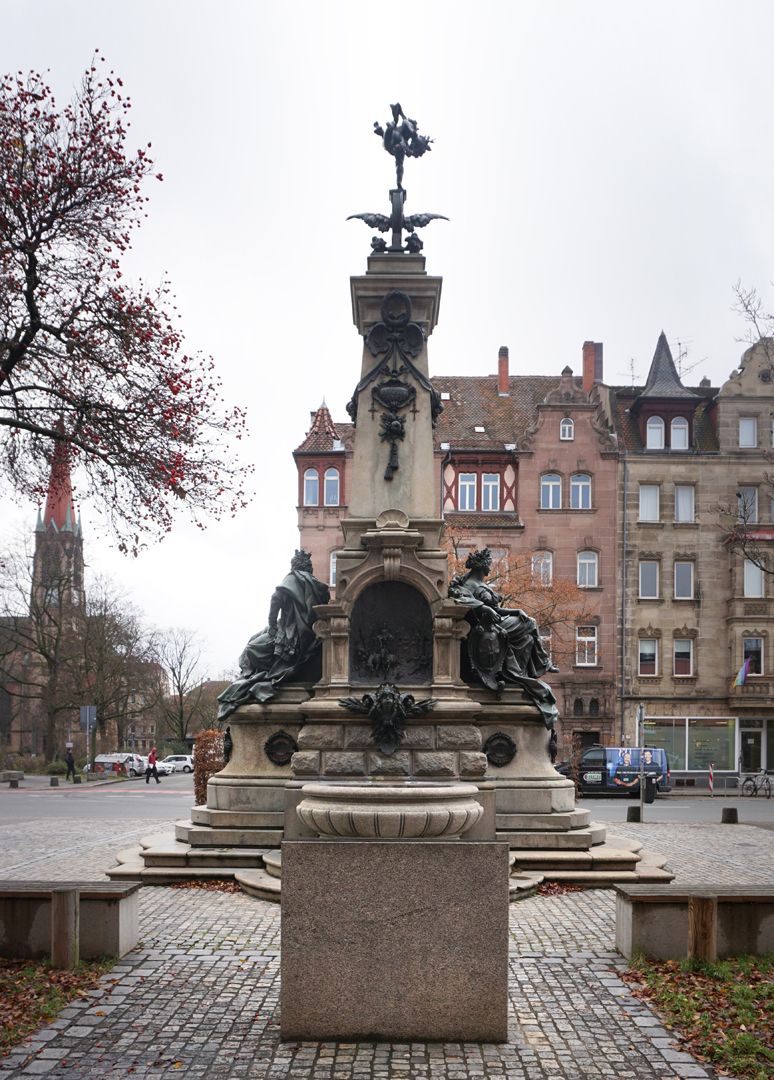
North side, in the foreground Pultstein with two inscription panels
On October 16, 1890, an art fountain by Heinrich Schwabe was unveiled at Plärrer. After stops at the city limits (1930; 1981), it has been at its current location since 1993. The small bronze sculpture that decorates the approximately 10 m high granite obelisk glorifies the first German railway journey as a triumph of technology and comes - like the flanking personifications of Noris and Furthia - from the Lenz art foundry. The foundation stone was laid on December 7th, 1885, the 50th anniversary of the Adler voyage between Nuremberg and Fürth. Schwabe won the competition that was only announced in May 1887, although the jury recognized Rudolf Maison's design "Hercules" - later realized at the Fürth train station - as the best artistic achievement. Half of the costs of 58,500 marks were borne by the Bavarian state. The other half was shared by the Ludwig Railway Company, the city, the suburban association and private patrons, including Ludwig Gerngros. quoted from: Nuremberg City Lexicon, edited by Michael Diefenbacher and Rudolf Endres, Nuremberg, 1999
Location: Nuremberg, Gostenhof, Fürther Straße (Bärenschanze subway station)
Design: Schwabe, Georg Heinrich Joseph
Realization: Lenz, Christoph (I.)
Depicted: Klutentreter, Kurt, Gerngros, Ludwig Ritter von
photo 2023, Theo Noll
Memorial to King Ludwig´s Railway (Ludwigseisenbahn)
1890
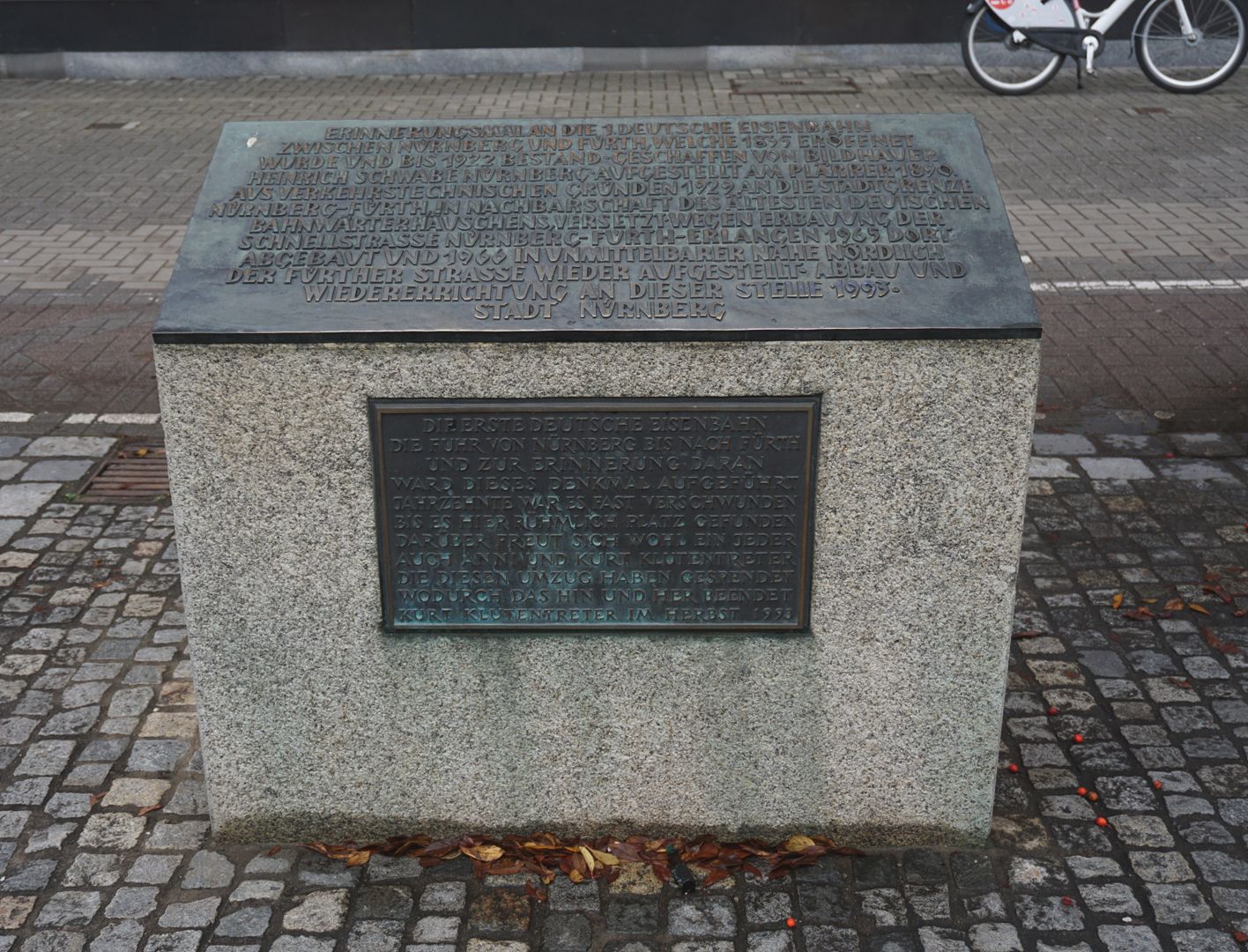
Stone with two inscription panels
On October 16, 1890, an art fountain by Heinrich Schwabe was unveiled at Plärrer. After stops at the city limits (1930; 1981), it has been at its current location since 1993. The small bronze sculpture that decorates the approximately 10 m high granite obelisk glorifies the first German railway journey as a triumph of technology and comes - like the flanking personifications of Noris and Furthia - from the Lenz art foundry. The foundation stone was laid on December 7th, 1885, the 50th anniversary of the Adler voyage between Nuremberg and Fürth. Schwabe won the competition that was only announced in May 1887, although the jury recognized Rudolf Maison's design "Hercules" - later realized at the Fürth train station - as the best artistic achievement. Half of the costs of 58,500 marks were borne by the Bavarian state. The other half was shared by the Ludwig Railway Company, the city, the suburban association and private patrons, including Ludwig Gerngros. quoted from: Nuremberg City Lexicon, edited by Michael Diefenbacher and Rudolf Endres, Nuremberg, 1999
Location: Nuremberg, Gostenhof, Fürther Straße (Bärenschanze subway station)
Design: Schwabe, Georg Heinrich Joseph
Realization: Lenz, Christoph (I.)
Depicted: Klutentreter, Kurt, Gerngros, Ludwig Ritter von
photo 2023, Theo Noll
Memorial to King Ludwig´s Railway (Ludwigseisenbahn)
1890
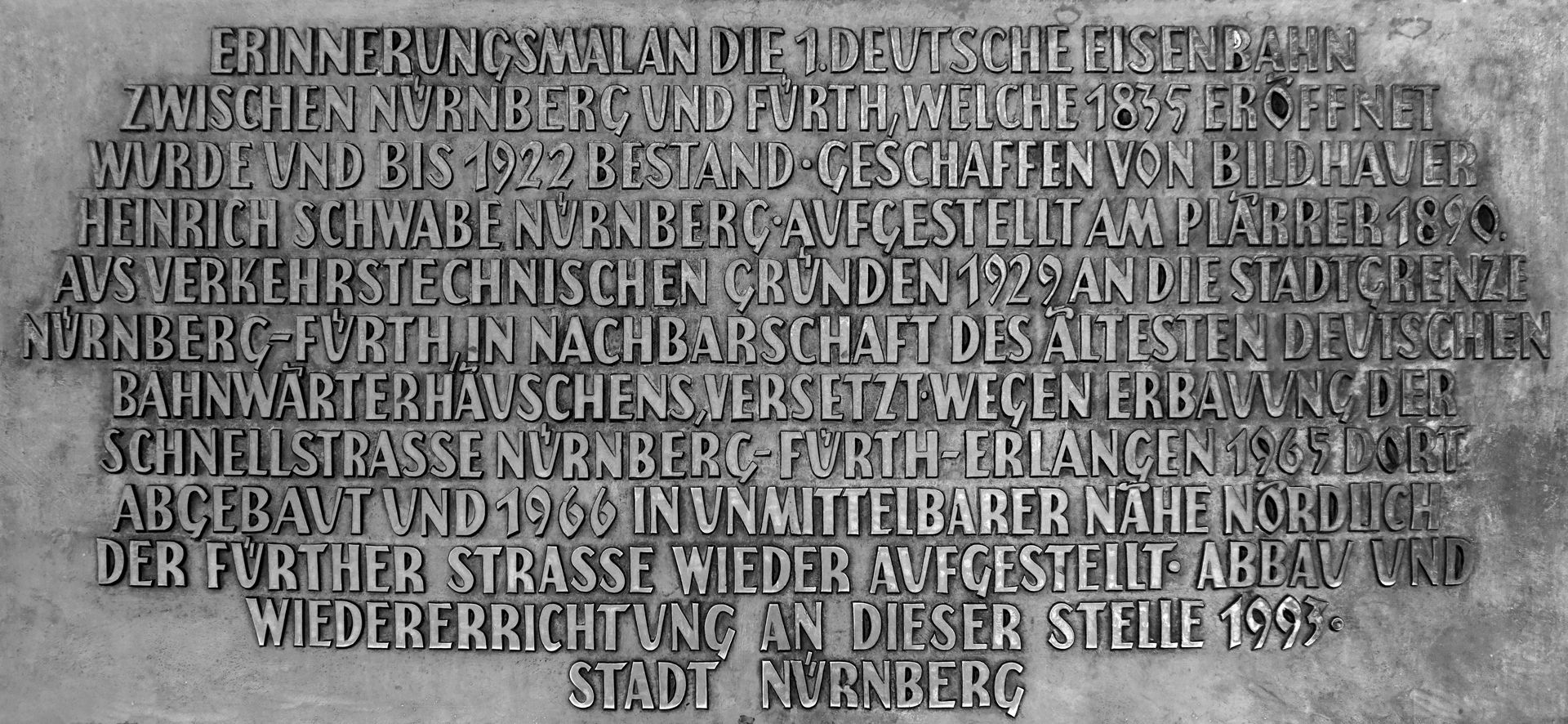
Inscription of the City of Nuremberg an the stone
photo 2023, Theo Noll
On October 16, 1890, an art fountain by Heinrich Schwabe was unveiled at Plärrer. After stops at the city limits (1930; 1981), it has been at its current location since 1993. The small bronze sculpture that decorates the approximately 10 m high granite obelisk glorifies the first German railway journey as a triumph of technology and comes - like the flanking personifications of Noris and Furthia - from the Lenz art foundry. The foundation stone was laid on December 7th, 1885, the 50th anniversary of the Adler voyage between Nuremberg and Fürth. Schwabe won the competition that was only announced in May 1887, although the jury recognized Rudolf Maison's design "Hercules" - later realized at the Fürth train station - as the best artistic achievement. Half of the costs of 58,500 marks were borne by the Bavarian state. The other half was shared by the Ludwig Railway Company, the city, the suburban association and private patrons, including Ludwig Gerngros. quoted from: Nuremberg City Lexicon, edited by Michael Diefenbacher and Rudolf Endres, Nuremberg, 1999
Location: Nuremberg, Gostenhof, Fürther Straße (Bärenschanze subway station)
Design: Schwabe, Georg Heinrich Joseph
Realization: Lenz, Christoph (I.)
Depicted: Klutentreter, Kurt, Gerngros, Ludwig Ritter von
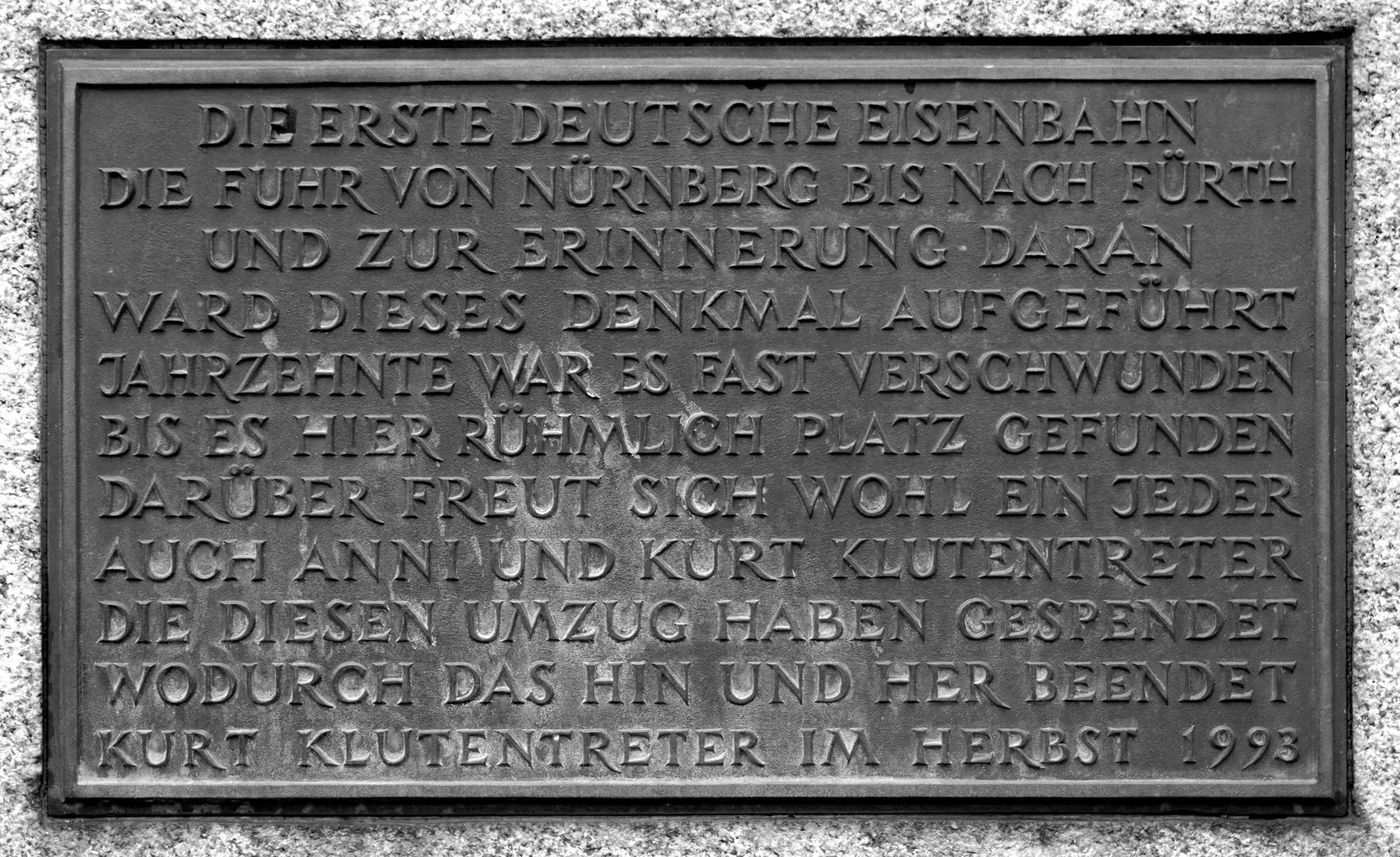
Memorial to King Ludwig´s Railway (Ludwigseisenbahn)
1890
On the monument side of the Pultstein, inscription by Anni and Kurt Klutentreter
On October 16, 1890, an art fountain by Heinrich Schwabe was unveiled at Plärrer. After stops at the city limits (1930; 1981), it has been at its current location since 1993. The small bronze sculpture that decorates the approximately 10 m high granite obelisk glorifies the first German railway journey as a triumph of technology and comes - like the flanking personifications of Noris and Furthia - from the Lenz art foundry. The foundation stone was laid on December 7th, 1885, the 50th anniversary of the Adler voyage between Nuremberg and Fürth. Schwabe won the competition that was only announced in May 1887, although the jury recognized Rudolf Maison's design "Hercules" - later realized at the Fürth train station - as the best artistic achievement. Half of the costs of 58,500 marks were borne by the Bavarian state. The other half was shared by the Ludwig Railway Company, the city, the suburban association and private patrons, including Ludwig Gerngros. quoted from: Nuremberg City Lexicon, edited by Michael Diefenbacher and Rudolf Endres, Nuremberg, 1999
Location: Nuremberg, Gostenhof, Fürther Straße (Bärenschanze subway station)
Design: Schwabe, Georg Heinrich Joseph
Realization: Lenz, Christoph (I.)
Depicted: Klutentreter, Kurt, Gerngros, Ludwig Ritter von
photo 2023, Theo Noll
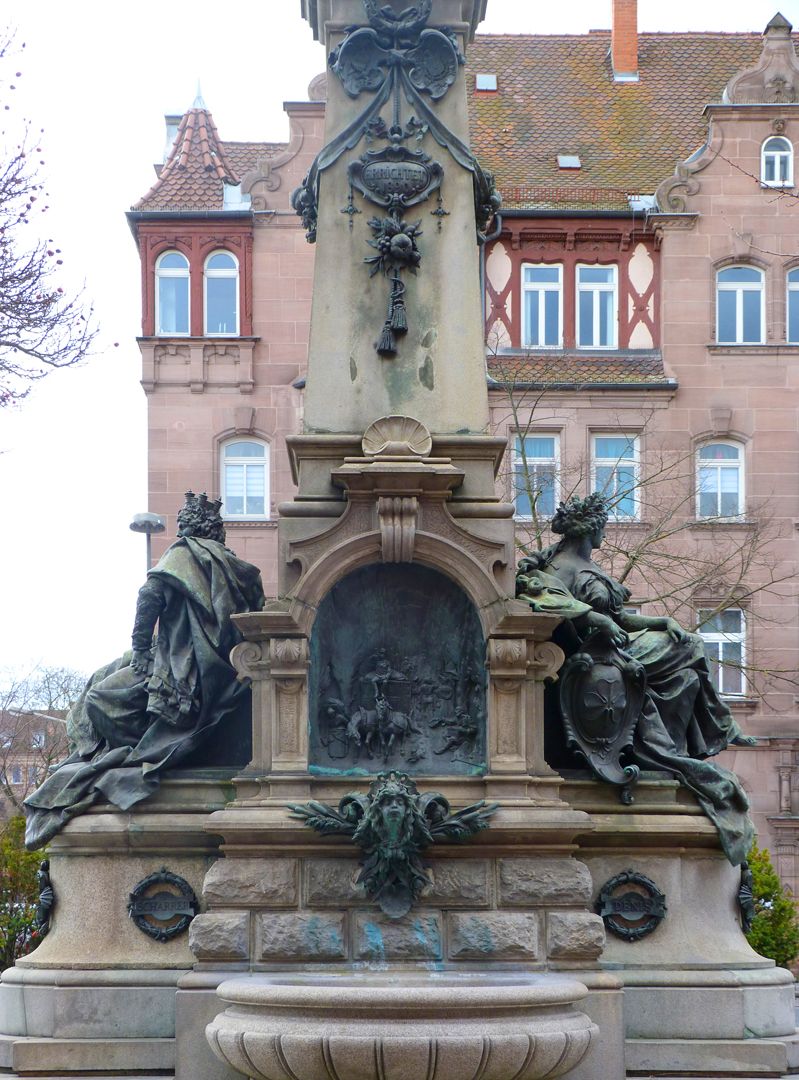
Memorial to King Ludwig´s Railway (Ludwigseisenbahn)
1890
North side
On October 16, 1890, an art fountain by Heinrich Schwabe was unveiled at Plärrer. After stops at the city limits (1930; 1981), it has been at its current location since 1993. The small bronze sculpture that decorates the approximately 10 m high granite obelisk glorifies the first German railway journey as a triumph of technology and comes - like the flanking personifications of Noris and Furthia - from the Lenz art foundry. The foundation stone was laid on December 7th, 1885, the 50th anniversary of the Adler voyage between Nuremberg and Fürth. Schwabe won the competition that was only announced in May 1887, although the jury recognized Rudolf Maison's design "Hercules" - later realized at the Fürth train station - as the best artistic achievement. Half of the costs of 58,500 marks were borne by the Bavarian state. The other half was shared by the Ludwig Railway Company, the city, the suburban association and private patrons, including Ludwig Gerngros. quoted from: Nuremberg City Lexicon, edited by Michael Diefenbacher and Rudolf Endres, Nuremberg, 1999
Location: Nuremberg, Gostenhof, Fürther Straße (Bärenschanze subway station)
Design: Schwabe, Georg Heinrich Joseph
Realization: Lenz, Christoph (I.)
Depicted: Klutentreter, Kurt, Gerngros, Ludwig Ritter von
photo 2018, Theo Noll
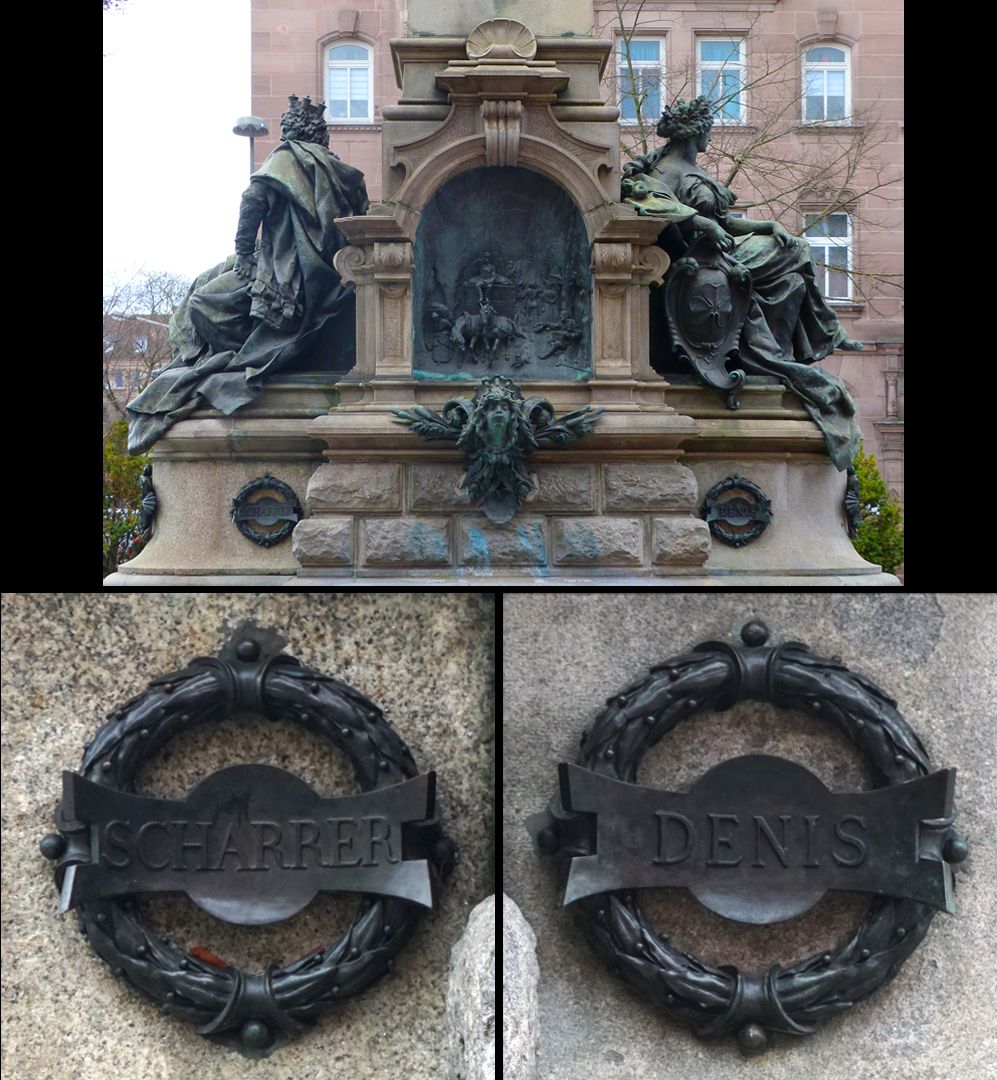
Memorial to King Ludwig´s Railway (Ludwigseisenbahn)
1890
North side, two laurel wreaths with the names SCHARRER (Johannes Scharrer, 1785 - 1844, 2nd mayor of Nuremberg, joint leader with Zacharias Platner, 1781 - 1862, ) and DENIS (Paul Camille Denis, 1796 - 1872, district engineer)
On October 16, 1890, an art fountain by Heinrich Schwabe was unveiled at Plärrer. After stops at the city limits (1930; 1981), it has been at its current location since 1993. The small bronze sculpture that decorates the approximately 10 m high granite obelisk glorifies the first German railway journey as a triumph of technology and comes - like the flanking personifications of Noris and Furthia - from the Lenz art foundry. The foundation stone was laid on December 7th, 1885, the 50th anniversary of the Adler voyage between Nuremberg and Fürth. Schwabe won the competition that was only announced in May 1887, although the jury recognized Rudolf Maison's design "Hercules" - later realized at the Fürth train station - as the best artistic achievement. Half of the costs of 58,500 marks were borne by the Bavarian state. The other half was shared by the Ludwig Railway Company, the city, the suburban association and private patrons, including Ludwig Gerngros. quoted from: Nuremberg City Lexicon, edited by Michael Diefenbacher and Rudolf Endres, Nuremberg, 1999
Location: Nuremberg, Gostenhof, Fürther Straße (Bärenschanze subway station)
Design: Schwabe, Georg Heinrich Joseph
Realization: Lenz, Christoph (I.)
Depicted: Klutentreter, Kurt, Gerngros, Ludwig Ritter von
photo 2023, Theo Noll
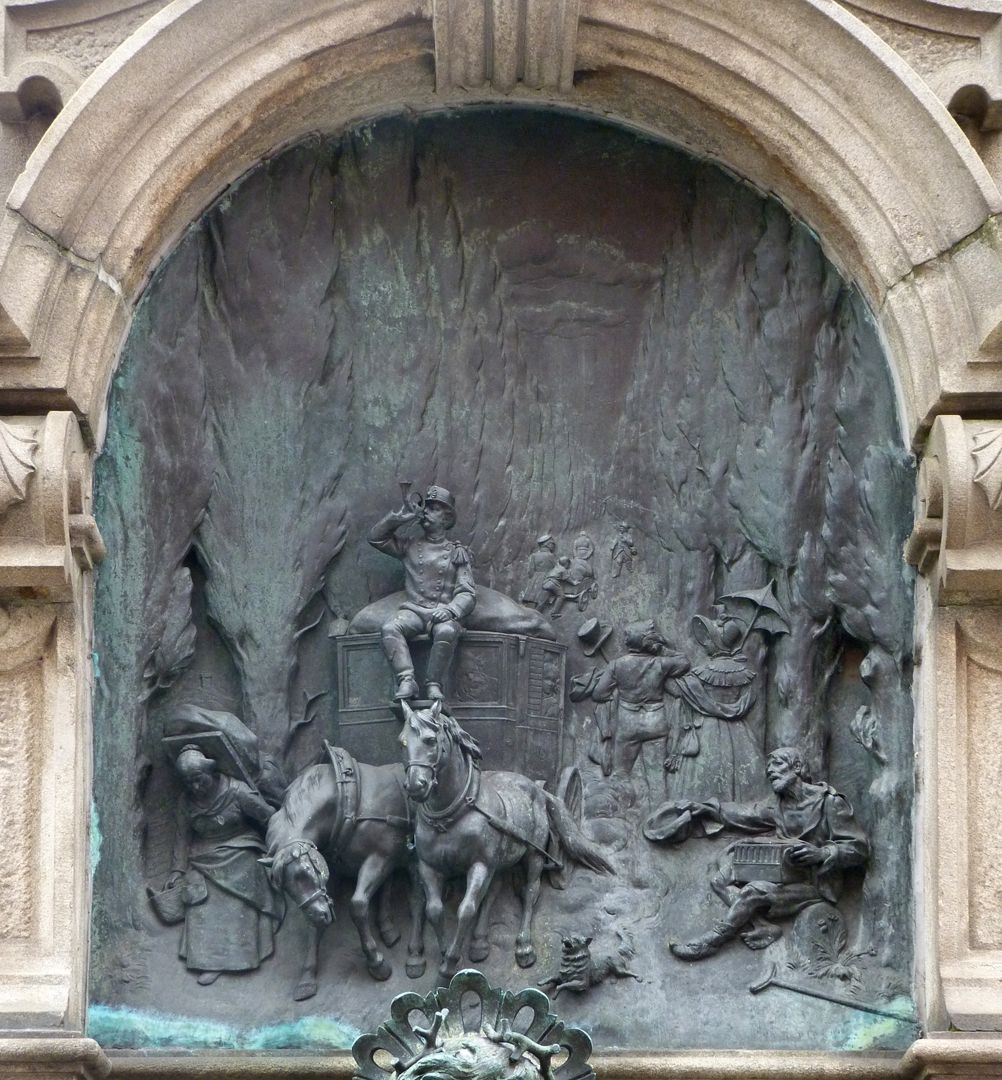
Memorial to King Ludwig´s Railway (Ludwigseisenbahn)
1890
Relief image on the north side, "The time before the railway" with a stagecoach
On October 16, 1890, an art fountain by Heinrich Schwabe was unveiled at Plärrer. After stops at the city limits (1930; 1981), it has been at its current location since 1993. The small bronze sculpture that decorates the approximately 10 m high granite obelisk glorifies the first German railway journey as a triumph of technology and comes - like the flanking personifications of Noris and Furthia - from the Lenz art foundry. The foundation stone was laid on December 7th, 1885, the 50th anniversary of the Adler voyage between Nuremberg and Fürth. Schwabe won the competition that was only announced in May 1887, although the jury recognized Rudolf Maison's design "Hercules" - later realized at the Fürth train station - as the best artistic achievement. Half of the costs of 58,500 marks were borne by the Bavarian state. The other half was shared by the Ludwig Railway Company, the city, the suburban association and private patrons, including Ludwig Gerngros. quoted from: Nuremberg City Lexicon, edited by Michael Diefenbacher and Rudolf Endres, Nuremberg, 1999
Location: Nuremberg, Gostenhof, Fürther Straße (Bärenschanze subway station)
Design: Schwabe, Georg Heinrich Joseph
Realization: Lenz, Christoph (I.)
Depicted: Klutentreter, Kurt, Gerngros, Ludwig Ritter von
photo 2018, Theo Noll
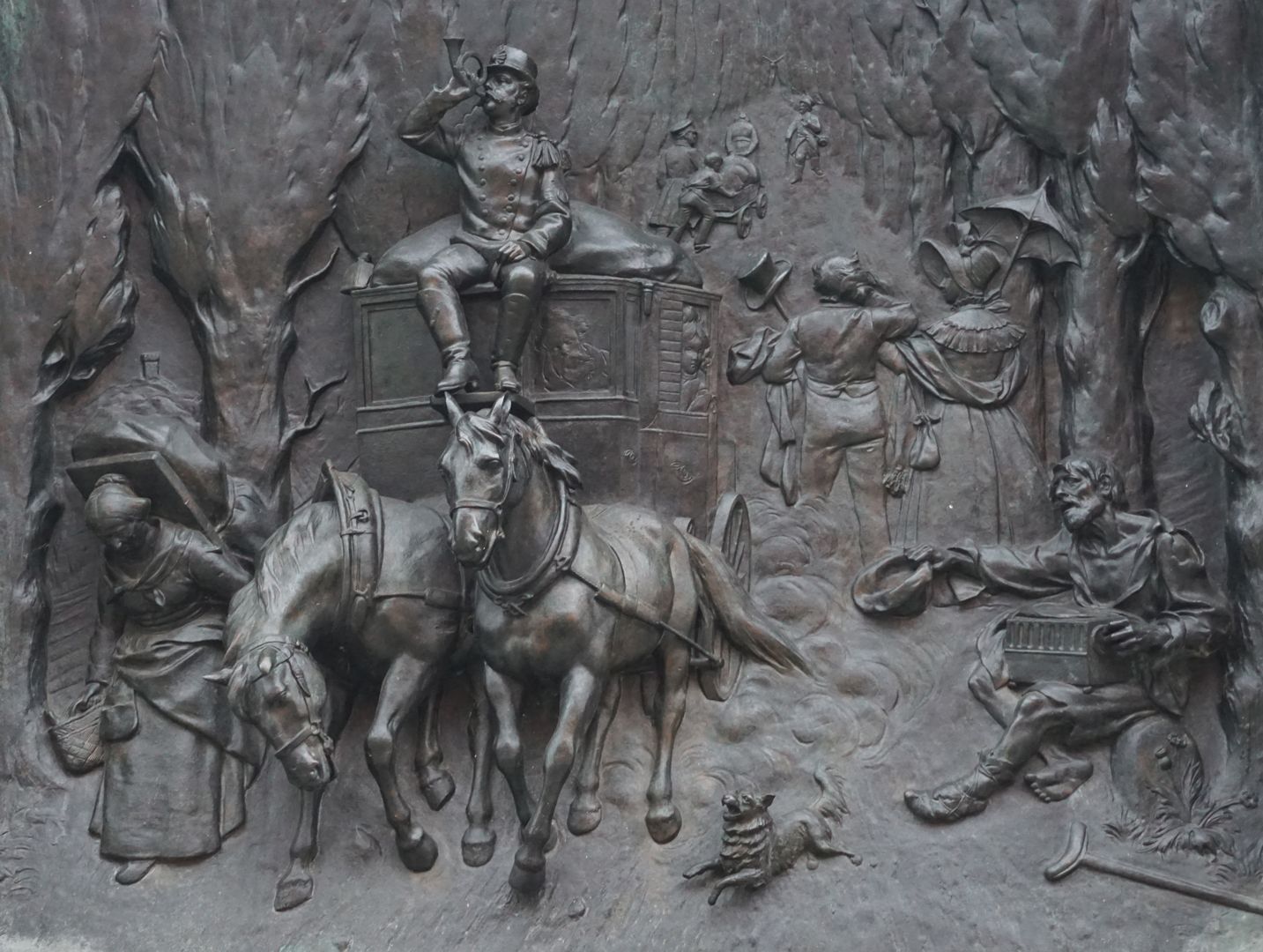
Memorial to King Ludwig´s Railway (Ludwigseisenbahn)
1890
Relief image on the north side, "The time before the railway" detail view
On October 16, 1890, an art fountain by Heinrich Schwabe was unveiled at Plärrer. After stops at the city limits (1930; 1981), it has been at its current location since 1993. The small bronze sculpture that decorates the approximately 10 m high granite obelisk glorifies the first German railway journey as a triumph of technology and comes - like the flanking personifications of Noris and Furthia - from the Lenz art foundry. The foundation stone was laid on December 7th, 1885, the 50th anniversary of the Adler voyage between Nuremberg and Fürth. Schwabe won the competition that was only announced in May 1887, although the jury recognized Rudolf Maison's design "Hercules" - later realized at the Fürth train station - as the best artistic achievement. Half of the costs of 58,500 marks were borne by the Bavarian state. The other half was shared by the Ludwig Railway Company, the city, the suburban association and private patrons, including Ludwig Gerngros. quoted from: Nuremberg City Lexicon, edited by Michael Diefenbacher and Rudolf Endres, Nuremberg, 1999
Location: Nuremberg, Gostenhof, Fürther Straße (Bärenschanze subway station)
Design: Schwabe, Georg Heinrich Joseph
Realization: Lenz, Christoph (I.)
Depicted: Klutentreter, Kurt, Gerngros, Ludwig Ritter von
photo 2023, Theo Noll
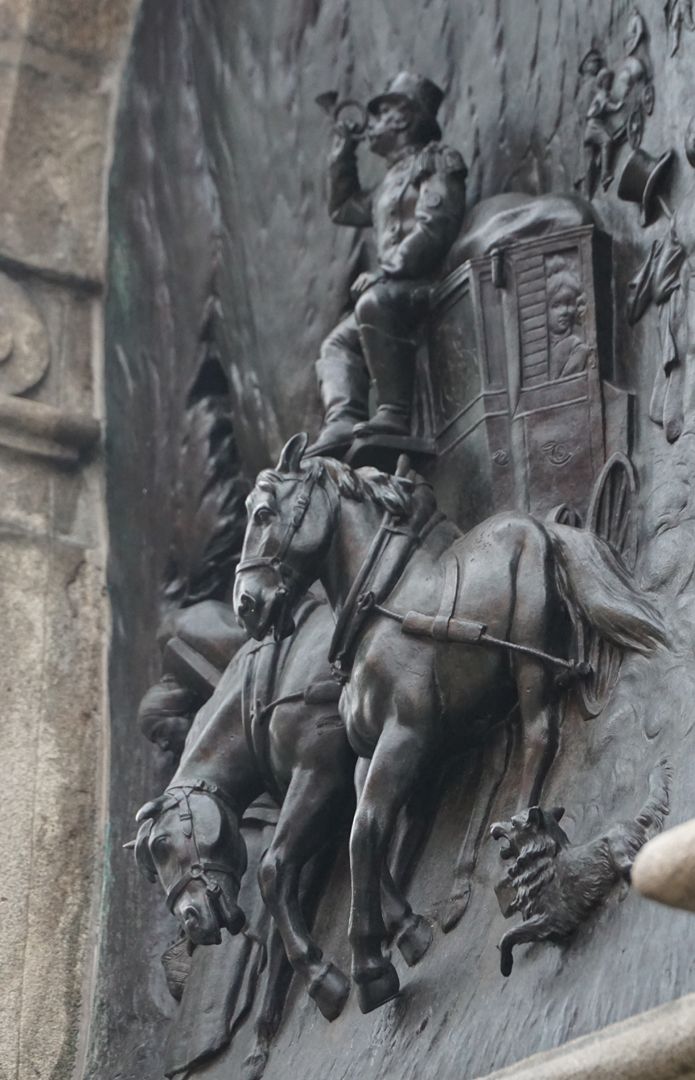
Memorial to King Ludwig´s Railway (Ludwigseisenbahn)
1890
Relief image on the north side, "The time before the railway" oblique view
On October 16, 1890, an art fountain by Heinrich Schwabe was unveiled at Plärrer. After stops at the city limits (1930; 1981), it has been at its current location since 1993. The small bronze sculpture that decorates the approximately 10 m high granite obelisk glorifies the first German railway journey as a triumph of technology and comes - like the flanking personifications of Noris and Furthia - from the Lenz art foundry. The foundation stone was laid on December 7th, 1885, the 50th anniversary of the Adler voyage between Nuremberg and Fürth. Schwabe won the competition that was only announced in May 1887, although the jury recognized Rudolf Maison's design "Hercules" - later realized at the Fürth train station - as the best artistic achievement. Half of the costs of 58,500 marks were borne by the Bavarian state. The other half was shared by the Ludwig Railway Company, the city, the suburban association and private patrons, including Ludwig Gerngros. quoted from: Nuremberg City Lexicon, edited by Michael Diefenbacher and Rudolf Endres, Nuremberg, 1999
Location: Nuremberg, Gostenhof, Fürther Straße (Bärenschanze subway station)
Design: Schwabe, Georg Heinrich Joseph
Realization: Lenz, Christoph (I.)
Depicted: Klutentreter, Kurt, Gerngros, Ludwig Ritter von
photo 2023, Theo Noll
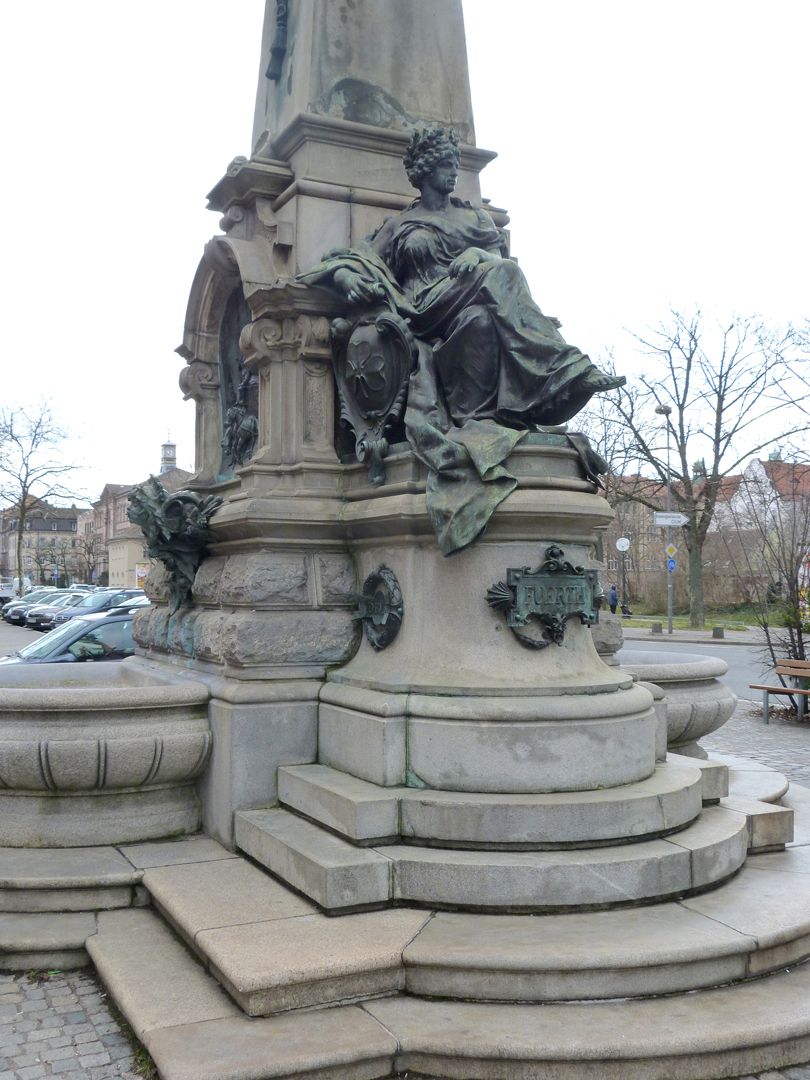
Memorial to King Ludwig´s Railway (Ludwigseisenbahn)
1890
base area, northwest side
On October 16, 1890, an art fountain by Heinrich Schwabe was unveiled at Plärrer. After stops at the city limits (1930; 1981), it has been at its current location since 1993. The small bronze sculpture that decorates the approximately 10 m high granite obelisk glorifies the first German railway journey as a triumph of technology and comes - like the flanking personifications of Noris and Furthia - from the Lenz art foundry. The foundation stone was laid on December 7th, 1885, the 50th anniversary of the Adler voyage between Nuremberg and Fürth. Schwabe won the competition that was only announced in May 1887, although the jury recognized Rudolf Maison's design "Hercules" - later realized at the Fürth train station - as the best artistic achievement. Half of the costs of 58,500 marks were borne by the Bavarian state. The other half was shared by the Ludwig Railway Company, the city, the suburban association and private patrons, including Ludwig Gerngros. quoted from: Nuremberg City Lexicon, edited by Michael Diefenbacher and Rudolf Endres, Nuremberg, 1999
Location: Nuremberg, Gostenhof, Fürther Straße (Bärenschanze subway station)
Design: Schwabe, Georg Heinrich Joseph
Realization: Lenz, Christoph (I.)
Depicted: Klutentreter, Kurt, Gerngros, Ludwig Ritter von
photo 2018, Theo Noll
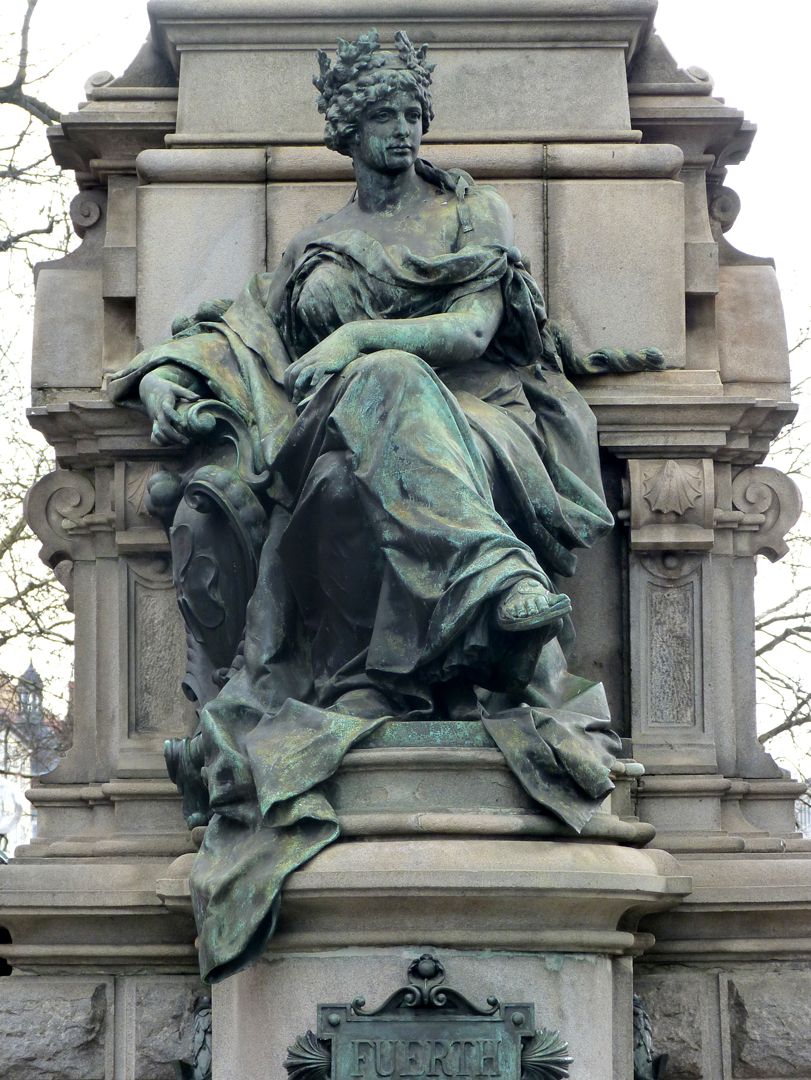
Memorial to King Ludwig´s Railway (Ludwigseisenbahn)
1890
Furthia" with laurel wreath and coat of arms
On October 16, 1890, an art fountain by Heinrich Schwabe was unveiled at Plärrer. After stops at the city limits (1930; 1981), it has been at its current location since 1993. The small bronze sculpture that decorates the approximately 10 m high granite obelisk glorifies the first German railway journey as a triumph of technology and comes - like the flanking personifications of Noris and Furthia - from the Lenz art foundry. The foundation stone was laid on December 7th, 1885, the 50th anniversary of the Adler voyage between Nuremberg and Fürth. Schwabe won the competition that was only announced in May 1887, although the jury recognized Rudolf Maison's design "Hercules" - later realized at the Fürth train station - as the best artistic achievement. Half of the costs of 58,500 marks were borne by the Bavarian state. The other half was shared by the Ludwig Railway Company, the city, the suburban association and private patrons, including Ludwig Gerngros. quoted from: Nuremberg City Lexicon, edited by Michael Diefenbacher and Rudolf Endres, Nuremberg, 1999
Location: Nürnberg, Gostenhof, Fürther Straße (U-Bahnstation Bärenschanze)
Design: Schwabe, Georg Heinrich Joseph
Realization: Lenz, Christoph (I.)
Depicted: Klutentreter, Kurt, Gerngros, Ludwig Ritter von
photo 2018, Theo Noll
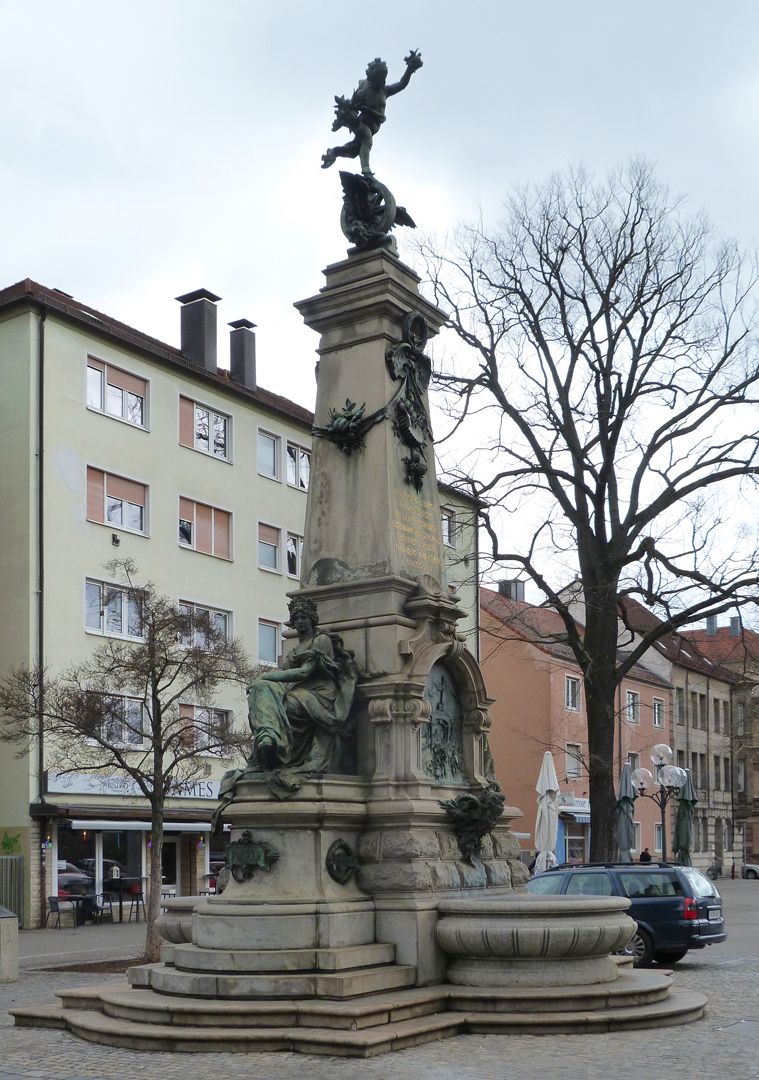
Memorial to King Ludwig´s Railway (Ludwigseisenbahn)
1890
Soth west side
On October 16, 1890, an art fountain by Heinrich Schwabe was unveiled at Plärrer. After stops at the city limits (1930; 1981), it has been at its current location since 1993. The small bronze sculpture that decorates the approximately 10 m high granite obelisk glorifies the first German railway journey as a triumph of technology and comes - like the flanking personifications of Noris and Furthia - from the Lenz art foundry. The foundation stone was laid on December 7th, 1885, the 50th anniversary of the Adler voyage between Nuremberg and Fürth. Schwabe won the competition that was only announced in May 1887, although the jury recognized Rudolf Maison's design "Hercules" - later realized at the Fürth train station - as the best artistic achievement. Half of the costs of 58,500 marks were borne by the Bavarian state. The other half was shared by the Ludwig Railway Company, the city, the suburban association and private patrons, including Ludwig Gerngros. quoted from: Nuremberg City Lexicon, edited by Michael Diefenbacher and Rudolf Endres, Nuremberg, 1999
Location: Nuremberg, Gostenhof, Fürther Straße (Bärenschanze subway station)
Design: Schwabe, Georg Heinrich Joseph
Realization: Lenz, Christoph (I.)
Depicted: Klutentreter, Kurt, Gerngros, Ludwig Ritter von
photo 2018, Theo Noll
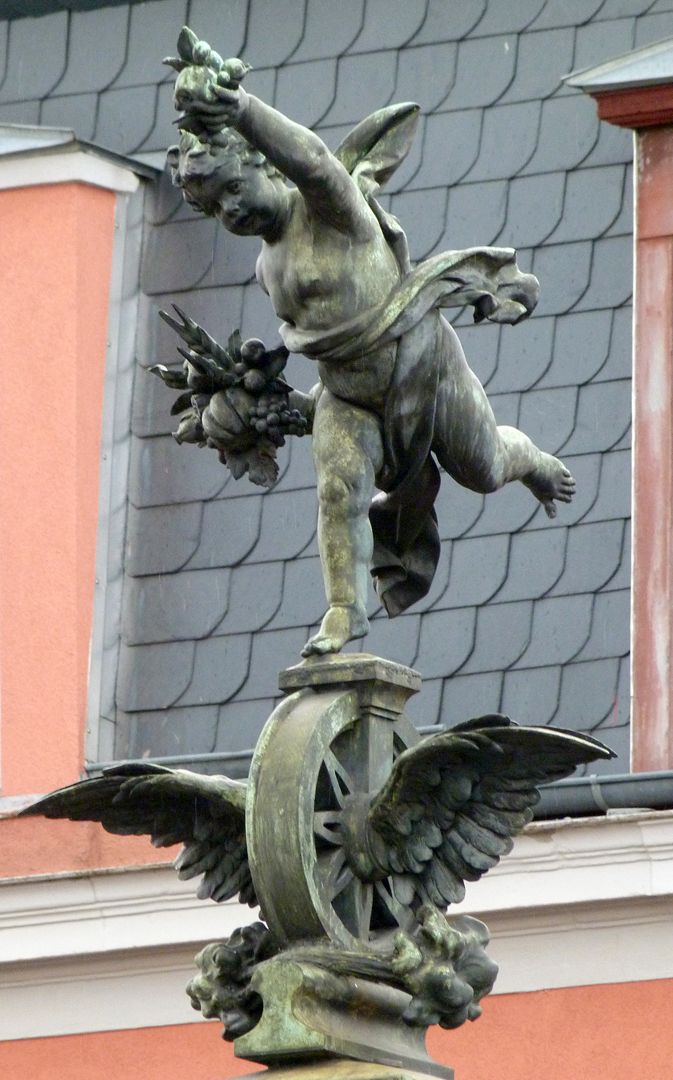
Memorial to King Ludwig´s Railway (Ludwigseisenbahn)
1890
Obelisk crown, southwest side
On October 16, 1890, an art fountain by Heinrich Schwabe was unveiled at Plärrer. After stops at the city limits (1930; 1981), it has been at its current location since 1993. The small bronze sculpture that decorates the approximately 10 m high granite obelisk glorifies the first German railway journey as a triumph of technology and comes - like the flanking personifications of Noris and Furthia - from the Lenz art foundry. The foundation stone was laid on December 7th, 1885, the 50th anniversary of the Adler voyage between Nuremberg and Fürth. Schwabe won the competition that was only announced in May 1887, although the jury recognized Rudolf Maison's design "Hercules" - later realized at the Fürth train station - as the best artistic achievement. Half of the costs of 58,500 marks were borne by the Bavarian state. The other half was shared by the Ludwig Railway Company, the city, the suburban association and private patrons, including Ludwig Gerngros. quoted from: Nuremberg City Lexicon, edited by Michael Diefenbacher and Rudolf Endres, Nuremberg, 1999
Location: Nuremberg, Gostenhof, Fürther Straße (Bärenschanze subway station)
Design: Schwabe, Georg Heinrich Joseph
Realization: Lenz, Christoph (I.)
Depicted: Klutentreter, Kurt, Gerngros, Ludwig Ritter von
photo 2018, Theo Noll
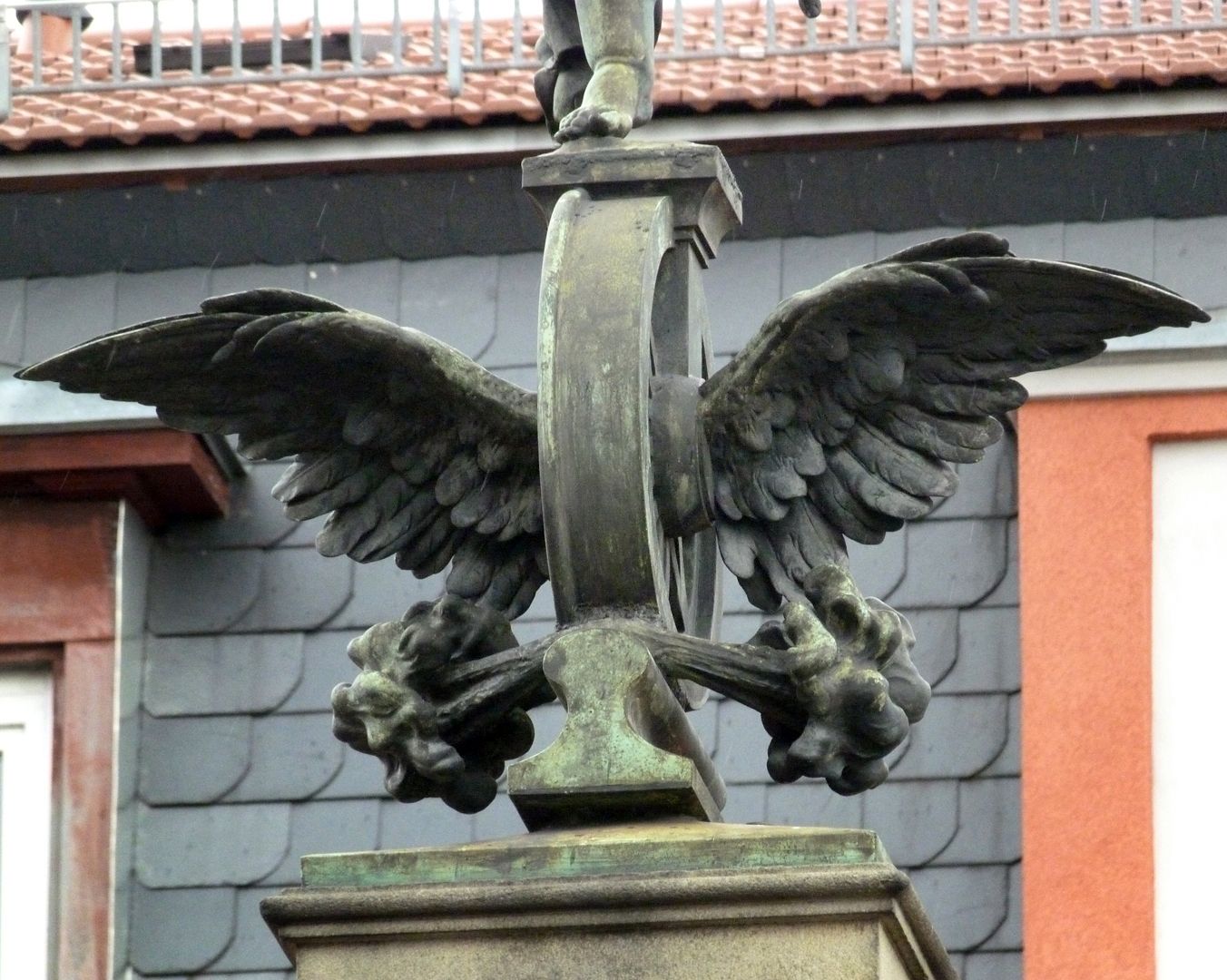
Memorial to King Ludwig´s Railway (Ludwigseisenbahn)
1890
Detailed view with a winged wheel as a symbol of the railway and rail transport, steaming over a piece of rail
On October 16, 1890, an art fountain by Heinrich Schwabe was unveiled at Plärrer. After stops at the city limits (1930; 1981), it has been at its current location since 1993. The small bronze sculpture that decorates the approximately 10 m high granite obelisk glorifies the first German railway journey as a triumph of technology and comes - like the flanking personifications of Noris and Furthia - from the Lenz art foundry. The foundation stone was laid on December 7th, 1885, the 50th anniversary of the Adler voyage between Nuremberg and Fürth. Schwabe won the competition that was only announced in May 1887, although the jury recognized Rudolf Maison's design "Hercules" - later realized at the Fürth train station - as the best artistic achievement. Half of the costs of 58,500 marks were borne by the Bavarian state. The other half was shared by the Ludwig Railway Company, the city, the suburban association and private patrons, including Ludwig Gerngros. quoted from: Nuremberg City Lexicon, edited by Michael Diefenbacher and Rudolf Endres, Nuremberg, 1999
Location: Nuremberg, Gostenhof, Fürther Straße (Bärenschanze subway station)
Design: Schwabe, Georg Heinrich Joseph
Realization: Lenz, Christoph (I.)
Depicted: Klutentreter, Kurt, Gerngros, Ludwig Ritter von
photo 2018, Theo Noll
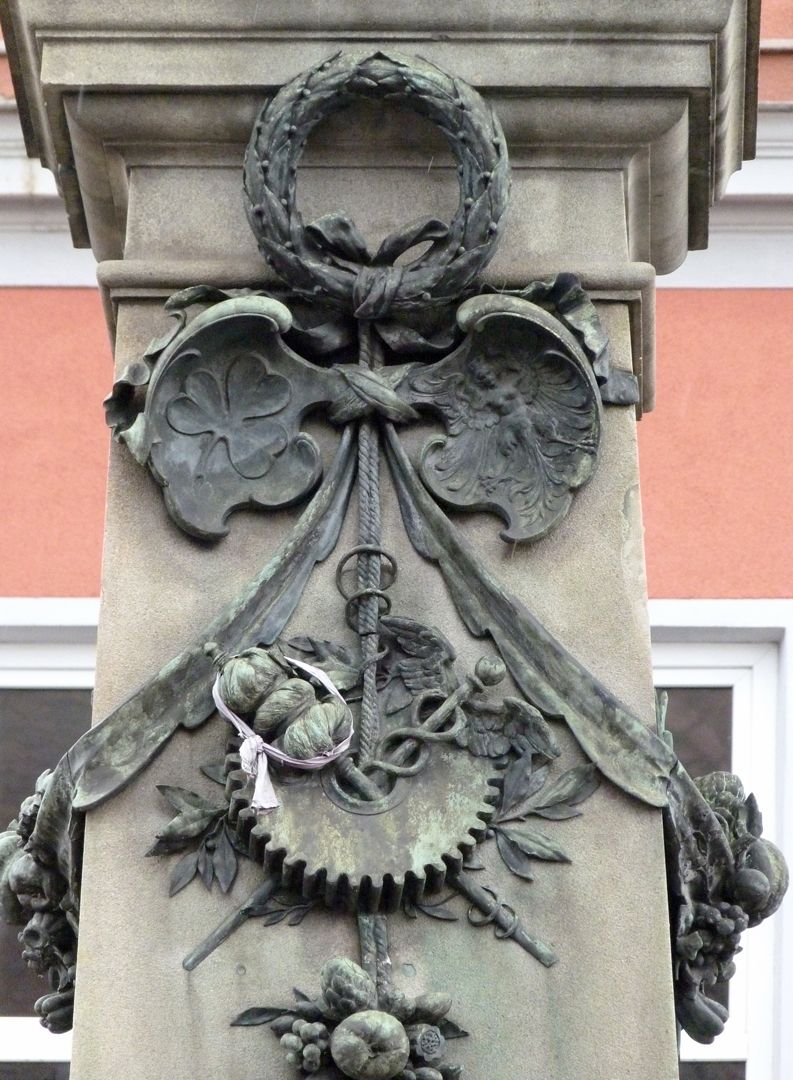
Memorial to King Ludwig´s Railway (Ludwigseisenbahn)
1890
Upper obelisk, southe side
On October 16, 1890, an art fountain by Heinrich Schwabe was unveiled at Plärrer. After stops at the city limits (1930; 1981), it has been at its current location since 1993. The small bronze sculpture that decorates the approximately 10 m high granite obelisk glorifies the first German railway journey as a triumph of technology and comes - like the flanking personifications of Noris and Furthia - from the Lenz art foundry. The foundation stone was laid on December 7th, 1885, the 50th anniversary of the Adler voyage between Nuremberg and Fürth. Schwabe won the competition that was only announced in May 1887, although the jury recognized Rudolf Maison's design "Hercules" - later realized at the Fürth train station - as the best artistic achievement. Half of the costs of 58,500 marks were borne by the Bavarian state. The other half was shared by the Ludwig Railway Company, the city, the suburban association and private patrons, including Ludwig Gerngros. quoted from: Nuremberg City Lexicon, edited by Michael Diefenbacher and Rudolf Endres, Nuremberg, 1999
Location: Nuremberg, Gostenhof, Fürther Straße (Bärenschanze subway station)
Design: Schwabe, Georg Heinrich Joseph
Realization: Lenz, Christoph (I.)
Depicted: Klutentreter, Kurt, Gerngros, Ludwig Ritter von
photo 2018, Theo Noll
Memorial to King Ludwig´s Railway (Ludwigseisenbahn)
1890
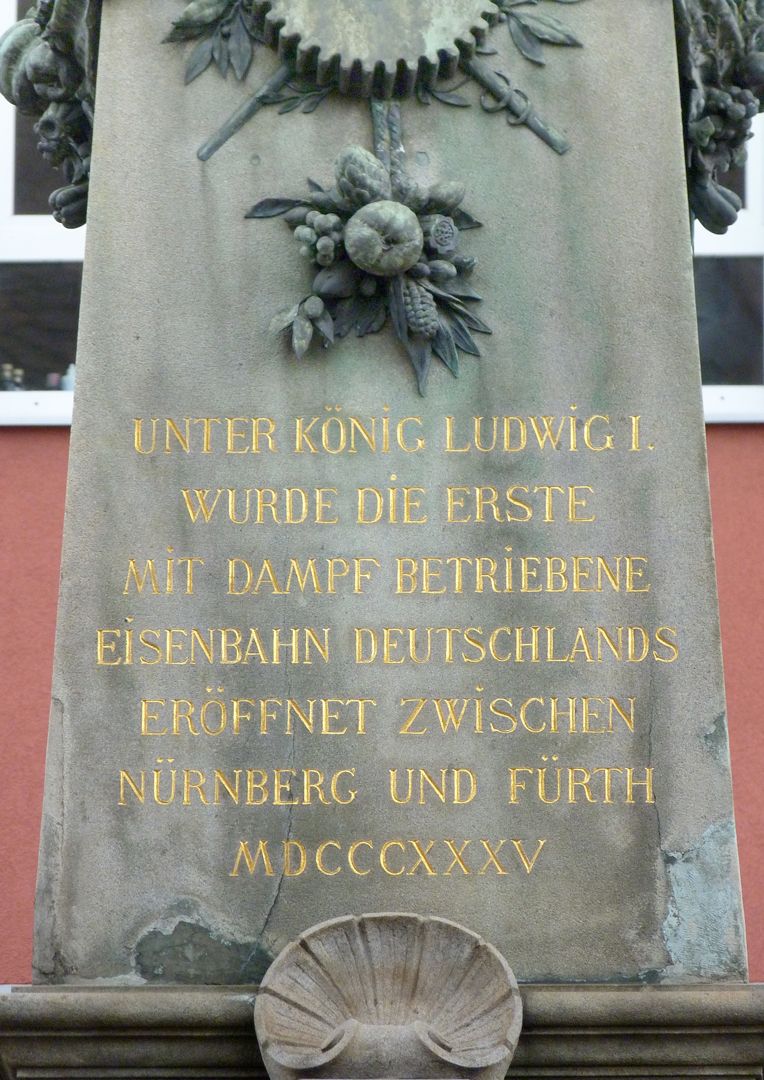
Inscription on the obelisk, south side (MDCCCXXXV = 1835)
On October 16, 1890, an art fountain by Heinrich Schwabe was unveiled at Plärrer. After stops at the city limits (1930; 1981), it has been at its current location since 1993. The small bronze sculpture that decorates the approximately 10 m high granite obelisk glorifies the first German railway journey as a triumph of technology and comes - like the flanking personifications of Noris and Furthia - from the Lenz art foundry. The foundation stone was laid on December 7th, 1885, the 50th anniversary of the Adler voyage between Nuremberg and Fürth. Schwabe won the competition that was only announced in May 1887, although the jury recognized Rudolf Maison's design "Hercules" - later realized at the Fürth train station - as the best artistic achievement. Half of the costs of 58,500 marks were borne by the Bavarian state. The other half was shared by the Ludwig Railway Company, the city, the suburban association and private patrons, including Ludwig Gerngros. quoted from: Nuremberg City Lexicon, edited by Michael Diefenbacher and Rudolf Endres, Nuremberg, 1999
Location: Nuremberg, Gostenhof, Fürther Straße (Bärenschanze subway station)
Design: Schwabe, Georg Heinrich Joseph
Realization: Lenz, Christoph (I.)
Depicted: Klutentreter, Kurt, Gerngros, Ludwig Ritter von
photo 2018, Theo Noll
Memorial to King Ludwig´s Railway (Ludwigseisenbahn)
1890
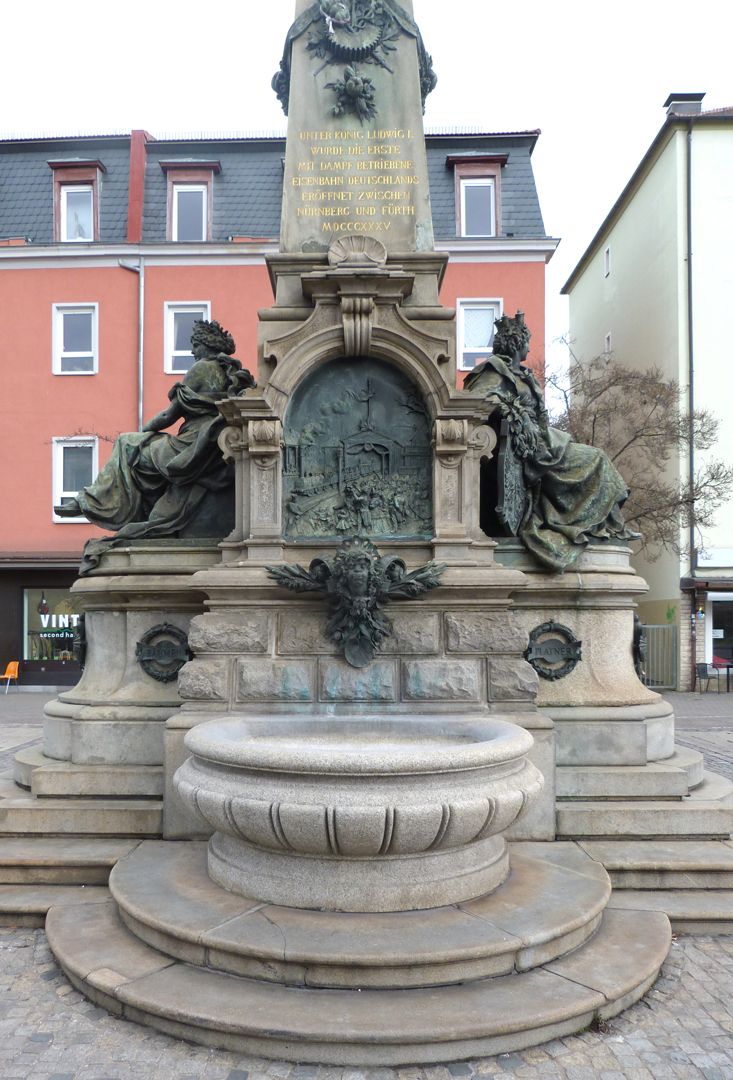
Base area, south side
On October 16, 1890, an art fountain by Heinrich Schwabe was unveiled at Plärrer. After stops at the city limits (1930; 1981), it has been at its current location since 1993. The small bronze sculpture that decorates the approximately 10 m high granite obelisk glorifies the first German railway journey as a triumph of technology and comes - like the flanking personifications of Noris and Furthia - from the Lenz art foundry. The foundation stone was laid on December 7th, 1885, the 50th anniversary of the Adler voyage between Nuremberg and Fürth. Schwabe won the competition that was only announced in May 1887, although the jury recognized Rudolf Maison's design "Hercules" - later realized at the Fürth train station - as the best artistic achievement. Half of the costs of 58,500 marks were borne by the Bavarian state. The other half was shared by the Ludwig Railway Company, the city, the suburban association and private patrons, including Ludwig Gerngros. quoted from: Nuremberg City Lexicon, edited by Michael Diefenbacher and Rudolf Endres, Nuremberg, 1999
Location: Nuremberg, Gostenhof, Fürther Straße (Bärenschanze subway station)
Design: Schwabe, Georg Heinrich Joseph
Realization: Lenz, Christoph (I.)
Depicted: Klutentreter, Kurt, Gerngros, Ludwig Ritter von
photo 2018, Theo Noll
Memorial to King Ludwig´s Railway (Ludwigseisenbahn)
1890
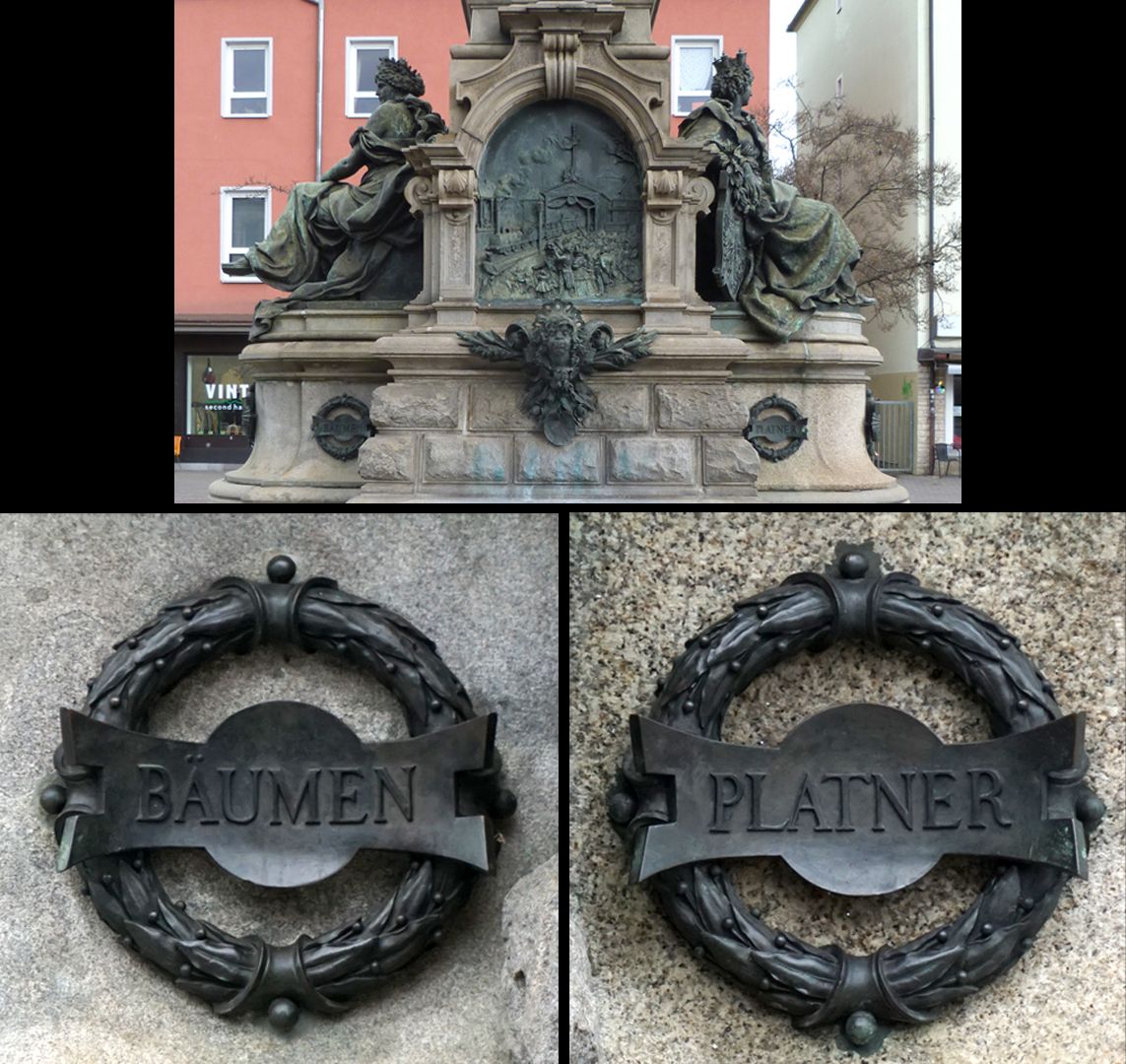
South side, two laurel wreaths with the names BÄUMEN (Franz Joseph von Bäume, 1784 - 1861, 1st mayor of Fürth) and PLATNER (Georg Zacharias Platner, 1781 - 1862, main shareholder and director of the "Ludwigs-Eisenbahn-Gesellschaft-Nürnberg")
On October 16, 1890, an art fountain by Heinrich Schwabe was unveiled at Plärrer. After stops at the city limits (1930; 1981), it has been at its current location since 1993. The small bronze sculpture that decorates the approximately 10 m high granite obelisk glorifies the first German railway journey as a triumph of technology and comes - like the flanking personifications of Noris and Furthia - from the Lenz art foundry. The foundation stone was laid on December 7th, 1885, the 50th anniversary of the Adler voyage between Nuremberg and Fürth. Schwabe won the competition that was only announced in May 1887, although the jury recognized Rudolf Maison's design "Hercules" - later realized at the Fürth train station - as the best artistic achievement. Half of the costs of 58,500 marks were borne by the Bavarian state. The other half was shared by the Ludwig Railway Company, the city, the suburban association and private patrons, including Ludwig Gerngros. quoted from: Nuremberg City Lexicon, edited by Michael Diefenbacher and Rudolf Endres, Nuremberg, 1999
Location: Nuremberg, Gostenhof, Fürther Straße (Bärenschanze subway station)
Design: Schwabe, Georg Heinrich Joseph
Realization: Lenz, Christoph (I.)
Depicted: Klutentreter, Kurt, Gerngros, Ludwig Ritter von
photo 2023, Theo Noll
Memorial to King Ludwig´s Railway (Ludwigseisenbahn)
1890
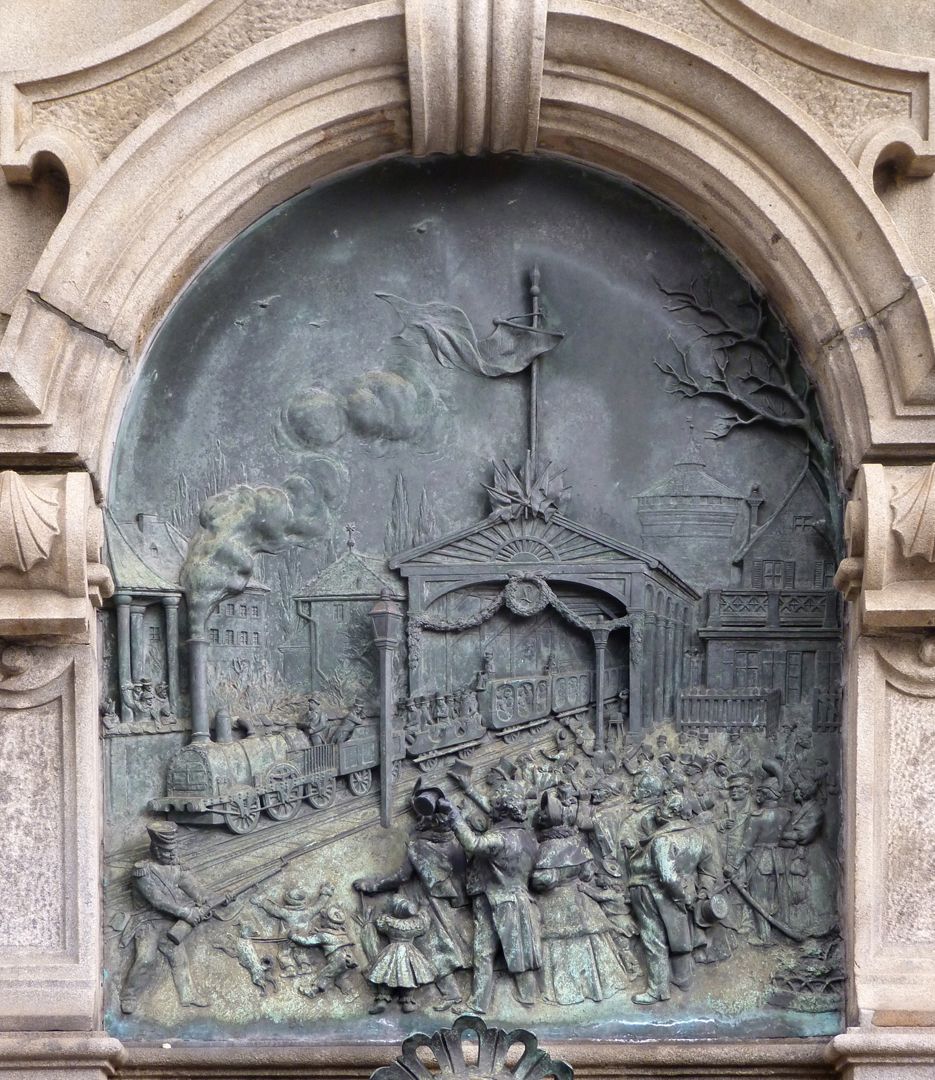
Relief image on the south side: exit of the train towards Fürth
On October 16, 1890, an art fountain by Heinrich Schwabe was unveiled at Plärrer. After stops at the city limits (1930; 1981), it has been at its current location since 1993. The small bronze sculpture that decorates the approximately 10 m high granite obelisk glorifies the first German railway journey as a triumph of technology and comes - like the flanking personifications of Noris and Furthia - from the Lenz art foundry. The foundation stone was laid on December 7th, 1885, the 50th anniversary of the Adler voyage between Nuremberg and Fürth. Schwabe won the competition that was only announced in May 1887, although the jury recognized Rudolf Maison's design "Hercules" - later realized at the Fürth train station - as the best artistic achievement. Half of the costs of 58,500 marks were borne by the Bavarian state. The other half was shared by the Ludwig Railway Company, the city, the suburban association and private patrons, including Ludwig Gerngros. quoted from: Nuremberg City Lexicon, edited by Michael Diefenbacher and Rudolf Endres, Nuremberg, 1999
Location: Nuremberg, Gostenhof, Fürther Straße (Bärenschanze subway station)
Design: Schwabe, Georg Heinrich Joseph
Realization: Lenz, Christoph (I.)
Depicted: Klutentreter, Kurt, Gerngros, Ludwig Ritter von
photo 2018, Theo Noll
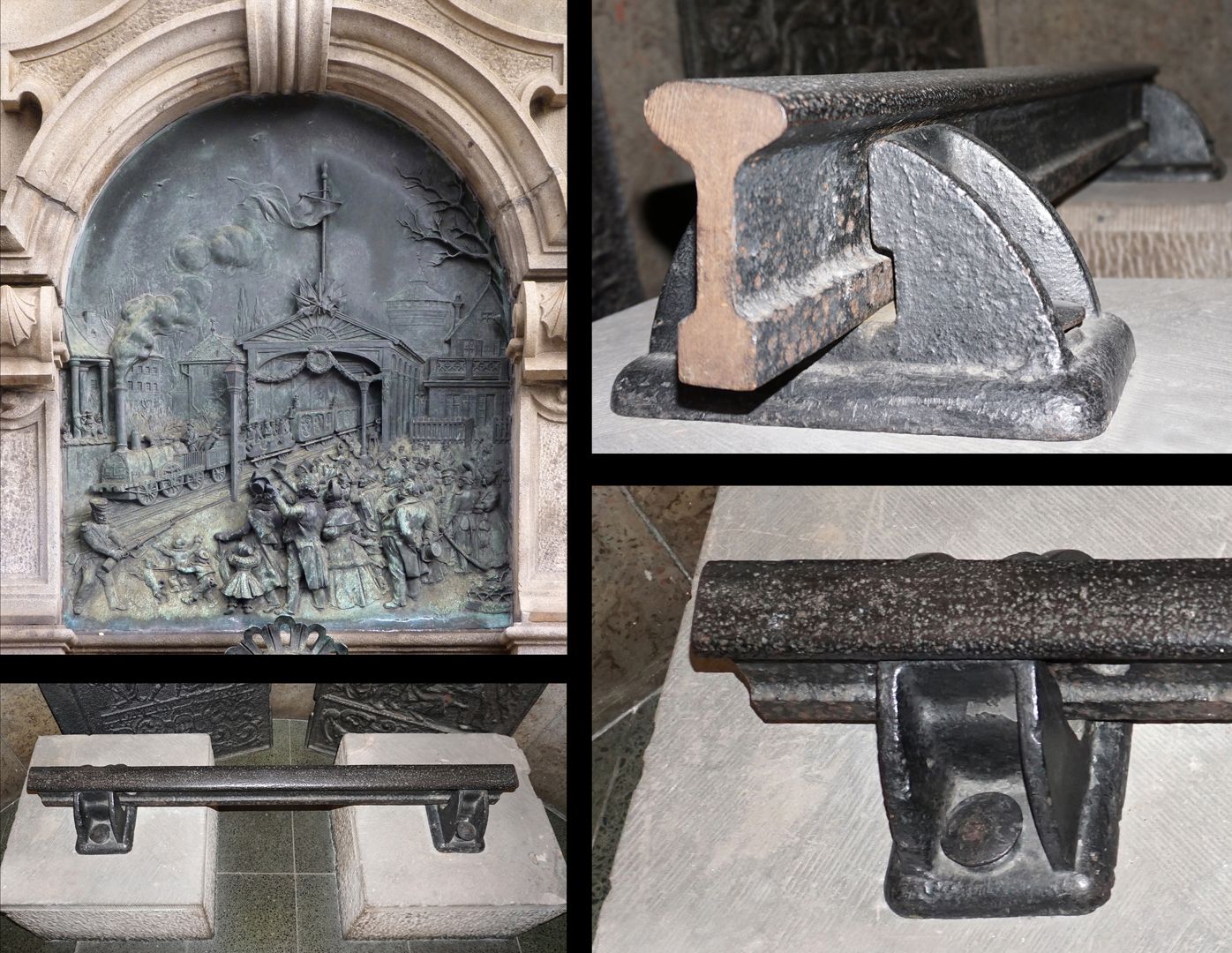
Memorial to King Ludwig´s Railway (Ludwigseisenbahn)
1890
Relief image of the south side and part of an original rail rolled by the Rasselstein company in Neuwied (1835)
On October 16, 1890, an art fountain by Heinrich Schwabe was unveiled at Plärrer. After stops at the city limits (1930; 1981), it has been at its current location since 1993. The small bronze sculpture that decorates the approximately 10 m high granite obelisk glorifies the first German railway journey as a triumph of technology and comes - like the flanking personifications of Noris and Furthia - from the Lenz art foundry. The foundation stone was laid on December 7th, 1885, the 50th anniversary of the Adler voyage between Nuremberg and Fürth. Schwabe won the competition that was only announced in May 1887, although the jury recognized Rudolf Maison's design "Hercules" - later realized at the Fürth train station - as the best artistic achievement. Half of the costs of 58,500 marks were borne by the Bavarian state. The other half was shared by the Ludwig Railway Company, the city, the suburban association and private patrons, including Ludwig Gerngros. quoted from: Nuremberg City Lexicon, edited by Michael Diefenbacher and Rudolf Endres, Nuremberg, 1999
Location: Nuremberg, Gostenhof, Fürther Straße (Bärenschanze subway station)
Design: Schwabe, Georg Heinrich Joseph
Realization: Lenz, Christoph (I.)
Depicted: Klutentreter, Kurt, Gerngros, Ludwig Ritter von
photo 2018 und 2023, Theo Noll
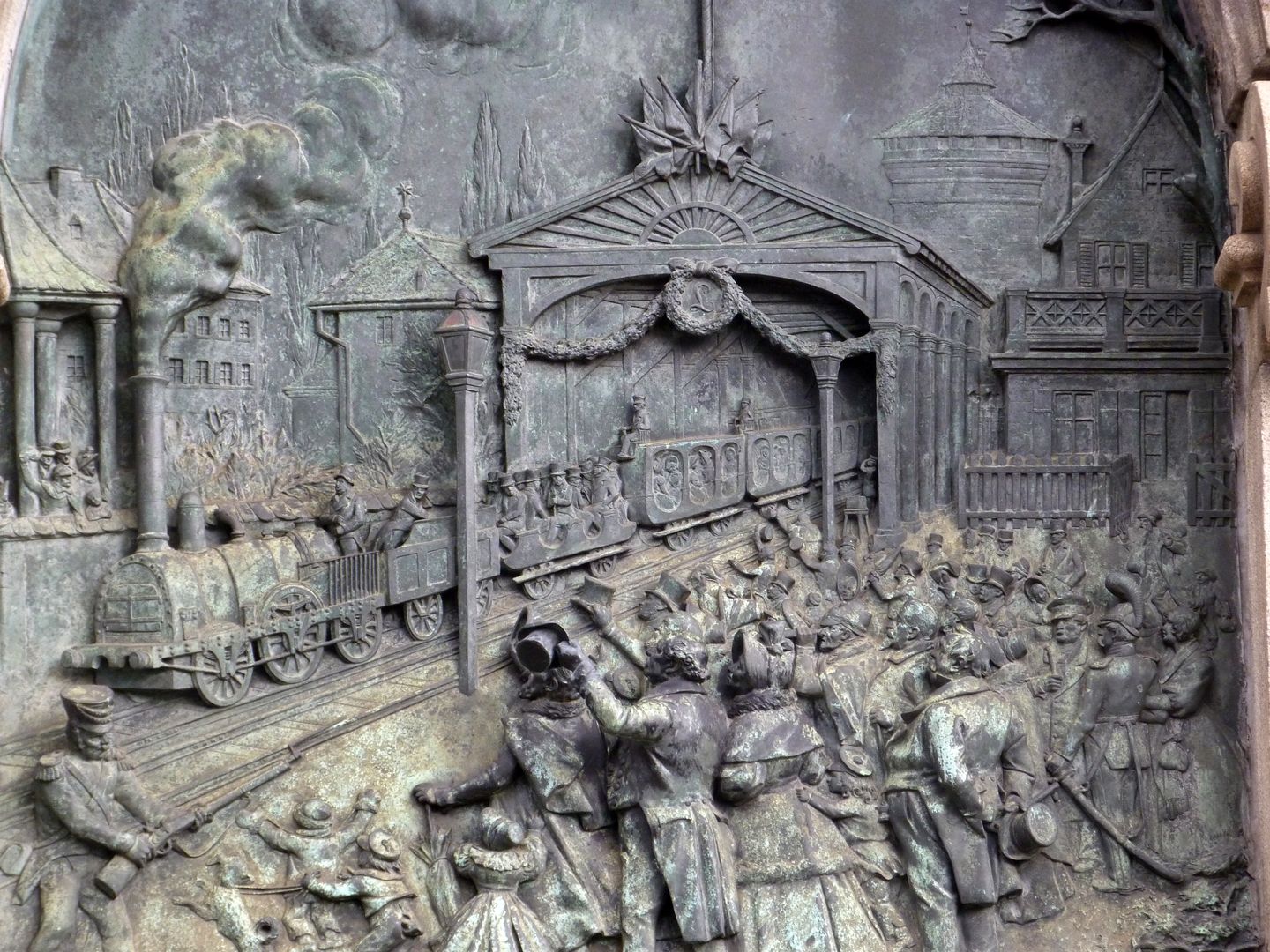
Memorial to King Ludwig´s Railway (Ludwigseisenbahn)
1890
Relief image of the south side, detailed view
On October 16, 1890, an art fountain by Heinrich Schwabe was unveiled at Plärrer. After stops at the city limits (1930; 1981), it has been at its current location since 1993. The small bronze sculpture that decorates the approximately 10 m high granite obelisk glorifies the first German railway journey as a triumph of technology and comes - like the flanking personifications of Noris and Furthia - from the Lenz art foundry. The foundation stone was laid on December 7th, 1885, the 50th anniversary of the Adler voyage between Nuremberg and Fürth. Schwabe won the competition that was only announced in May 1887, although the jury recognized Rudolf Maison's design "Hercules" - later realized at the Fürth train station - as the best artistic achievement. Half of the costs of 58,500 marks were borne by the Bavarian state. The other half was shared by the Ludwig Railway Company, the city, the suburban association and private patrons, including Ludwig Gerngros. quoted from: Nuremberg City Lexicon, edited by Michael Diefenbacher and Rudolf Endres, Nuremberg, 1999
Location: Nuremberg, Gostenhof, Fürther Straße (Bärenschanze subway station)
Design: Schwabe, Georg Heinrich Joseph
Realization: Lenz, Christoph (I.)
Depicted: Klutentreter, Kurt, Gerngros, Ludwig Ritter von
photo 2018, Theo Noll
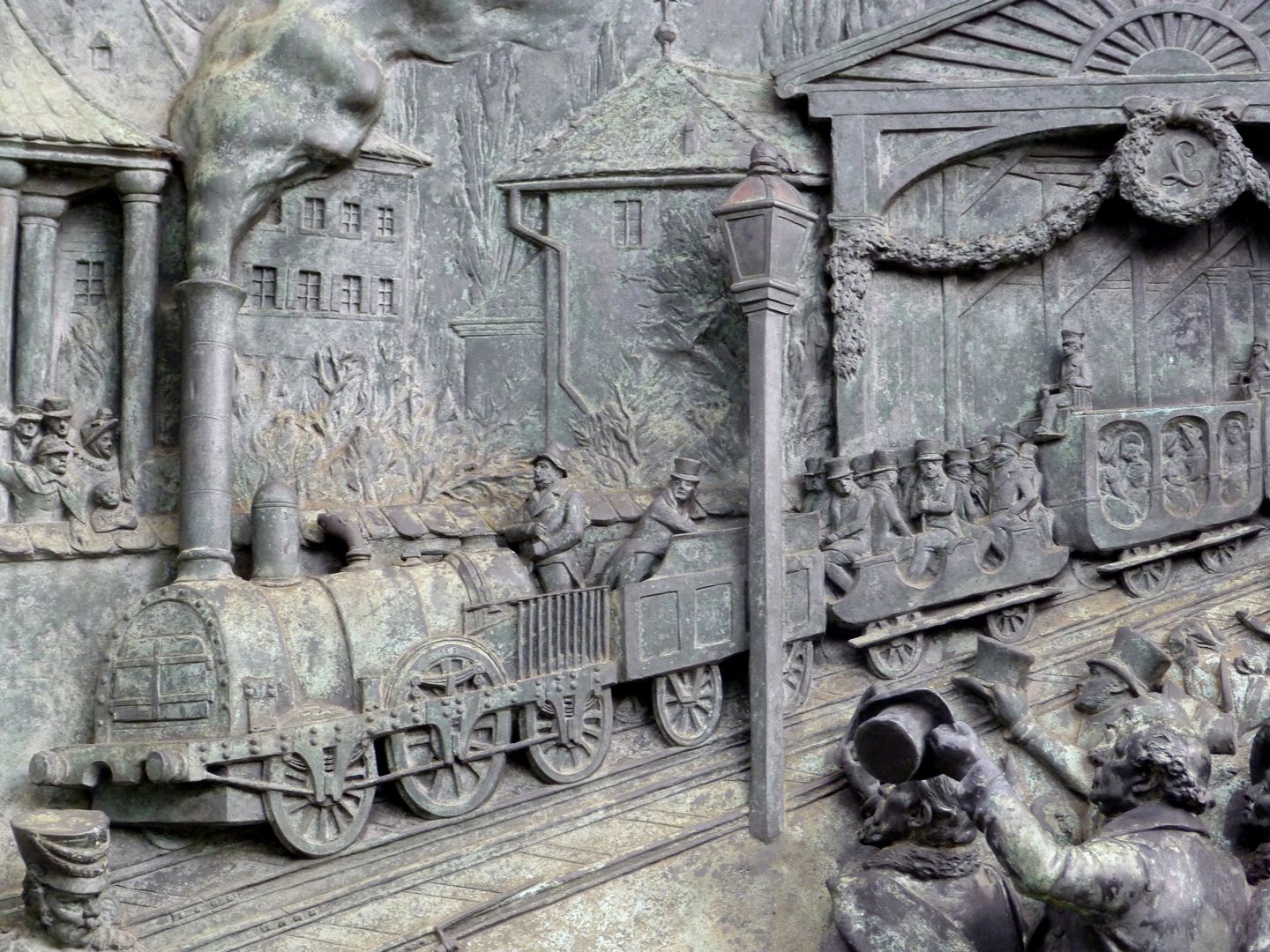
Memorial to King Ludwig´s Railway (Ludwigseisenbahn)
1890
Relief image of the south side, detailed view
On October 16, 1890, an art fountain by Heinrich Schwabe was unveiled at Plärrer. After stops at the city limits (1930; 1981), it has been at its current location since 1993. The small bronze sculpture that decorates the approximately 10 m high granite obelisk glorifies the first German railway journey as a triumph of technology and comes - like the flanking personifications of Noris and Furthia - from the Lenz art foundry. The foundation stone was laid on December 7th, 1885, the 50th anniversary of the Adler voyage between Nuremberg and Fürth. Schwabe won the competition that was only announced in May 1887, although the jury recognized Rudolf Maison's design "Hercules" - later realized at the Fürth train station - as the best artistic achievement. Half of the costs of 58,500 marks were borne by the Bavarian state. The other half was shared by the Ludwig Railway Company, the city, the suburban association and private patrons, including Ludwig Gerngros. quoted from: Nuremberg City Lexicon, edited by Michael Diefenbacher and Rudolf Endres, Nuremberg, 1999
Location: Nuremberg, Gostenhof, Fürther Straße (Bärenschanze subway station)
Design: Schwabe, Georg Heinrich Joseph
Realization: Lenz, Christoph (I.)
Depicted: Klutentreter, Kurt, Gerngros, Ludwig Ritter von
photo 2018, Theo Noll
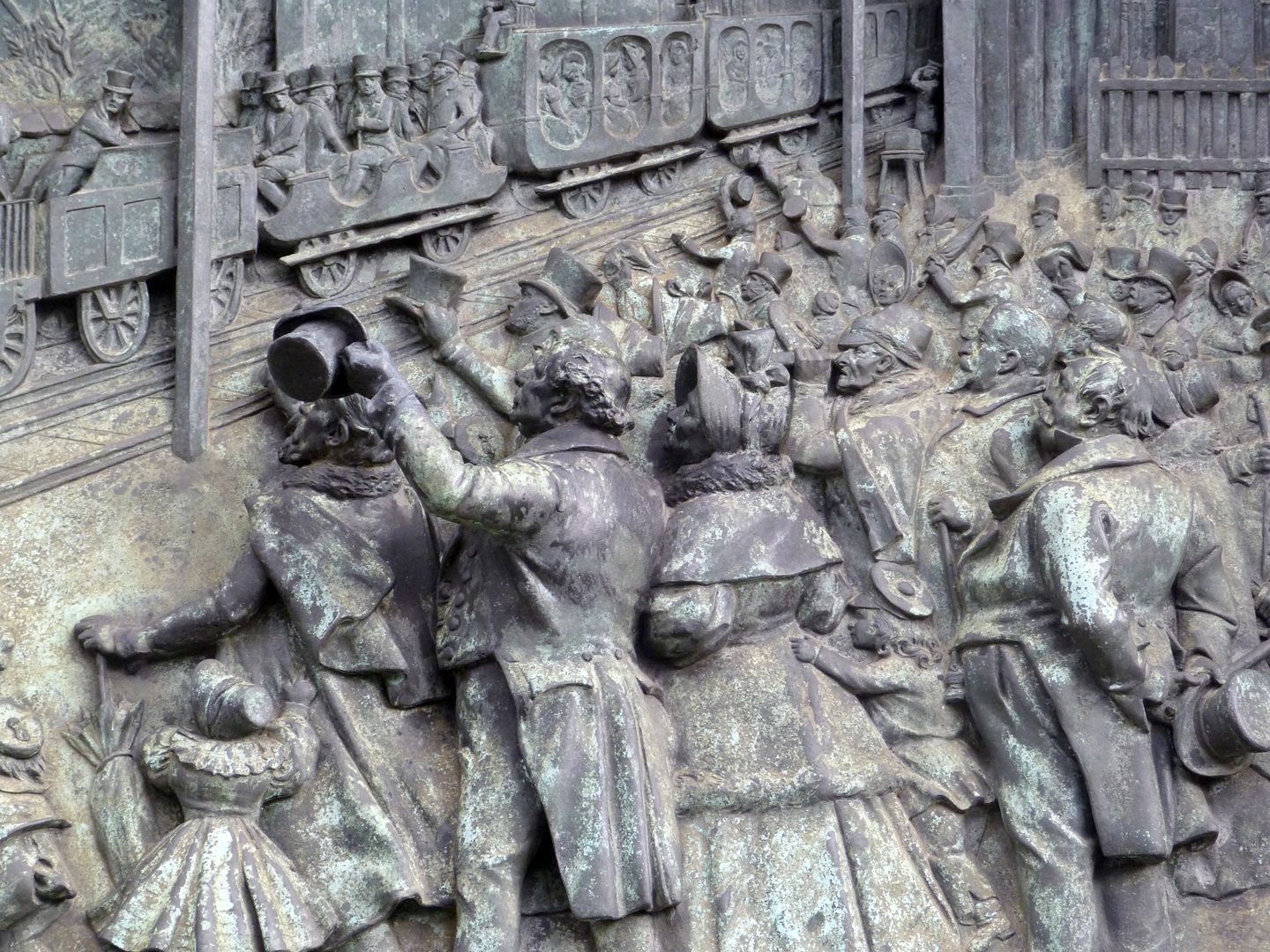
Memorial to King Ludwig´s Railway (Ludwigseisenbahn)
1890
Relief image of the south side, detailed view
On October 16, 1890, an art fountain by Heinrich Schwabe was unveiled at Plärrer. After stops at the city limits (1930; 1981), it has been at its current location since 1993. The small bronze sculpture that decorates the approximately 10 m high granite obelisk glorifies the first German railway journey as a triumph of technology and comes - like the flanking personifications of Noris and Furthia - from the Lenz art foundry. The foundation stone was laid on December 7th, 1885, the 50th anniversary of the Adler voyage between Nuremberg and Fürth. Schwabe won the competition that was only announced in May 1887, although the jury recognized Rudolf Maison's design "Hercules" - later realized at the Fürth train station - as the best artistic achievement. Half of the costs of 58,500 marks were borne by the Bavarian state. The other half was shared by the Ludwig Railway Company, the city, the suburban association and private patrons, including Ludwig Gerngros. quoted from: Nuremberg City Lexicon, edited by Michael Diefenbacher and Rudolf Endres, Nuremberg, 1999
Location: Nuremberg, Gostenhof, Fürther Straße (Bärenschanze subway station)
Design: Schwabe, Georg Heinrich Joseph
Realization: Lenz, Christoph (I.)
Depicted: Klutentreter, Kurt, Gerngros, Ludwig Ritter von
photo 2018, Theo Noll
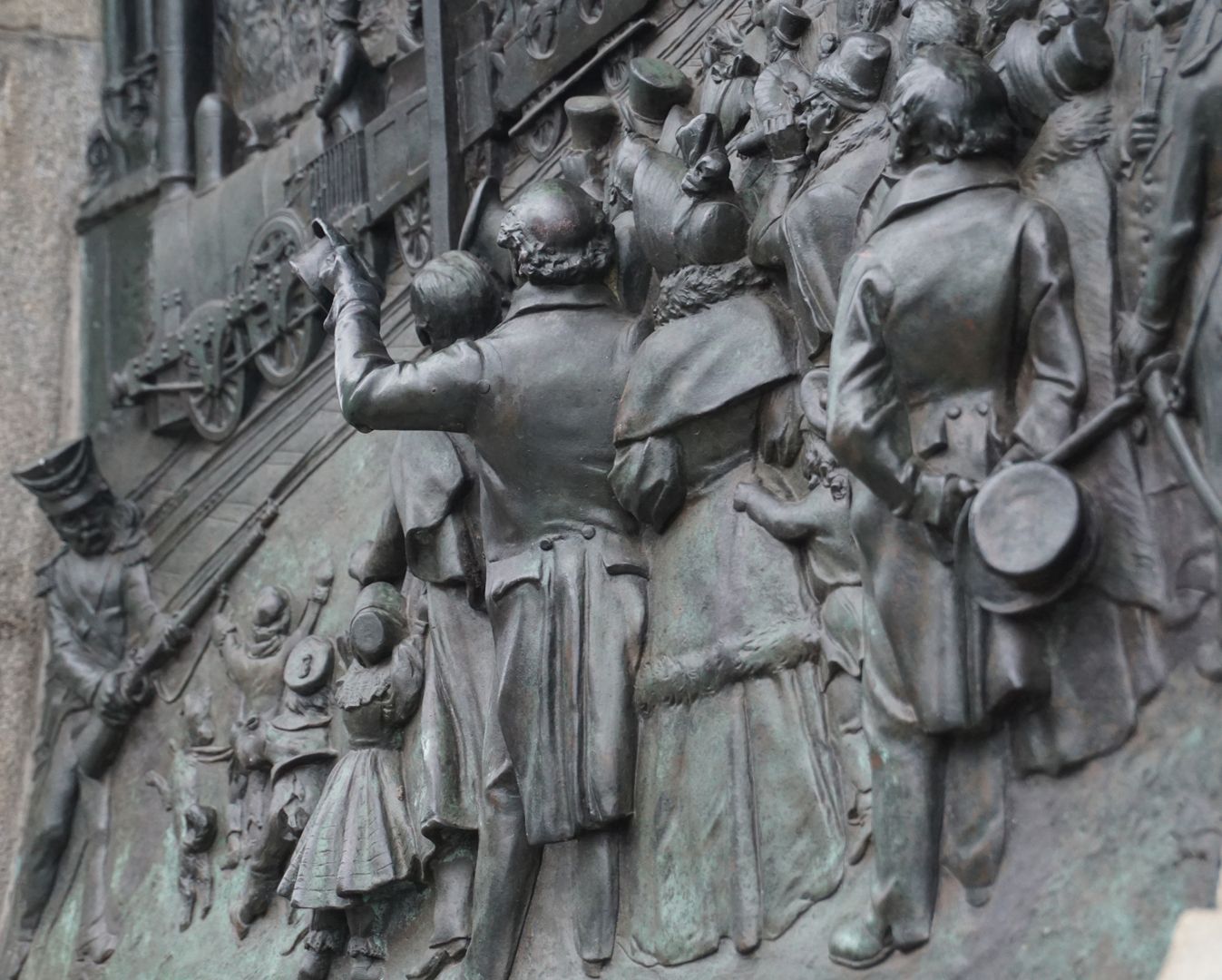
Memorial to King Ludwig´s Railway (Ludwigseisenbahn)
1890
Relief image of the south side, detailed view
On October 16, 1890, an art fountain by Heinrich Schwabe was unveiled at Plärrer. After stops at the city limits (1930; 1981), it has been at its current location since 1993. The small bronze sculpture that decorates the approximately 10 m high granite obelisk glorifies the first German railway journey as a triumph of technology and comes - like the flanking personifications of Noris and Furthia - from the Lenz art foundry. The foundation stone was laid on December 7th, 1885, the 50th anniversary of the Adler voyage between Nuremberg and Fürth. Schwabe won the competition that was only announced in May 1887, although the jury recognized Rudolf Maison's design "Hercules" - later realized at the Fürth train station - as the best artistic achievement. Half of the costs of 58,500 marks were borne by the Bavarian state. The other half was shared by the Ludwig Railway Company, the city, the suburban association and private patrons, including Ludwig Gerngros. quoted from: Nuremberg City Lexicon, edited by Michael Diefenbacher and Rudolf Endres, Nuremberg, 1999
Location: Nuremberg, Gostenhof, Fürther Straße (Bärenschanze subway station)
Design: Schwabe, Georg Heinrich Joseph
Realization: Lenz, Christoph (I.)
Depicted: Klutentreter, Kurt, Gerngros, Ludwig Ritter von
photo 2023, Theo Noll
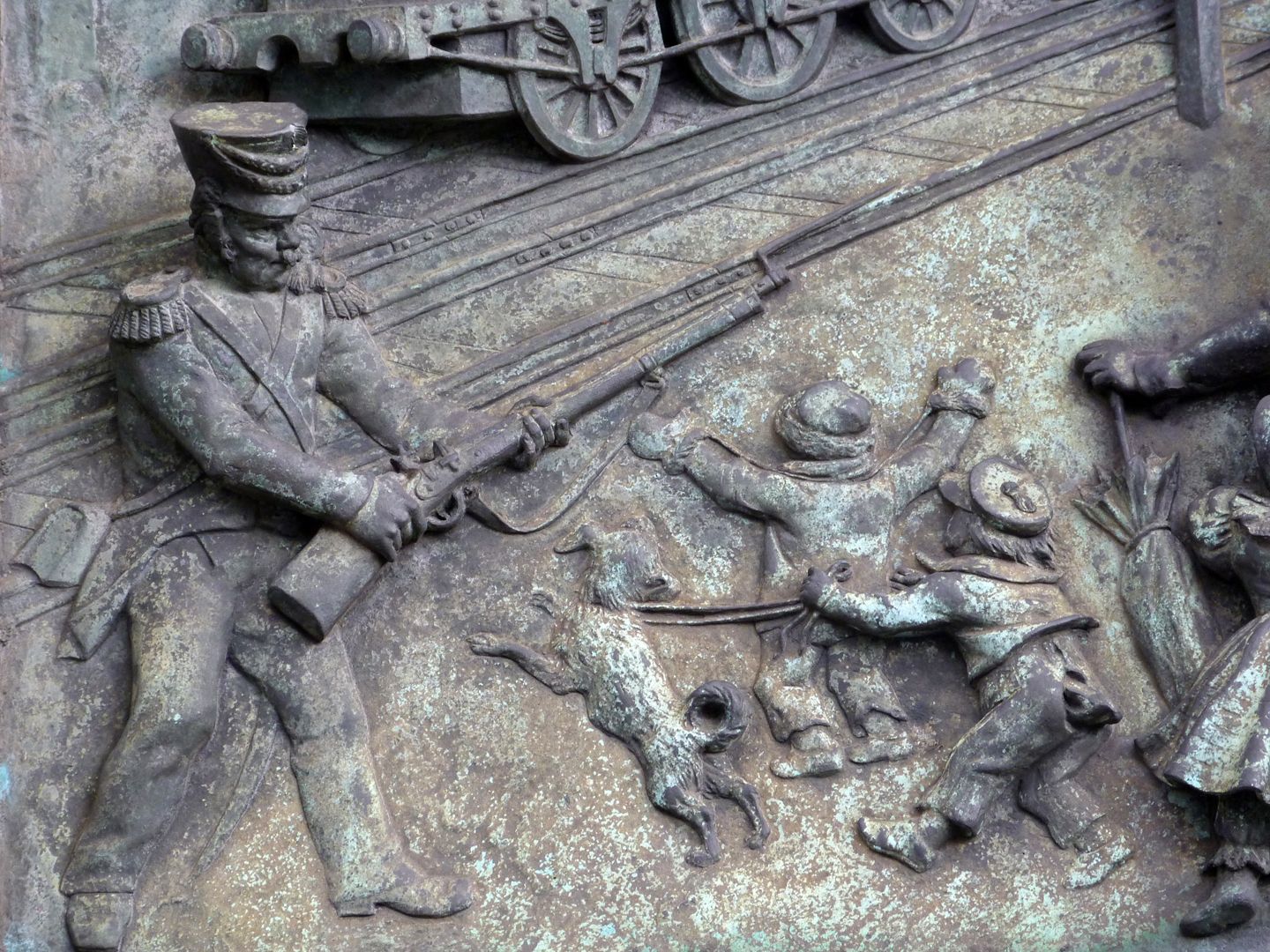
Memorial to King Ludwig´s Railway (Ludwigseisenbahn)
1890
Relief image of the south side, detailed view
On October 16, 1890, an art fountain by Heinrich Schwabe was unveiled at Plärrer. After stops at the city limits (1930; 1981), it has been at its current location since 1993. The small bronze sculpture that decorates the approximately 10 m high granite obelisk glorifies the first German railway journey as a triumph of technology and comes - like the flanking personifications of Noris and Furthia - from the Lenz art foundry. The foundation stone was laid on December 7th, 1885, the 50th anniversary of the Adler voyage between Nuremberg and Fürth. Schwabe won the competition that was only announced in May 1887, although the jury recognized Rudolf Maison's design "Hercules" - later realized at the Fürth train station - as the best artistic achievement. Half of the costs of 58,500 marks were borne by the Bavarian state. The other half was shared by the Ludwig Railway Company, the city, the suburban association and private patrons, including Ludwig Gerngros. quoted from: Nuremberg City Lexicon, edited by Michael Diefenbacher and Rudolf Endres, Nuremberg, 1999
Location: Nuremberg, Gostenhof, Fürther Straße (Bärenschanze subway station)
Design: Schwabe, Georg Heinrich Joseph
Realization: Lenz, Christoph (I.)
Depicted: Klutentreter, Kurt, Gerngros, Ludwig Ritter von
photo 2018, Theo Noll
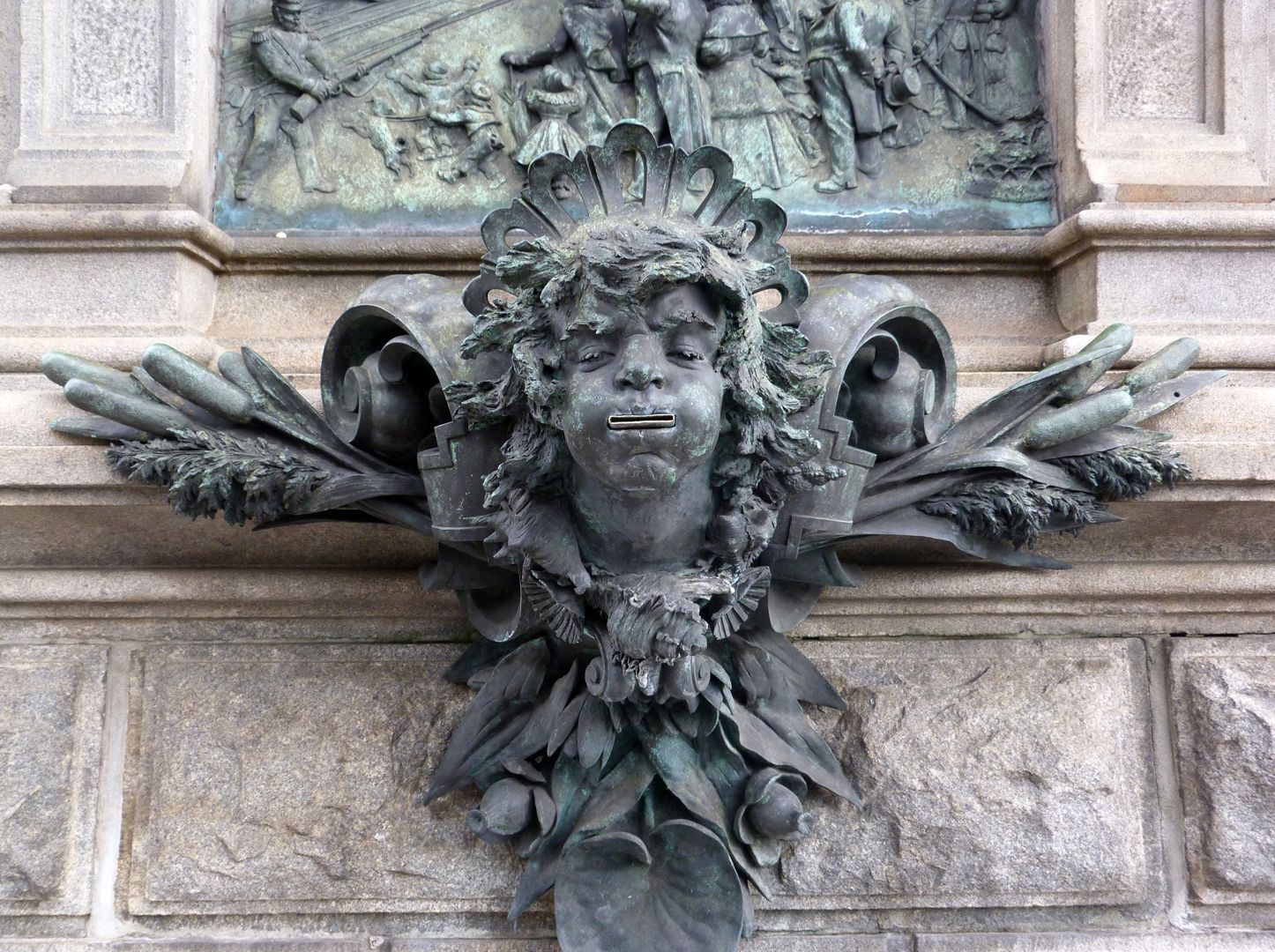
Memorial to King Ludwig´s Railway (Ludwigseisenbahn)
1890
Gargoyle on the south side
On October 16, 1890, an art fountain by Heinrich Schwabe was unveiled at Plärrer. After stops at the city limits (1930; 1981), it has been at its current location since 1993. The small bronze sculpture that decorates the approximately 10 m high granite obelisk glorifies the first German railway journey as a triumph of technology and comes - like the flanking personifications of Noris and Furthia - from the Lenz art foundry. The foundation stone was laid on December 7th, 1885, the 50th anniversary of the Adler voyage between Nuremberg and Fürth. Schwabe won the competition that was only announced in May 1887, although the jury recognized Rudolf Maison's design "Hercules" - later realized at the Fürth train station - as the best artistic achievement. Half of the costs of 58,500 marks were borne by the Bavarian state. The other half was shared by the Ludwig Railway Company, the city, the suburban association and private patrons, including Ludwig Gerngros. quoted from: Nuremberg City Lexicon, edited by Michael Diefenbacher and Rudolf Endres, Nuremberg, 1999
Location: Nuremberg, Gostenhof, Fürther Straße (Bärenschanze subway station)
Design: Schwabe, Georg Heinrich Joseph
Realization: Lenz, Christoph (I.)
Depicted: Klutentreter, Kurt, Gerngros, Ludwig Ritter von
photo 2018, Theo Noll