Devil's Fountain

Devil's Fountain
1888
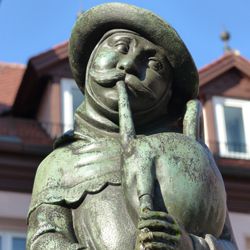
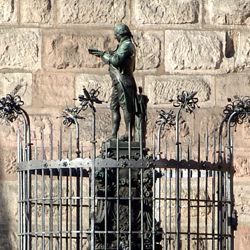
The depiction refers to the legend of the "Schusserbuben" (Schusser = playing ball) and thus also indirectly to the Lorenzer schoolhouse (formerly Lorenzer Platz 3), which was destroyed in World War II: A schoolboy, after class—book and slate still under his arm—was playing ball in Lorenzer Platz. He was a hothead, and he cheated whenever he could. When his classmates noticed this and confronted him, he denied everything and protested his innocence. "If it's not true, may the devil take me!" Suddenly, there was a rushing sound in the air, and the devil came riding along and seized the sinner. The slate and book slipped from the boy's hand. This scene is preserved as a reminder of the importance of honesty. The distinctive shape of the metal knob on the chancel roof of St. Lorenz Church likely inspired the embellishment of the story. As the devil carried him away through the air, the little boy is said to have lost his cap, which then got caught on the lightning rod of the choir roof and can still be seen there today as the "rascal's cap." Nuremberg, City Lexicon, ed. Diefenbacher and Endres, 1999
Location: Nürnberg, St. Lorenz, Nordturm, Nordwest Ecke
Design: Wanderer, Friedrich
photo 2012, Theo Noll

Devil's Fountain
1888
The depiction refers to the legend of the "Schusserbuben" (Schusser = playing ball) and thus also indirectly to the Lorenzer schoolhouse (formerly Lorenzer Platz 3), which was destroyed in World War II: A schoolboy, after class—book and slate still under his arm—was playing ball in Lorenzer Platz. He was a hothead, and he cheated whenever he could. When his classmates noticed this and confronted him, he denied everything and protested his innocence. "If it's not true, may the devil take me!" Suddenly, there was a rushing sound in the air, and the devil came riding along and seized the sinner. The slate and book slipped from the boy's hand. This scene is preserved as a reminder of the importance of honesty. The distinctive shape of the metal knob on the chancel roof of St. Lorenz Church likely inspired the embellishment of the story. As the devil carried him away through the air, the little boy is said to have lost his cap, which then got caught on the lightning rod of the choir roof and can still be seen there today as the "rascal's cap." Nuremberg, City Lexicon, ed. Diefenbacher and Endres, 1999
Location: Nuremberg, St. Lawrence, North Tower, Northwest Corner
Design: Wanderer, Friedrich
photo 2022, Theo Noll

Devil's Fountain
1888
without fountain grid
The depiction refers to the legend of the "Schusserbuben" (Schusser = playing ball) and thus also indirectly to the Lorenzer schoolhouse (formerly Lorenzer Platz 3), which was destroyed in World War II: A schoolboy, after class—book and slate still under his arm—was playing ball in Lorenzer Platz. He was a hothead, and he cheated whenever he could. When his classmates noticed this and confronted him, he denied everything and protested his innocence. "If it's not true, may the devil take me!" Suddenly, there was a rushing sound in the air, and the devil came riding along and seized the sinner. The slate and book slipped from the boy's hand. This scene is preserved as a reminder of the importance of honesty. The distinctive shape of the metal knob on the chancel roof of St. Lorenz Church likely inspired the embellishment of the story. As the devil carried him away through the air, the little boy is said to have lost his cap, which then got caught on the lightning rod of the choir roof and can still be seen there today as the "rascal's cap." Nuremberg, City Lexicon, ed. Diefenbacher and Endres, 1999
Location: Nuremberg, St. Lawrence, North Tower, Northwest Corner
Design: Wanderer, Friedrich
photo 2018, Theo Noll

Devil's Fountain
1888
Fountain top
The depiction refers to the legend of the "Schusserbuben" (Schusser = playing ball) and thus also indirectly to the Lorenzer schoolhouse (formerly Lorenzer Platz 3), which was destroyed in World War II: A schoolboy, after class—book and slate still under his arm—was playing ball in Lorenzer Platz. He was a hothead, and he cheated whenever he could. When his classmates noticed this and confronted him, he denied everything and protested his innocence. "If it's not true, may the devil take me!" Suddenly, there was a rushing sound in the air, and the devil came riding along and seized the sinner. The slate and book slipped from the boy's hand. This scene is preserved as a reminder of the importance of honesty. The distinctive shape of the metal knob on the chancel roof of St. Lorenz Church likely inspired the embellishment of the story. As the devil carried him away through the air, the little boy is said to have lost his cap, which then got caught on the lightning rod of the choir roof and can still be seen there today as the "rascal's cap." Nuremberg, City Lexicon, ed. Diefenbacher and Endres, 1999
Location: Nuremberg, St. Lawrence, North Tower, Northwest Corner
Design: Wanderer, Friedrich
photo 2018, Theo Noll

Devil's Fountain
1888
upper body of fountain
The depiction refers to the legend of the "Schusserbuben" (Schusser = playing ball) and thus also indirectly to the Lorenzer schoolhouse (formerly Lorenzer Platz 3), which was destroyed in World War II: A schoolboy, after class—book and slate still under his arm—was playing ball in Lorenzer Platz. He was a hothead, and he cheated whenever he could. When his classmates noticed this and confronted him, he denied everything and protested his innocence. "If it's not true, may the devil take me!" Suddenly, there was a rushing sound in the air, and the devil came riding along and seized the sinner. The slate and book slipped from the boy's hand. This scene is preserved as a reminder of the importance of honesty. The distinctive shape of the metal knob on the chancel roof of St. Lorenz Church likely inspired the embellishment of the story. As the devil carried him away through the air, the little boy is said to have lost his cap, which then got caught on the lightning rod of the choir roof and can still be seen there today as the "rascal's cap." Nuremberg, City Lexicon, ed. Diefenbacher and Endres, 1999
Location: Nuremberg, St. Lawrence, North Tower, Northwest Corner
Design: Wanderer, Friedrich
photo 2018, Theo Noll

Devil's Fountain
1888
Schoolchild has thrown writing tablet and book from himself and is taken by the devil, detail
The depiction refers to the legend of the "Schusserbuben" (Schusser = playing ball) and thus also indirectly to the Lorenzer schoolhouse (formerly Lorenzer Platz 3), which was destroyed in World War II: A schoolboy, after class—book and slate still under his arm—was playing ball in Lorenzer Platz. He was a hothead, and he cheated whenever he could. When his classmates noticed this and confronted him, he denied everything and protested his innocence. "If it's not true, may the devil take me!" Suddenly, there was a rushing sound in the air, and the devil came riding along and seized the sinner. The slate and book slipped from the boy's hand. This scene is preserved as a reminder of the importance of honesty. The distinctive shape of the metal knob on the chancel roof of St. Lorenz Church likely inspired the embellishment of the story. As the devil carried him away through the air, the little boy is said to have lost his cap, which then got caught on the lightning rod of the choir roof and can still be seen there today as the "rascal's cap." Nuremberg, City Lexicon, ed. Diefenbacher and Endres, 1999
Location: Nuremberg, St. Lawrence, North Tower, Northwest Corner
Design: Wanderer, Friedrich
photo 2012, Theo Noll

Devil's Fountain
1888
Schoolchild has thrown writing tablet and book from himself and is taken by the devil, detail
The depiction refers to the legend of the "Schusserbuben" (Schusser = playing ball) and thus also indirectly to the Lorenzer schoolhouse (formerly Lorenzer Platz 3), which was destroyed in World War II: A schoolboy, after class—book and slate still under his arm—was playing ball in Lorenzer Platz. He was a hothead, and he cheated whenever he could. When his classmates noticed this and confronted him, he denied everything and protested his innocence. "If it's not true, may the devil take me!" Suddenly, there was a rushing sound in the air, and the devil came riding along and seized the sinner. The slate and book slipped from the boy's hand. This scene is preserved as a reminder of the importance of honesty. The distinctive shape of the metal knob on the chancel roof of St. Lorenz Church likely inspired the embellishment of the story. As the devil carried him away through the air, the little boy is said to have lost his cap, which then got caught on the lightning rod of the choir roof and can still be seen there today as the "rascal's cap." Nuremberg, City Lexicon, ed. Diefenbacher and Endres, 1999
Location: Nuremberg, St. Lawrence, North Tower, Northwest Corner
Design: Wanderer, Friedrich
photo 2018, Theo Noll

Devil's Fountain
1888
Gargoyle with leaf mask in the centre, on the left with the coat of arms of St. Lawrence (depicting the grate on which he was martyred) and on the right the Nuremberg city coat of arms.
The depiction refers to the legend of the "Schusserbuben" (Schusser = playing ball) and thus also indirectly to the Lorenzer schoolhouse (formerly Lorenzer Platz 3), which was destroyed in World War II: A schoolboy, after class—book and slate still under his arm—was playing ball in Lorenzer Platz. He was a hothead, and he cheated whenever he could. When his classmates noticed this and confronted him, he denied everything and protested his innocence. "If it's not true, may the devil take me!" Suddenly, there was a rushing sound in the air, and the devil came riding along and seized the sinner. The slate and book slipped from the boy's hand. This scene is preserved as a reminder of the importance of honesty. The distinctive shape of the metal knob on the chancel roof of St. Lorenz Church likely inspired the embellishment of the story. As the devil carried him away through the air, the little boy is said to have lost his cap, which then got caught on the lightning rod of the choir roof and can still be seen there today as the "rascal's cap." Nuremberg, City Lexicon, ed. Diefenbacher and Endres, 1999
Location: Nuremberg, St. Lawrence, North Tower, Northwest Corner
Design: Wanderer, Friedrich
photo 2018, Theo Noll