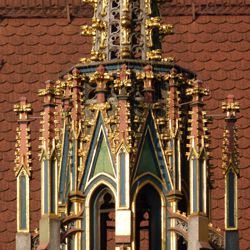
Beautiful fountain
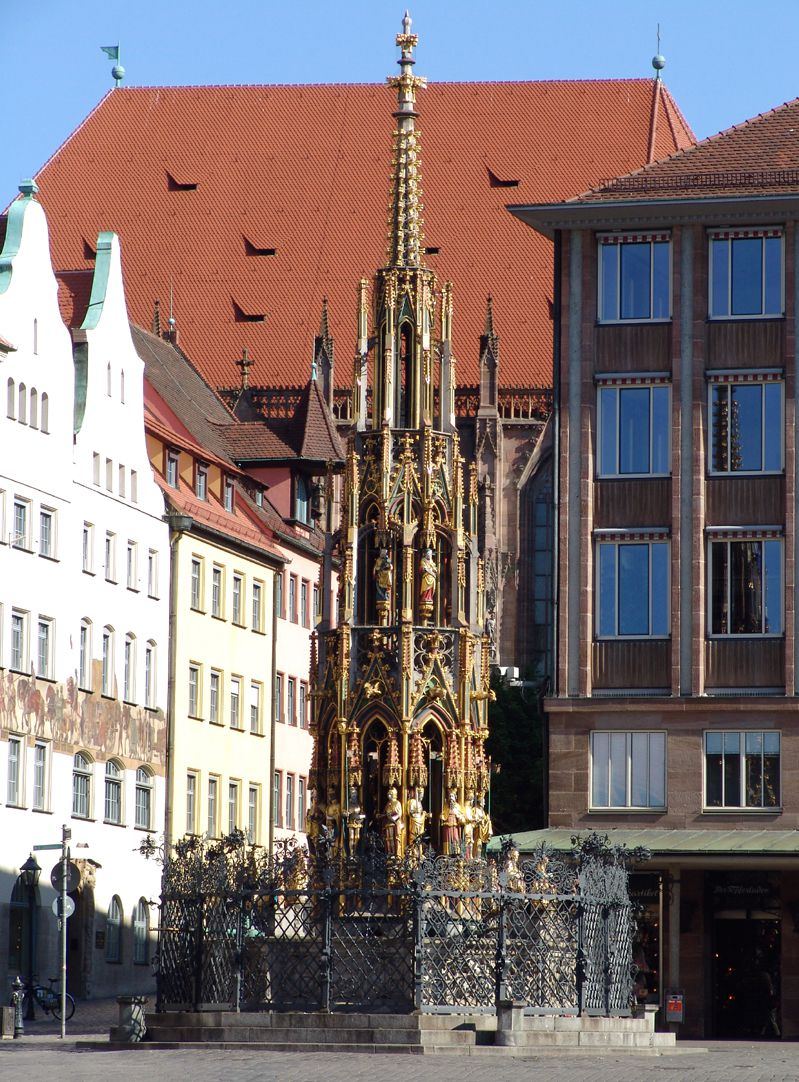
Beautiful fountain
1385 1395
View from the south
"Parlier" Heinrich is said to have been in charge of the overall design. The original sculptural parts are attributed to several masters. The fountain was repaired two times at the end of the 18th century. It was removed respectively renewed 1821-24, restored in 1835 and finally completely replaced by a valuable copy by Heinrich Wallraff 1897-1902. Original parts of the fountain have been preserved in the German National Museum as have parts of the sculptures in Bodemuseum in Berlin. Whereas the fountain architecture can be considered to be originally Gothic, the statues are but an echo of the originals. The original quality of these sculptures is evident by the fragments that have been preserved, it supersedes by far the quality of the sculptures of the previous period in Nuremberg, it is of much higher quality than the one of the figures at the West portal of St. Lorenz-Church and even of the portal of Our Lady´s Church (Frauenkirche) which was created under the Parlers. Regarding architectural history the tower-shaped fountain is a sensation, it is a micro-architecture, definitely with a secular purpose, but completely designed in sacred form-language. In the following time the fountain was adopted as far away as in the Norman Rouen. Relationships with tabernacles of the Late Gothic Period are evident. Concerning the iconographic program the design of the fountain is highly ambitious. The exclusively male figures are distributed over two tiers at the edge of the basin (allegories of Philosophy, the Seven Liberal Arts, the Four Evangelists and the Four Latin Fathers of the Church), apart from that the figures are distributed over two levels of the octagonal tower. The main level displays the Nine Good Heroes, and Seven Electors, over them the Prophets. The hollow octagon ends in an casing of buttresses with an open-worked tracery helmet. The fountain was explicitly mentioned in 1517 by the Italian Antonio de Beatis, correspondent of Cardinal Luigi d´Aragona. Dr. Pablo de la Riestra
Location: Nuremberg, Hauptmarkt
Design: Parlier (Heinrich Parlirer, Beheim, Bheiheim ), Heinrich
photo 2008, Pablo de la Riestra
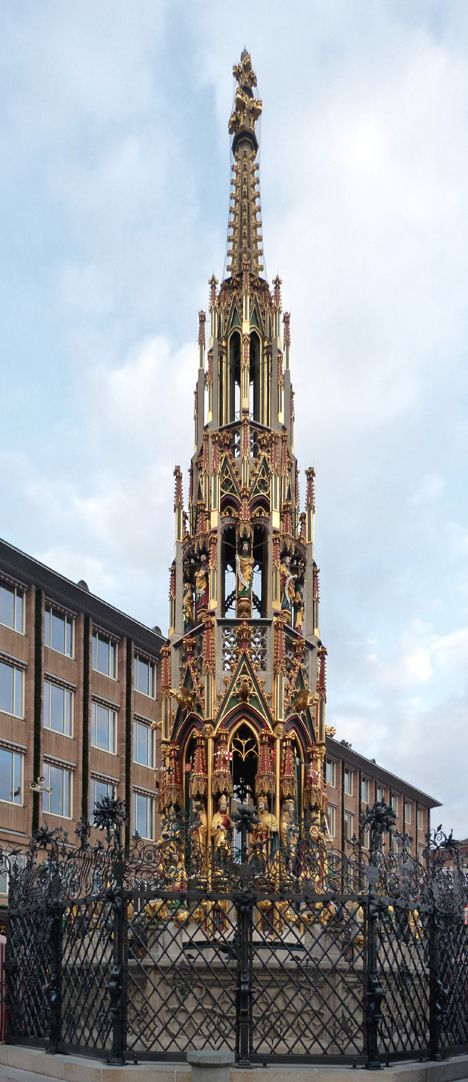
Beautiful fountain
1385 1395
State today after the restoration of 2015-2016
"Parlier" Heinrich is said to have been in charge of the overall design. The original sculptural parts are attributed to several masters. The fountain was repaired two times at the end of the 18th century. It was removed respectively renewed 1821-24, restored in 1835 and finally completely replaced by a valuable copy by Heinrich Wallraff 1897-1902. Original parts of the fountain have been preserved in the German National Museum as have parts of the sculptures in Bodemuseum in Berlin. Whereas the fountain architecture can be considered to be originally Gothic, the statues are but an echo of the originals. The original quality of these sculptures is evident by the fragments that have been preserved, it supersedes by far the quality of the sculptures of the previous period in Nuremberg, it is of much higher quality than the one of the figures at the West portal of St. Lorenz-Church and even of the portal of Our Lady´s Church (Frauenkirche) which was created under the Parlers. Regarding architectural history the tower-shaped fountain is a sensation, it is a micro-architecture, definitely with a secular purpose, but completely designed in sacred form-language. In the following time the fountain was adopted as far away as in the Norman Rouen. Relationships with tabernacles of the Late Gothic Period are evident. Concerning the iconographic program the design of the fountain is highly ambitious. The exclusively male figures are distributed over two tiers at the edge of the basin (allegories of Philosophy, the Seven Liberal Arts, the Four Evangelists and the Four Latin Fathers of the Church), apart from that the figures are distributed over two levels of the octagonal tower. The main level displays the Nine Good Heroes, and Seven Electors, over them the Prophets. The hollow octagon ends in an casing of buttresses with an open-worked tracery helmet. The fountain was explicitly mentioned in 1517 by the Italian Antonio de Beatis, correspondent of Cardinal Luigi d´Aragona. Dr. Pablo de la Riestra
Location: Nuremberg, Hauptmarkt
Design: Parlier (Heinrich Parlirer, Beheim, Bheiheim ), Heinrich
photo 12. Nov 2016, Theo Noll
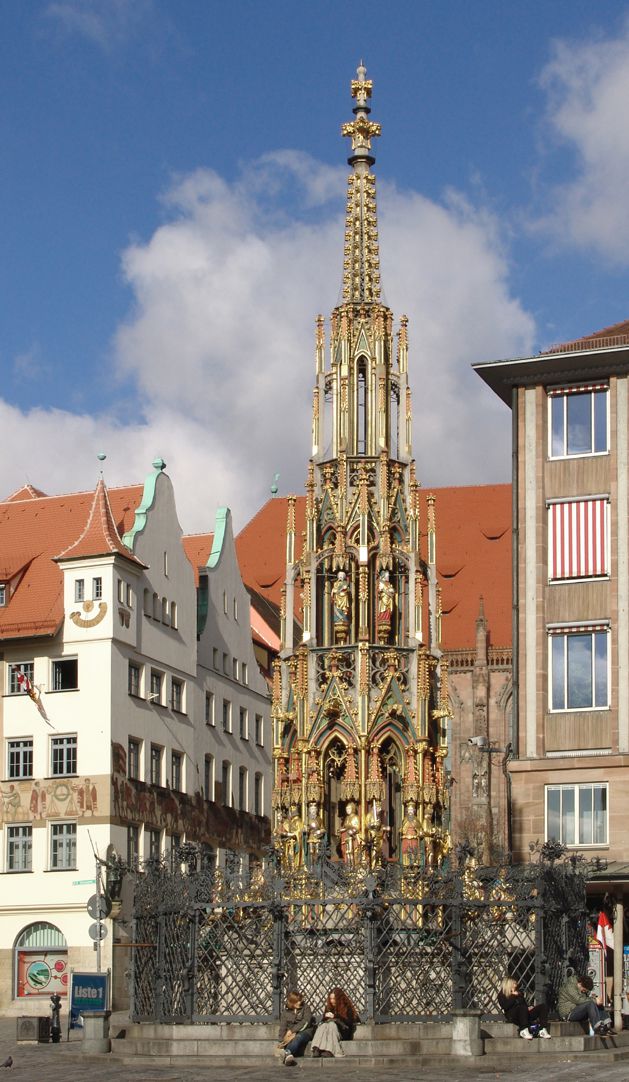
Beautiful fountain
1385 1395
View from the south east
"Parlier" Heinrich is said to have been in charge of the overall design. The original sculptural parts are attributed to several masters. The fountain was repaired two times at the end of the 18th century. It was removed respectively renewed 1821-24, restored in 1835 and finally completely replaced by a valuable copy by Heinrich Wallraff 1897-1902. Original parts of the fountain have been preserved in the German National Museum as have parts of the sculptures in Bodemuseum in Berlin. Whereas the fountain architecture can be considered to be originally Gothic, the statues are but an echo of the originals. The original quality of these sculptures is evident by the fragments that have been preserved, it supersedes by far the quality of the sculptures of the previous period in Nuremberg, it is of much higher quality than the one of the figures at the West portal of St. Lorenz-Church and even of the portal of Our Lady´s Church (Frauenkirche) which was created under the Parlers. Regarding architectural history the tower-shaped fountain is a sensation, it is a micro-architecture, definitely with a secular purpose, but completely designed in sacred form-language. In the following time the fountain was adopted as far away as in the Norman Rouen. Relationships with tabernacles of the Late Gothic Period are evident. Concerning the iconographic program the design of the fountain is highly ambitious. The exclusively male figures are distributed over two tiers at the edge of the basin (allegories of Philosophy, the Seven Liberal Arts, the Four Evangelists and the Four Latin Fathers of the Church), apart from that the figures are distributed over two levels of the octagonal tower. The main level displays the Nine Good Heroes, and Seven Electors, over them the Prophets. The hollow octagon ends in an casing of buttresses with an open-worked tracery helmet. The fountain was explicitly mentioned in 1517 by the Italian Antonio de Beatis, correspondent of Cardinal Luigi d´Aragona. Dr. Pablo de la Riestra
Location: Nuremberg, Hauptmarkt
Design: Parlier (Heinrich Parlirer, Beheim, Bheiheim ), Heinrich
photo 2008, Pablo de la Riestra
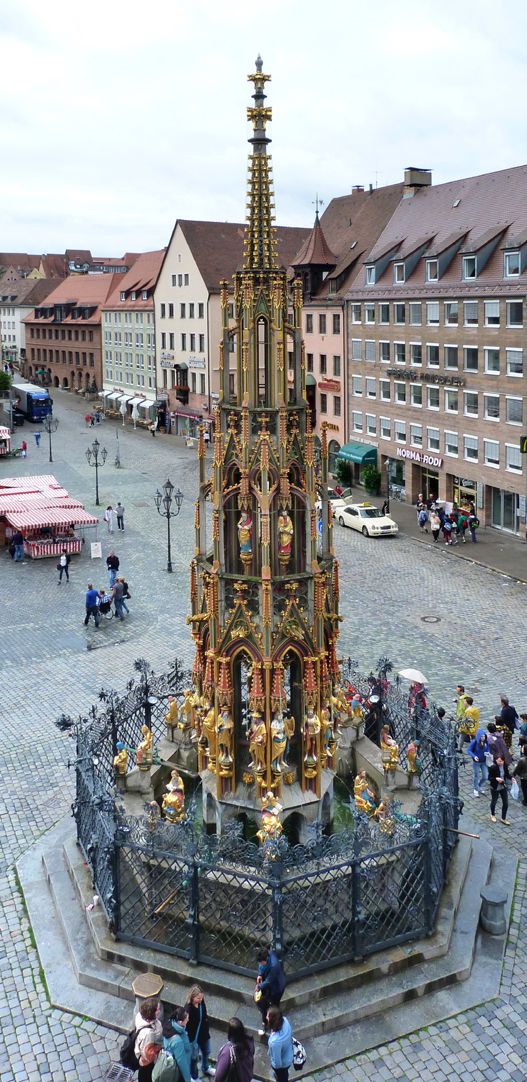
Beautiful fountain
1385 1395
View from the north east
"Parlier" Heinrich is said to have been in charge of the overall design. The original sculptural parts are attributed to several masters. The fountain was repaired two times at the end of the 18th century. It was removed respectively renewed 1821-24, restored in 1835 and finally completely replaced by a valuable copy by Heinrich Wallraff 1897-1902. Original parts of the fountain have been preserved in the German National Museum as have parts of the sculptures in Bodemuseum in Berlin. Whereas the fountain architecture can be considered to be originally Gothic, the statues are but an echo of the originals. The original quality of these sculptures is evident by the fragments that have been preserved, it supersedes by far the quality of the sculptures of the previous period in Nuremberg, it is of much higher quality than the one of the figures at the West portal of St. Lorenz-Church and even of the portal of Our Lady´s Church (Frauenkirche) which was created under the Parlers. Regarding architectural history the tower-shaped fountain is a sensation, it is a micro-architecture, definitely with a secular purpose, but completely designed in sacred form-language. In the following time the fountain was adopted as far away as in the Norman Rouen. Relationships with tabernacles of the Late Gothic Period are evident. Concerning the iconographic program the design of the fountain is highly ambitious. The exclusively male figures are distributed over two tiers at the edge of the basin (allegories of Philosophy, the Seven Liberal Arts, the Four Evangelists and the Four Latin Fathers of the Church), apart from that the figures are distributed over two levels of the octagonal tower. The main level displays the Nine Good Heroes, and Seven Electors, over them the Prophets. The hollow octagon ends in an casing of buttresses with an open-worked tracery helmet. The fountain was explicitly mentioned in 1517 by the Italian Antonio de Beatis, correspondent of Cardinal Luigi d´Aragona. Dr. Pablo de la Riestra
Location: Nuremberg, Hauptmarkt
Design: Parlier (Heinrich Parlirer, Beheim, Bheiheim ), Heinrich
photo 2012, Pablo de la Riestra
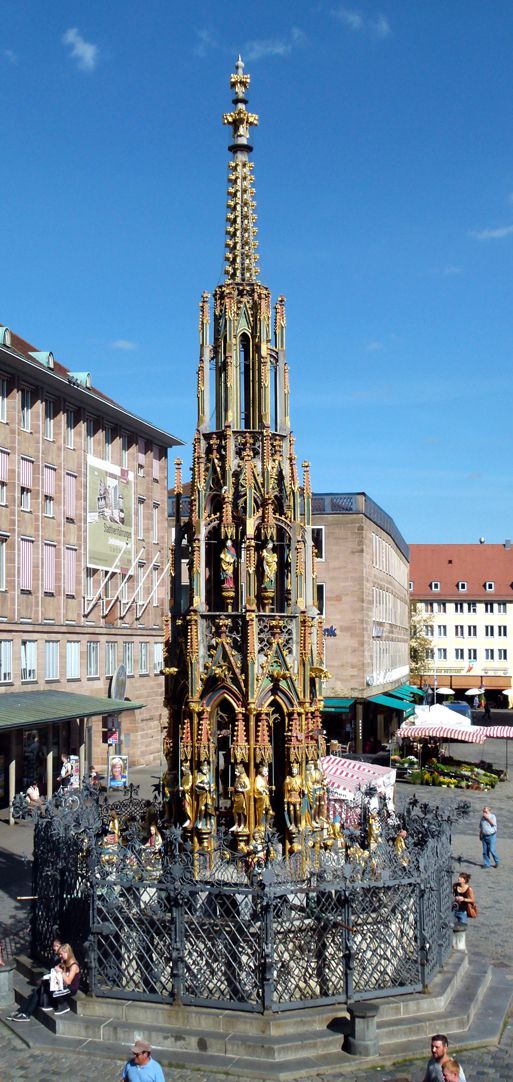
Beautiful fountain
1385 1395
View from the south west
"Parlier" Heinrich is said to have been in charge of the overall design. The original sculptural parts are attributed to several masters. The fountain was repaired two times at the end of the 18th century. It was removed respectively renewed 1821-24, restored in 1835 and finally completely replaced by a valuable copy by Heinrich Wallraff 1897-1902. Original parts of the fountain have been preserved in the German National Museum as have parts of the sculptures in Bodemuseum in Berlin. Whereas the fountain architecture can be considered to be originally Gothic, the statues are but an echo of the originals. The original quality of these sculptures is evident by the fragments that have been preserved, it supersedes by far the quality of the sculptures of the previous period in Nuremberg, it is of much higher quality than the one of the figures at the West portal of St. Lorenz-Church and even of the portal of Our Lady´s Church (Frauenkirche) which was created under the Parlers. Regarding architectural history the tower-shaped fountain is a sensation, it is a micro-architecture, definitely with a secular purpose, but completely designed in sacred form-language. In the following time the fountain was adopted as far away as in the Norman Rouen. Relationships with tabernacles of the Late Gothic Period are evident. Concerning the iconographic program the design of the fountain is highly ambitious. The exclusively male figures are distributed over two tiers at the edge of the basin (allegories of Philosophy, the Seven Liberal Arts, the Four Evangelists and the Four Latin Fathers of the Church), apart from that the figures are distributed over two levels of the octagonal tower. The main level displays the Nine Good Heroes, and Seven Electors, over them the Prophets. The hollow octagon ends in an casing of buttresses with an open-worked tracery helmet. The fountain was explicitly mentioned in 1517 by the Italian Antonio de Beatis, correspondent of Cardinal Luigi d´Aragona. Dr. Pablo de la Riestra
Location: Nuremberg, Hauptmarkt
Design: Parlier (Heinrich Parlirer, Beheim, Bheiheim ), Heinrich
photo 2013, Pablo de la Riestra
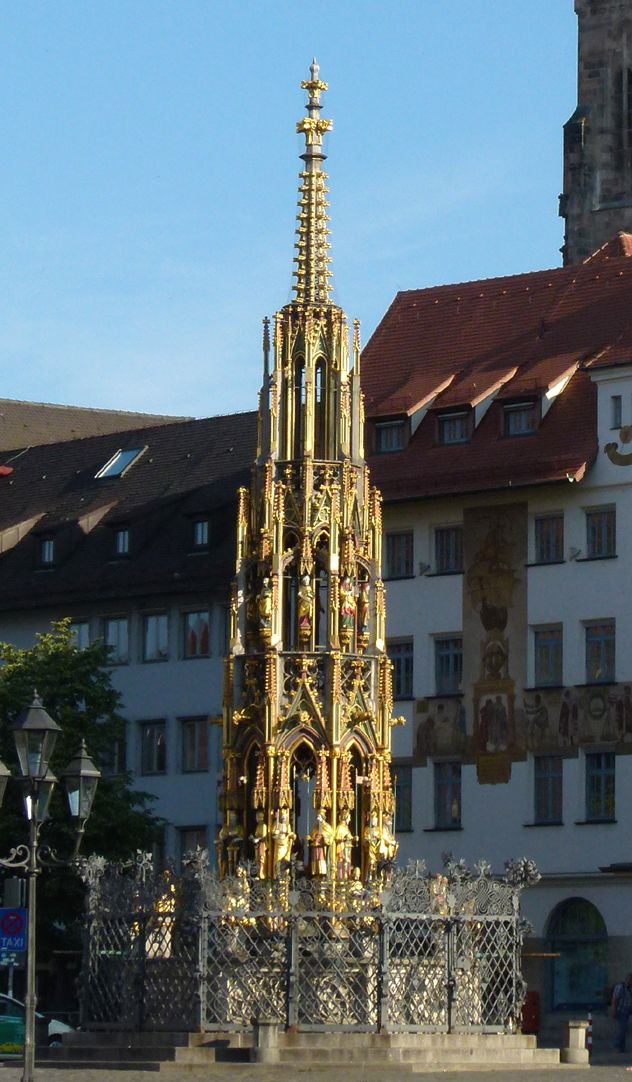
Beautiful fountain
1385 1395
View from the south east
"Parlier" Heinrich is said to have been in charge of the overall design. The original sculptural parts are attributed to several masters. The fountain was repaired two times at the end of the 18th century. It was removed respectively renewed 1821-24, restored in 1835 and finally completely replaced by a valuable copy by Heinrich Wallraff 1897-1902. Original parts of the fountain have been preserved in the German National Museum as have parts of the sculptures in Bodemuseum in Berlin. Whereas the fountain architecture can be considered to be originally Gothic, the statues are but an echo of the originals. The original quality of these sculptures is evident by the fragments that have been preserved, it supersedes by far the quality of the sculptures of the previous period in Nuremberg, it is of much higher quality than the one of the figures at the West portal of St. Lorenz-Church and even of the portal of Our Lady´s Church (Frauenkirche) which was created under the Parlers. Regarding architectural history the tower-shaped fountain is a sensation, it is a micro-architecture, definitely with a secular purpose, but completely designed in sacred form-language. In the following time the fountain was adopted as far away as in the Norman Rouen. Relationships with tabernacles of the Late Gothic Period are evident. Concerning the iconographic program the design of the fountain is highly ambitious. The exclusively male figures are distributed over two tiers at the edge of the basin (allegories of Philosophy, the Seven Liberal Arts, the Four Evangelists and the Four Latin Fathers of the Church), apart from that the figures are distributed over two levels of the octagonal tower. The main level displays the Nine Good Heroes, and Seven Electors, over them the Prophets. The hollow octagon ends in an casing of buttresses with an open-worked tracery helmet. The fountain was explicitly mentioned in 1517 by the Italian Antonio de Beatis, correspondent of Cardinal Luigi d´Aragona. Dr. Pablo de la Riestra
Location: Nuremberg, Hauptmarkt
Design: Parlier (Heinrich Parlirer, Beheim, Bheiheim ), Heinrich
photo 2014, Pablo de la Riestra
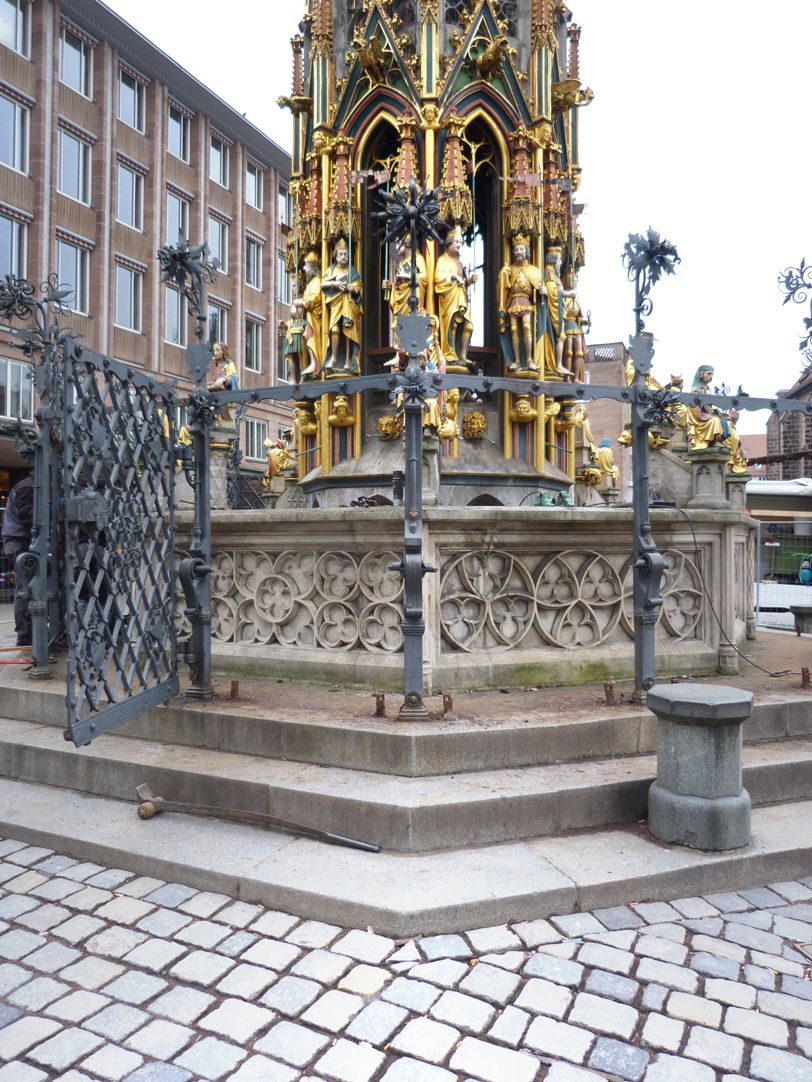
Beautiful fountain
1385 1395
Lower part without grid
"Parlier" Heinrich is said to have been in charge of the overall design. The original sculptural parts are attributed to several masters. The fountain was repaired two times at the end of the 18th century. It was removed respectively renewed 1821-24, restored in 1835 and finally completely replaced by a valuable copy by Heinrich Wallraff 1897-1902. Original parts of the fountain have been preserved in the German National Museum as have parts of the sculptures in Bodemuseum in Berlin. Whereas the fountain architecture can be considered to be originally Gothic, the statues are but an echo of the originals. The original quality of these sculptures is evident by the fragments that have been preserved, it supersedes by far the quality of the sculptures of the previous period in Nuremberg, it is of much higher quality than the one of the figures at the West portal of St. Lorenz-Church and even of the portal of Our Lady´s Church (Frauenkirche) which was created under the Parlers. Regarding architectural history the tower-shaped fountain is a sensation, it is a micro-architecture, definitely with a secular purpose, but completely designed in sacred form-language. In the following time the fountain was adopted as far away as in the Norman Rouen. Relationships with tabernacles of the Late Gothic Period are evident. Concerning the iconographic program the design of the fountain is highly ambitious. The exclusively male figures are distributed over two tiers at the edge of the basin (allegories of Philosophy, the Seven Liberal Arts, the Four Evangelists and the Four Latin Fathers of the Church), apart from that the figures are distributed over two levels of the octagonal tower. The main level displays the Nine Good Heroes, and Seven Electors, over them the Prophets. The hollow octagon ends in an casing of buttresses with an open-worked tracery helmet. The fountain was explicitly mentioned in 1517 by the Italian Antonio de Beatis, correspondent of Cardinal Luigi d´Aragona. Dr. Pablo de la Riestra
Location: Nuremberg, Hauptmarkt
Design: Parlier (Heinrich Parlirer, Beheim, Bheiheim ), Heinrich
photo Feb 2015, Theo Noll
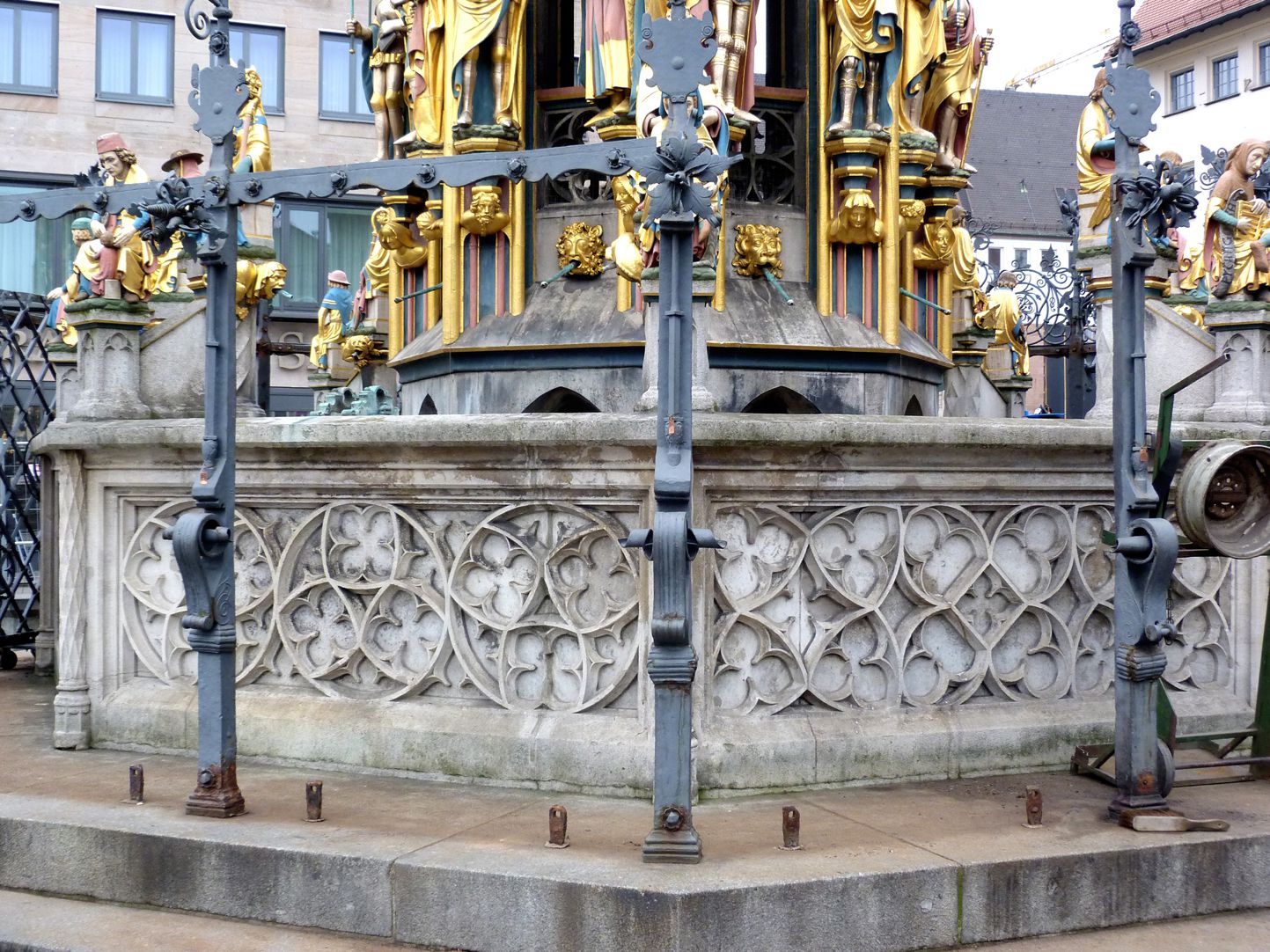
Beautiful fountain
1385 1395
Basin with tracery
"Parlier" Heinrich is said to have been in charge of the overall design. The original sculptural parts are attributed to several masters. The fountain was repaired two times at the end of the 18th century. It was removed respectively renewed 1821-24, restored in 1835 and finally completely replaced by a valuable copy by Heinrich Wallraff 1897-1902. Original parts of the fountain have been preserved in the German National Museum as have parts of the sculptures in Bodemuseum in Berlin. Whereas the fountain architecture can be considered to be originally Gothic, the statues are but an echo of the originals. The original quality of these sculptures is evident by the fragments that have been preserved, it supersedes by far the quality of the sculptures of the previous period in Nuremberg, it is of much higher quality than the one of the figures at the West portal of St. Lorenz-Church and even of the portal of Our Lady´s Church (Frauenkirche) which was created under the Parlers. Regarding architectural history the tower-shaped fountain is a sensation, it is a micro-architecture, definitely with a secular purpose, but completely designed in sacred form-language. In the following time the fountain was adopted as far away as in the Norman Rouen. Relationships with tabernacles of the Late Gothic Period are evident. Concerning the iconographic program the design of the fountain is highly ambitious. The exclusively male figures are distributed over two tiers at the edge of the basin (allegories of Philosophy, the Seven Liberal Arts, the Four Evangelists and the Four Latin Fathers of the Church), apart from that the figures are distributed over two levels of the octagonal tower. The main level displays the Nine Good Heroes, and Seven Electors, over them the Prophets. The hollow octagon ends in an casing of buttresses with an open-worked tracery helmet. The fountain was explicitly mentioned in 1517 by the Italian Antonio de Beatis, correspondent of Cardinal Luigi d´Aragona. Dr. Pablo de la Riestra
Location: Nuremberg, Hauptmarkt
Design: Parlier (Heinrich Parlirer, Beheim, Bheiheim ), Heinrich
photo Feb 2015, Theo Noll
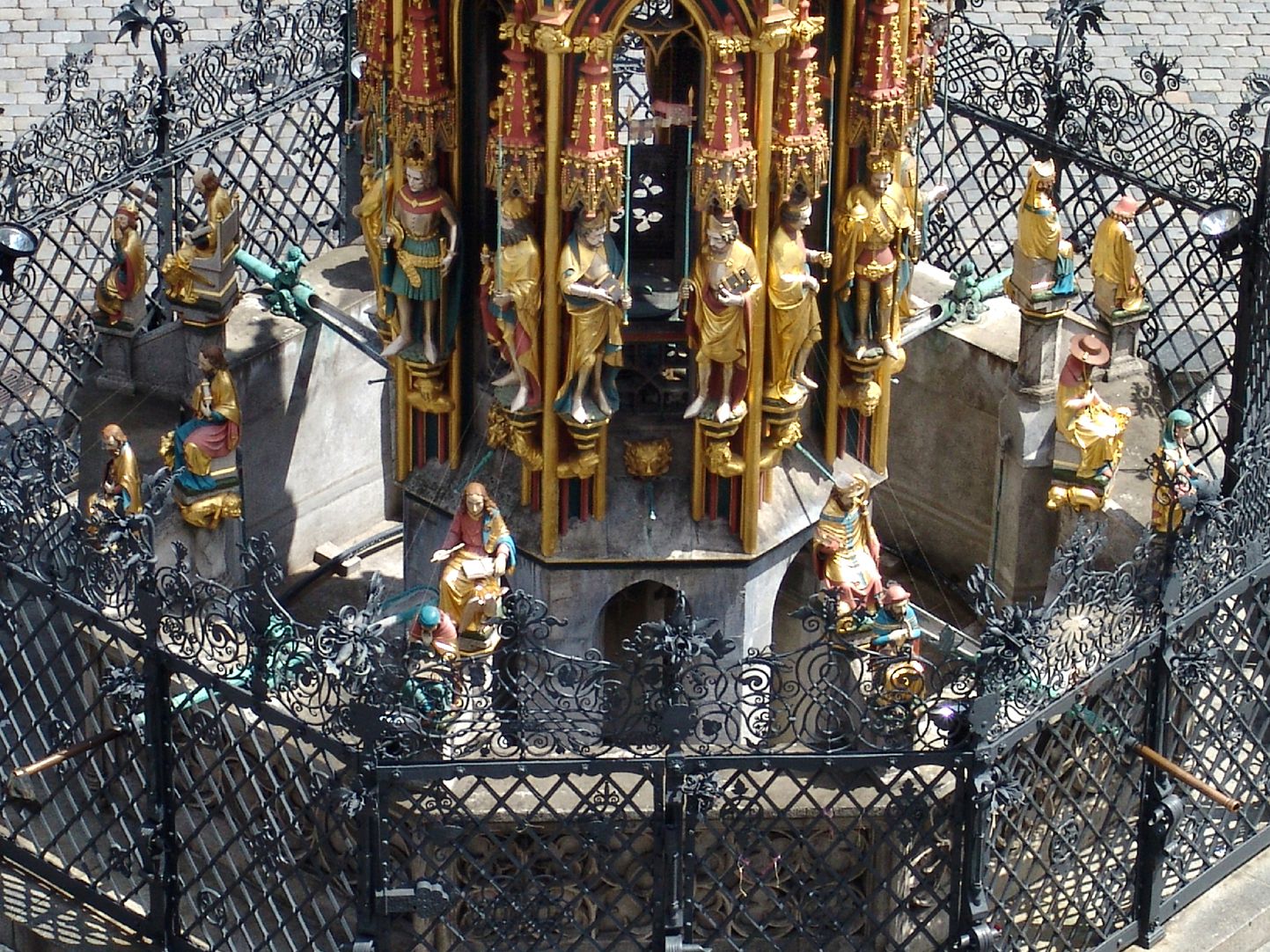
Beautiful fountain
1385 1395
Basin with lower part of the fountain tower
"Parlier" Heinrich is said to have been in charge of the overall design. The original sculptural parts are attributed to several masters. The fountain was repaired two times at the end of the 18th century. It was removed respectively renewed 1821-24, restored in 1835 and finally completely replaced by a valuable copy by Heinrich Wallraff 1897-1902. Original parts of the fountain have been preserved in the German National Museum as have parts of the sculptures in Bodemuseum in Berlin. Whereas the fountain architecture can be considered to be originally Gothic, the statues are but an echo of the originals. The original quality of these sculptures is evident by the fragments that have been preserved, it supersedes by far the quality of the sculptures of the previous period in Nuremberg, it is of much higher quality than the one of the figures at the West portal of St. Lorenz-Church and even of the portal of Our Lady´s Church (Frauenkirche) which was created under the Parlers. Regarding architectural history the tower-shaped fountain is a sensation, it is a micro-architecture, definitely with a secular purpose, but completely designed in sacred form-language. In the following time the fountain was adopted as far away as in the Norman Rouen. Relationships with tabernacles of the Late Gothic Period are evident. Concerning the iconographic program the design of the fountain is highly ambitious. The exclusively male figures are distributed over two tiers at the edge of the basin (allegories of Philosophy, the Seven Liberal Arts, the Four Evangelists and the Four Latin Fathers of the Church), apart from that the figures are distributed over two levels of the octagonal tower. The main level displays the Nine Good Heroes, and Seven Electors, over them the Prophets. The hollow octagon ends in an casing of buttresses with an open-worked tracery helmet. The fountain was explicitly mentioned in 1517 by the Italian Antonio de Beatis, correspondent of Cardinal Luigi d´Aragona. Dr. Pablo de la Riestra
Location: Nuremberg, Hauptmarkt
Design: Parlier (Heinrich Parlirer, Beheim, Bheiheim ), Heinrich
photo 2007, Pablo de la Riestra
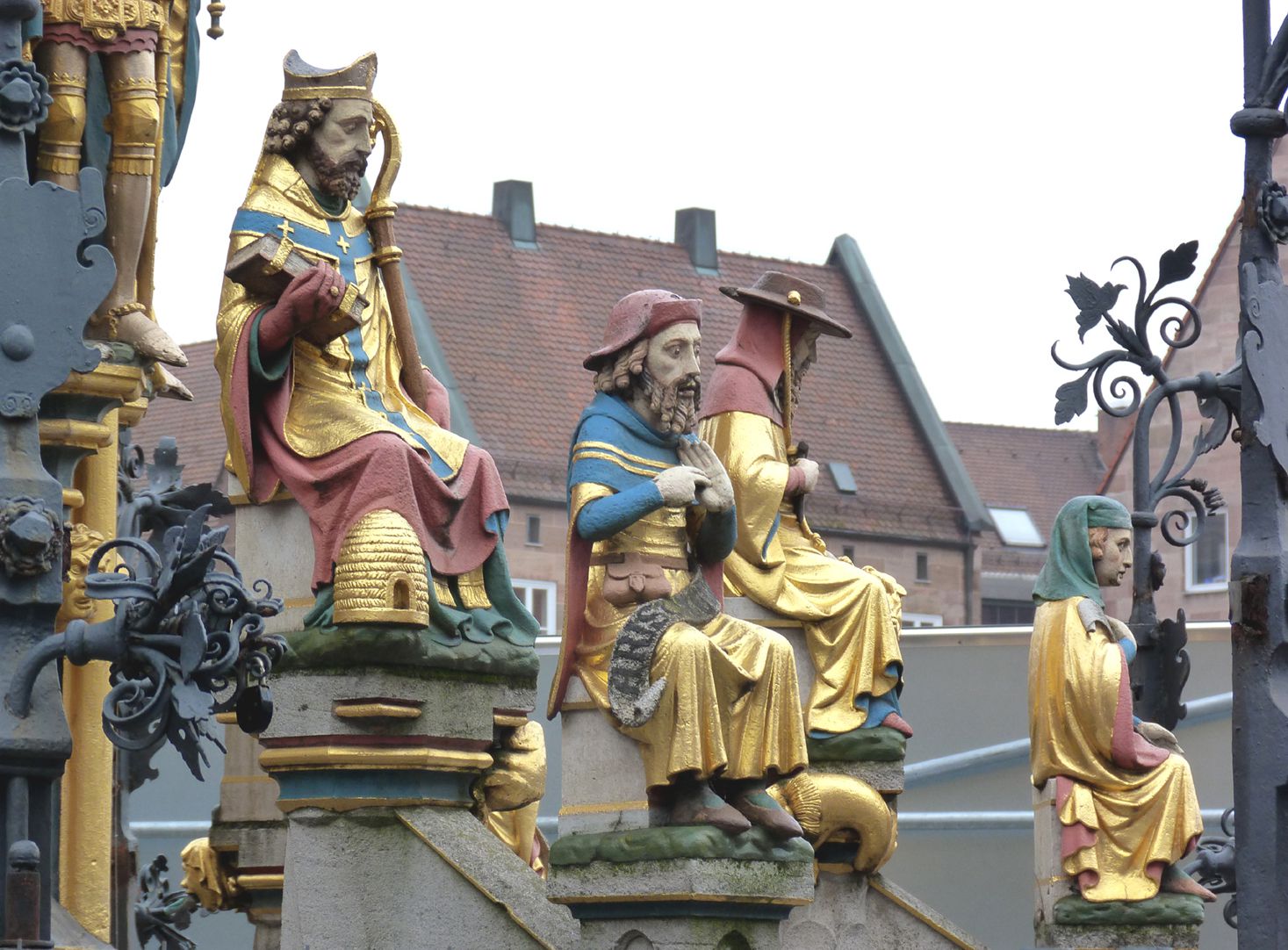
Beautiful fountain
1385 1395
Detail, two tiers of figures at the edge of the basin
"Parlier" Heinrich is said to have been in charge of the overall design. The original sculptural parts are attributed to several masters. The fountain was repaired two times at the end of the 18th century. It was removed respectively renewed 1821-24, restored in 1835 and finally completely replaced by a valuable copy by Heinrich Wallraff 1897-1902. Original parts of the fountain have been preserved in the German National Museum as have parts of the sculptures in Bodemuseum in Berlin. Whereas the fountain architecture can be considered to be originally Gothic, the statues are but an echo of the originals. The original quality of these sculptures is evident by the fragments that have been preserved, it supersedes by far the quality of the sculptures of the previous period in Nuremberg, it is of much higher quality than the one of the figures at the West portal of St. Lorenz-Church and even of the portal of Our Lady´s Church (Frauenkirche) which was created under the Parlers. Regarding architectural history the tower-shaped fountain is a sensation, it is a micro-architecture, definitely with a secular purpose, but completely designed in sacred form-language. In the following time the fountain was adopted as far away as in the Norman Rouen. Relationships with tabernacles of the Late Gothic Period are evident. Concerning the iconographic program the design of the fountain is highly ambitious. The exclusively male figures are distributed over two tiers at the edge of the basin (allegories of Philosophy, the Seven Liberal Arts, the Four Evangelists and the Four Latin Fathers of the Church), apart from that the figures are distributed over two levels of the octagonal tower. The main level displays the Nine Good Heroes, and Seven Electors, over them the Prophets. The hollow octagon ends in an casing of buttresses with an open-worked tracery helmet. The fountain was explicitly mentioned in 1517 by the Italian Antonio de Beatis, correspondent of Cardinal Luigi d´Aragona. Dr. Pablo de la Riestra
Location: Nuremberg, Hauptmarkt
Design: Parlier (Heinrich Parlirer, Beheim, Bheiheim ), Heinrich
photo Feb 2015, Theo Noll
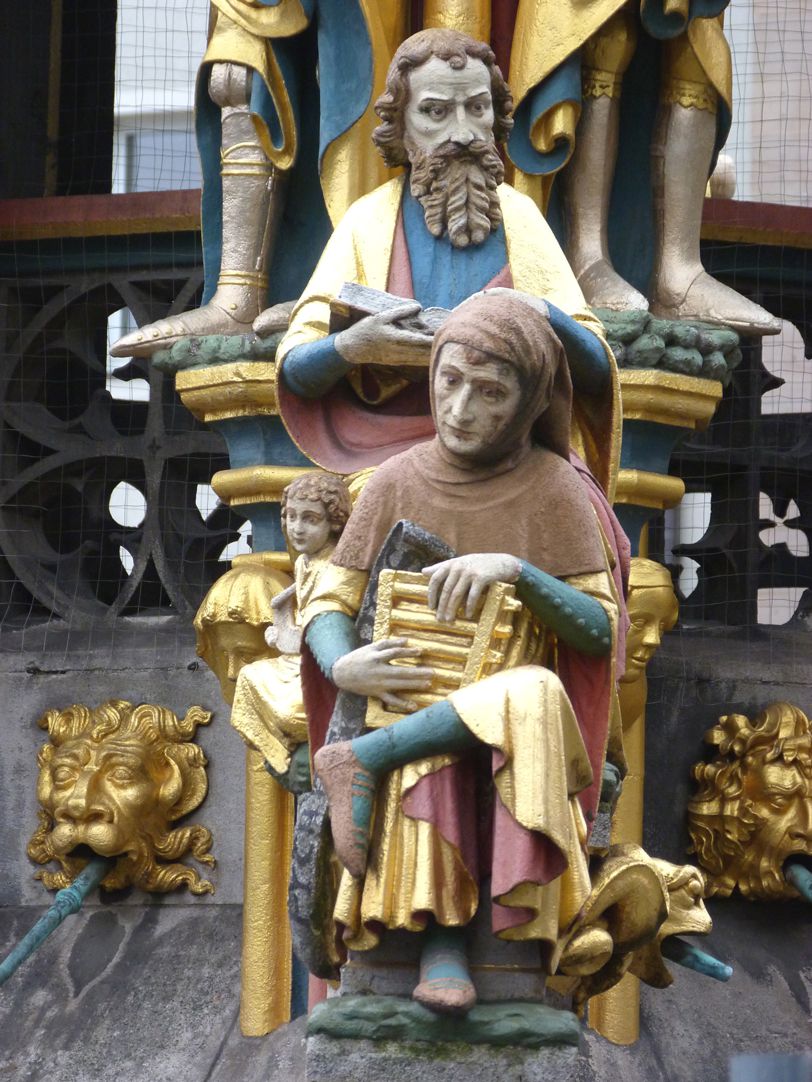
Beautiful fountain
1385 1395
Figures of the lower tiers at the edge of the basin
"Parlier" Heinrich is said to have been in charge of the overall design. The original sculptural parts are attributed to several masters. The fountain was repaired two times at the end of the 18th century. It was removed respectively renewed 1821-24, restored in 1835 and finally completely replaced by a valuable copy by Heinrich Wallraff 1897-1902. Original parts of the fountain have been preserved in the German National Museum as have parts of the sculptures in Bodemuseum in Berlin. Whereas the fountain architecture can be considered to be originally Gothic, the statues are but an echo of the originals. The original quality of these sculptures is evident by the fragments that have been preserved, it supersedes by far the quality of the sculptures of the previous period in Nuremberg, it is of much higher quality than the one of the figures at the West portal of St. Lorenz-Church and even of the portal of Our Lady´s Church (Frauenkirche) which was created under the Parlers. Regarding architectural history the tower-shaped fountain is a sensation, it is a micro-architecture, definitely with a secular purpose, but completely designed in sacred form-language. In the following time the fountain was adopted as far away as in the Norman Rouen. Relationships with tabernacles of the Late Gothic Period are evident. Concerning the iconographic program the design of the fountain is highly ambitious. The exclusively male figures are distributed over two tiers at the edge of the basin (allegories of Philosophy, the Seven Liberal Arts, the Four Evangelists and the Four Latin Fathers of the Church), apart from that the figures are distributed over two levels of the octagonal tower. The main level displays the Nine Good Heroes, and Seven Electors, over them the Prophets. The hollow octagon ends in an casing of buttresses with an open-worked tracery helmet. The fountain was explicitly mentioned in 1517 by the Italian Antonio de Beatis, correspondent of Cardinal Luigi d´Aragona. Dr. Pablo de la Riestra
Location: Nuremberg, Hauptmarkt
Design: Parlier (Heinrich Parlirer, Beheim, Bheiheim ), Heinrich
photo Feb 2015, Pablo de la Riestra
Beautiful fountain
1385 1395
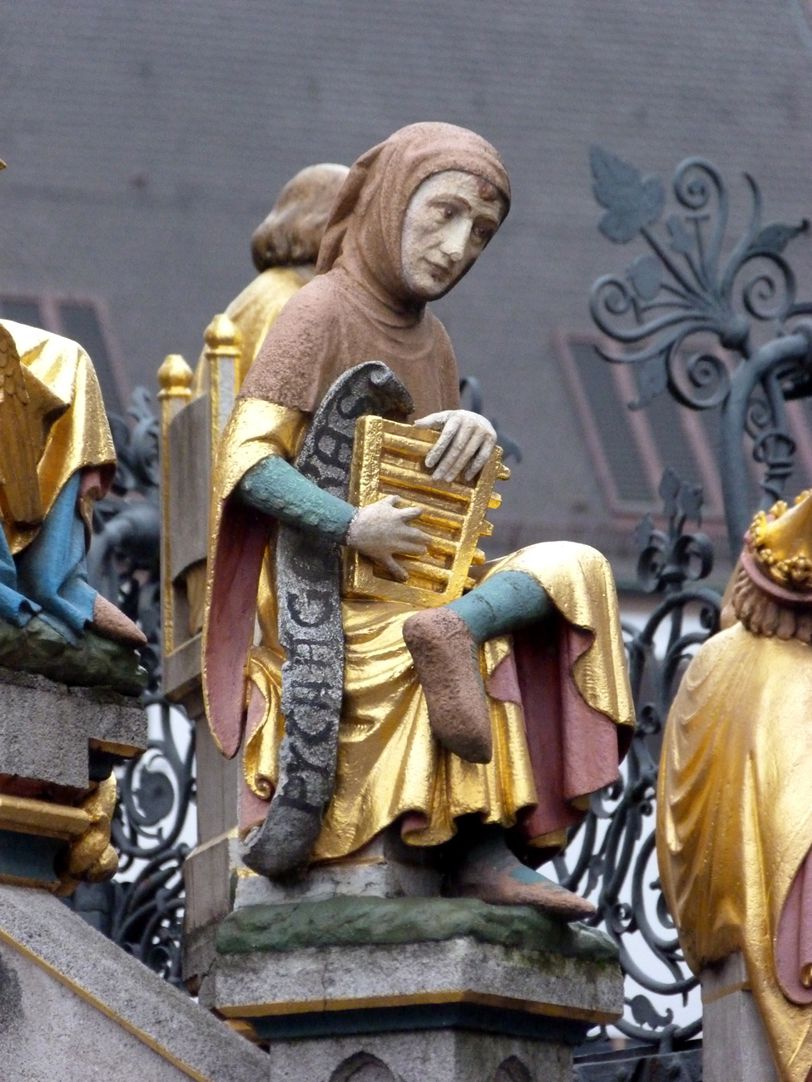
Edge of the basin: Pythagoras
"Parlier" Heinrich is said to have been in charge of the overall design. The original sculptural parts are attributed to several masters. The fountain was repaired two times at the end of the 18th century. It was removed respectively renewed 1821-24, restored in 1835 and finally completely replaced by a valuable copy by Heinrich Wallraff 1897-1902. Original parts of the fountain have been preserved in the German National Museum as have parts of the sculptures in Bodemuseum in Berlin. Whereas the fountain architecture can be considered to be originally Gothic, the statues are but an echo of the originals. The original quality of these sculptures is evident by the fragments that have been preserved, it supersedes by far the quality of the sculptures of the previous period in Nuremberg, it is of much higher quality than the one of the figures at the West portal of St. Lorenz-Church and even of the portal of Our Lady´s Church (Frauenkirche) which was created under the Parlers. Regarding architectural history the tower-shaped fountain is a sensation, it is a micro-architecture, definitely with a secular purpose, but completely designed in sacred form-language. In the following time the fountain was adopted as far away as in the Norman Rouen. Relationships with tabernacles of the Late Gothic Period are evident. Concerning the iconographic program the design of the fountain is highly ambitious. The exclusively male figures are distributed over two tiers at the edge of the basin (allegories of Philosophy, the Seven Liberal Arts, the Four Evangelists and the Four Latin Fathers of the Church), apart from that the figures are distributed over two levels of the octagonal tower. The main level displays the Nine Good Heroes, and Seven Electors, over them the Prophets. The hollow octagon ends in an casing of buttresses with an open-worked tracery helmet. The fountain was explicitly mentioned in 1517 by the Italian Antonio de Beatis, correspondent of Cardinal Luigi d´Aragona. Dr. Pablo de la Riestra
Location: Nuremberg, Hauptmarkt
Design: Parlier (Heinrich Parlirer, Beheim, Bheiheim ), Heinrich
photo Feb 2015, Theo Noll
Beautiful fountain
1385 1395
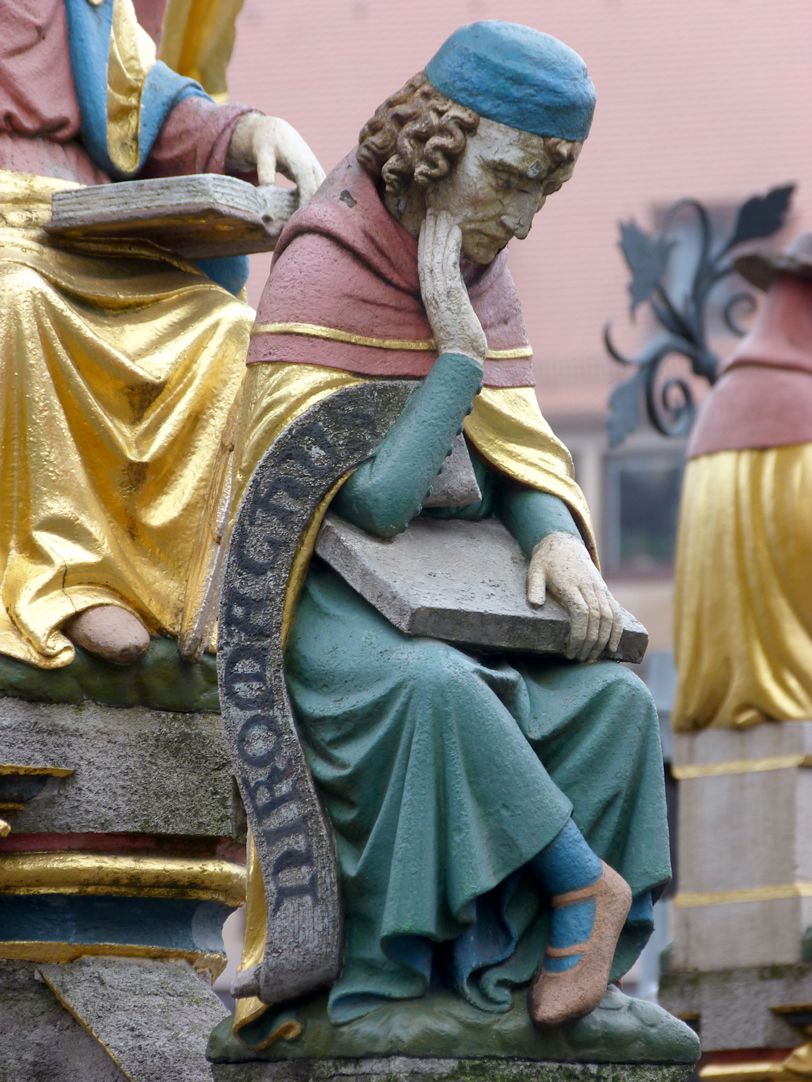
Edge of the basin: Nicomachus
"Parlier" Heinrich is said to have been in charge of the overall design. The original sculptural parts are attributed to several masters. The fountain was repaired two times at the end of the 18th century. It was removed respectively renewed 1821-24, restored in 1835 and finally completely replaced by a valuable copy by Heinrich Wallraff 1897-1902. Original parts of the fountain have been preserved in the German National Museum as have parts of the sculptures in Bodemuseum in Berlin. Whereas the fountain architecture can be considered to be originally Gothic, the statues are but an echo of the originals. The original quality of these sculptures is evident by the fragments that have been preserved, it supersedes by far the quality of the sculptures of the previous period in Nuremberg, it is of much higher quality than the one of the figures at the West portal of St. Lorenz-Church and even of the portal of Our Lady´s Church (Frauenkirche) which was created under the Parlers. Regarding architectural history the tower-shaped fountain is a sensation, it is a micro-architecture, definitely with a secular purpose, but completely designed in sacred form-language. In the following time the fountain was adopted as far away as in the Norman Rouen. Relationships with tabernacles of the Late Gothic Period are evident. Concerning the iconographic program the design of the fountain is highly ambitious. The exclusively male figures are distributed over two tiers at the edge of the basin (allegories of Philosophy, the Seven Liberal Arts, the Four Evangelists and the Four Latin Fathers of the Church), apart from that the figures are distributed over two levels of the octagonal tower. The main level displays the Nine Good Heroes, and Seven Electors, over them the Prophets. The hollow octagon ends in an casing of buttresses with an open-worked tracery helmet. The fountain was explicitly mentioned in 1517 by the Italian Antonio de Beatis, correspondent of Cardinal Luigi d´Aragona. Dr. Pablo de la Riestra
Location: Nuremberg, Hauptmarkt
Design: Parlier (Heinrich Parlirer, Beheim, Bheiheim ), Heinrich
photo Feb 2015, Theo Noll
Beautiful fountain
1385 1395
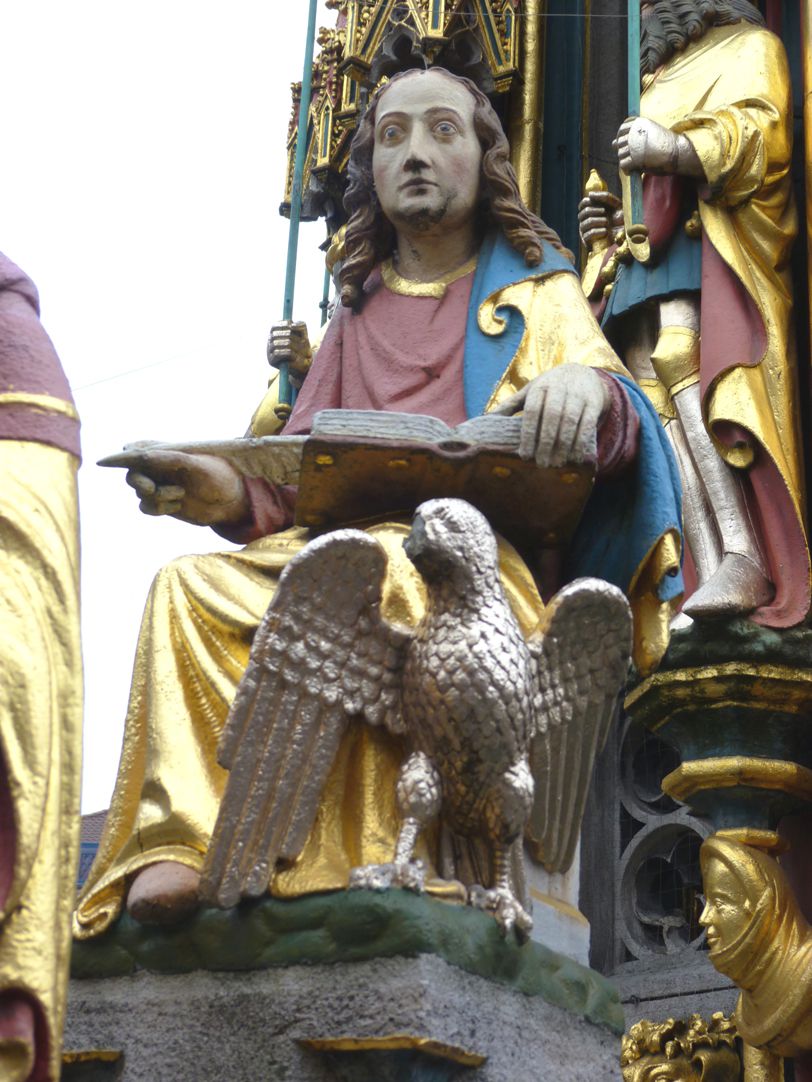
Upper edge of the basin: John Evangelist
"Parlier" Heinrich is said to have been in charge of the overall design. The original sculptural parts are attributed to several masters. The fountain was repaired two times at the end of the 18th century. It was removed respectively renewed 1821-24, restored in 1835 and finally completely replaced by a valuable copy by Heinrich Wallraff 1897-1902. Original parts of the fountain have been preserved in the German National Museum as have parts of the sculptures in Bodemuseum in Berlin. Whereas the fountain architecture can be considered to be originally Gothic, the statues are but an echo of the originals. The original quality of these sculptures is evident by the fragments that have been preserved, it supersedes by far the quality of the sculptures of the previous period in Nuremberg, it is of much higher quality than the one of the figures at the West portal of St. Lorenz-Church and even of the portal of Our Lady´s Church (Frauenkirche) which was created under the Parlers. Regarding architectural history the tower-shaped fountain is a sensation, it is a micro-architecture, definitely with a secular purpose, but completely designed in sacred form-language. In the following time the fountain was adopted as far away as in the Norman Rouen. Relationships with tabernacles of the Late Gothic Period are evident. Concerning the iconographic program the design of the fountain is highly ambitious. The exclusively male figures are distributed over two tiers at the edge of the basin (allegories of Philosophy, the Seven Liberal Arts, the Four Evangelists and the Four Latin Fathers of the Church), apart from that the figures are distributed over two levels of the octagonal tower. The main level displays the Nine Good Heroes, and Seven Electors, over them the Prophets. The hollow octagon ends in an casing of buttresses with an open-worked tracery helmet. The fountain was explicitly mentioned in 1517 by the Italian Antonio de Beatis, correspondent of Cardinal Luigi d´Aragona. Dr. Pablo de la Riestra
Location: Nuremberg, Hauptmarkt
Design: Parlier (Heinrich Parlirer, Beheim, Bheiheim ), Heinrich
photo Feb 2015, Pablo de la Riestra
Beautiful fountain
1385 1395
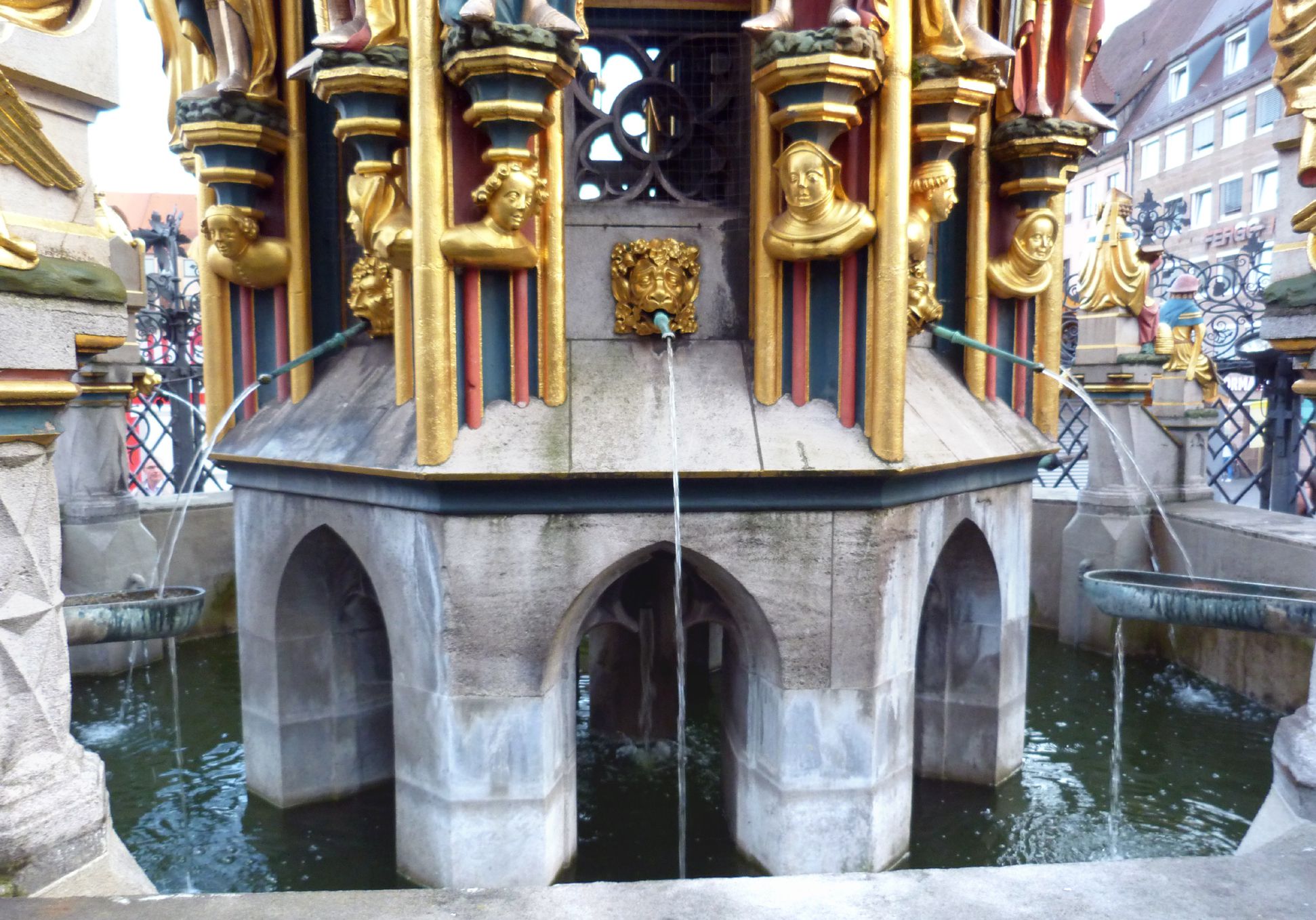
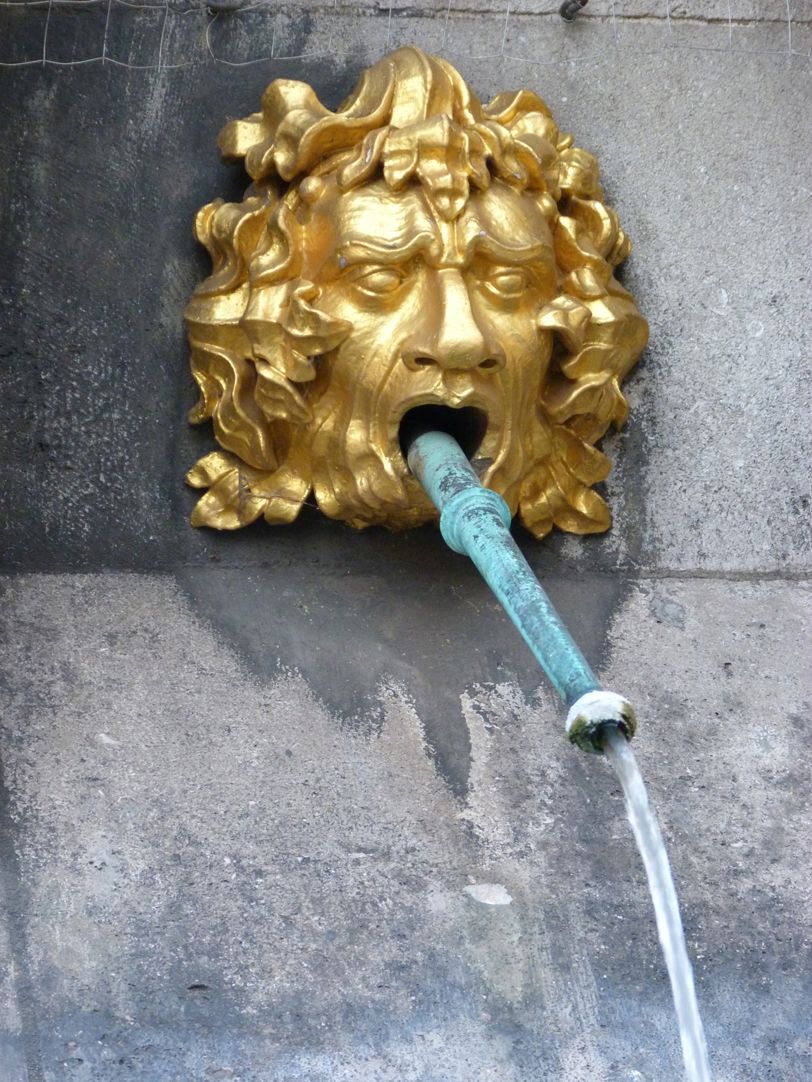
Octagonal basis with masks
photo 2014, Pablo de la Riestra
"Parlier" Heinrich is said to have been in charge of the overall design. The original sculptural parts are attributed to several masters. The fountain was repaired two times at the end of the 18th century. It was removed respectively renewed 1821-24, restored in 1835 and finally completely replaced by a valuable copy by Heinrich Wallraff 1897-1902. Original parts of the fountain have been preserved in the German National Museum as have parts of the sculptures in Bodemuseum in Berlin. Whereas the fountain architecture can be considered to be originally Gothic, the statues are but an echo of the originals. The original quality of these sculptures is evident by the fragments that have been preserved, it supersedes by far the quality of the sculptures of the previous period in Nuremberg, it is of much higher quality than the one of the figures at the West portal of St. Lorenz-Church and even of the portal of Our Lady´s Church (Frauenkirche) which was created under the Parlers. Regarding architectural history the tower-shaped fountain is a sensation, it is a micro-architecture, definitely with a secular purpose, but completely designed in sacred form-language. In the following time the fountain was adopted as far away as in the Norman Rouen. Relationships with tabernacles of the Late Gothic Period are evident. Concerning the iconographic program the design of the fountain is highly ambitious. The exclusively male figures are distributed over two tiers at the edge of the basin (allegories of Philosophy, the Seven Liberal Arts, the Four Evangelists and the Four Latin Fathers of the Church), apart from that the figures are distributed over two levels of the octagonal tower. The main level displays the Nine Good Heroes, and Seven Electors, over them the Prophets. The hollow octagon ends in an casing of buttresses with an open-worked tracery helmet. The fountain was explicitly mentioned in 1517 by the Italian Antonio de Beatis, correspondent of Cardinal Luigi d´Aragona. Dr. Pablo de la Riestra
Location: Nuremberg, Hauptmarkt
Design: Parlier (Heinrich Parlirer, Beheim, Bheiheim ), Heinrich
Beautiful fountain
1385 1395
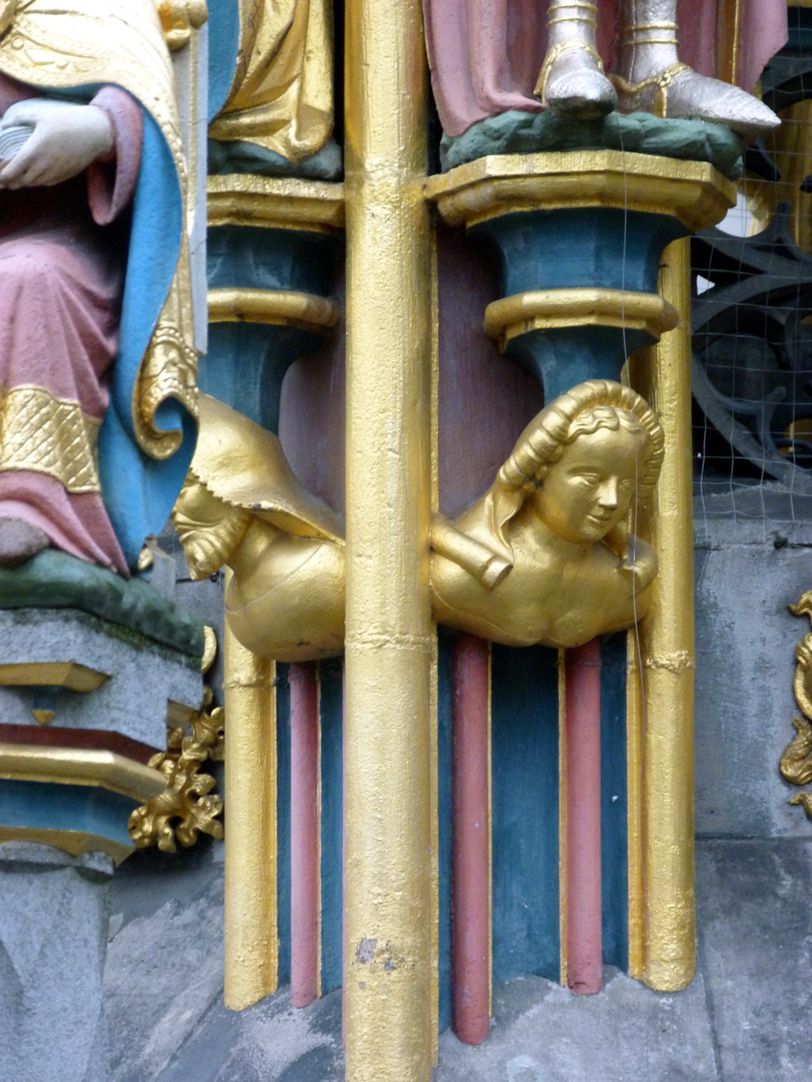
Mask at the octagonal basis
"Parlier" Heinrich is said to have been in charge of the overall design. The original sculptural parts are attributed to several masters. The fountain was repaired two times at the end of the 18th century. It was removed respectively renewed 1821-24, restored in 1835 and finally completely replaced by a valuable copy by Heinrich Wallraff 1897-1902. Original parts of the fountain have been preserved in the German National Museum as have parts of the sculptures in Bodemuseum in Berlin. Whereas the fountain architecture can be considered to be originally Gothic, the statues are but an echo of the originals. The original quality of these sculptures is evident by the fragments that have been preserved, it supersedes by far the quality of the sculptures of the previous period in Nuremberg, it is of much higher quality than the one of the figures at the West portal of St. Lorenz-Church and even of the portal of Our Lady´s Church (Frauenkirche) which was created under the Parlers. Regarding architectural history the tower-shaped fountain is a sensation, it is a micro-architecture, definitely with a secular purpose, but completely designed in sacred form-language. In the following time the fountain was adopted as far away as in the Norman Rouen. Relationships with tabernacles of the Late Gothic Period are evident. Concerning the iconographic program the design of the fountain is highly ambitious. The exclusively male figures are distributed over two tiers at the edge of the basin (allegories of Philosophy, the Seven Liberal Arts, the Four Evangelists and the Four Latin Fathers of the Church), apart from that the figures are distributed over two levels of the octagonal tower. The main level displays the Nine Good Heroes, and Seven Electors, over them the Prophets. The hollow octagon ends in an casing of buttresses with an open-worked tracery helmet. The fountain was explicitly mentioned in 1517 by the Italian Antonio de Beatis, correspondent of Cardinal Luigi d´Aragona. Dr. Pablo de la Riestra
Location: Nuremberg, Hauptmarkt
Design: Parlier (Heinrich Parlirer, Beheim, Bheiheim ), Heinrich
photo 2014, Theo Noll
Beautiful fountain
1385 1395
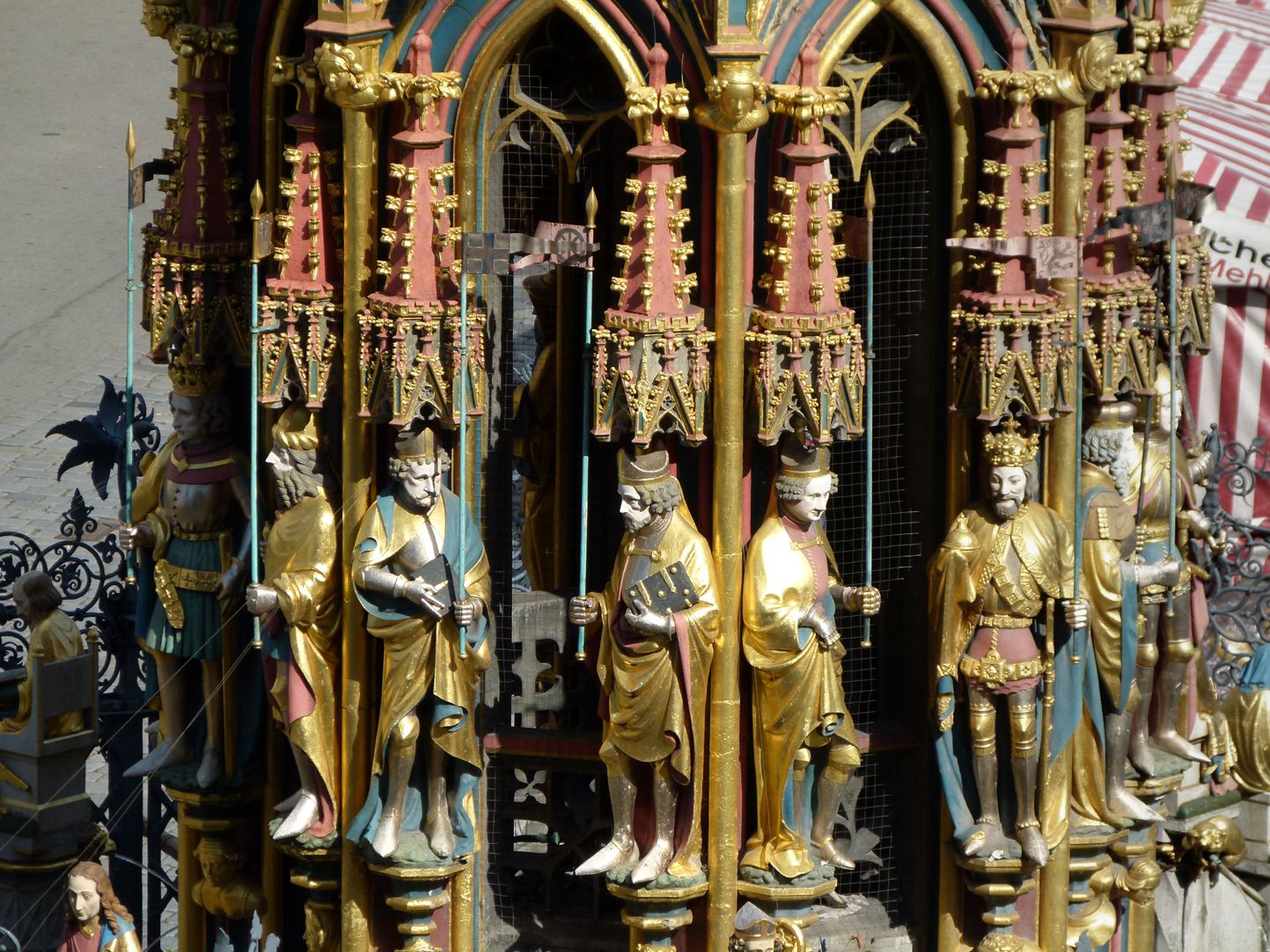
Detail: Busts at the lower octagonal tier
"Parlier" Heinrich is said to have been in charge of the overall design. The original sculptural parts are attributed to several masters. The fountain was repaired two times at the end of the 18th century. It was removed respectively renewed 1821-24, restored in 1835 and finally completely replaced by a valuable copy by Heinrich Wallraff 1897-1902. Original parts of the fountain have been preserved in the German National Museum as have parts of the sculptures in Bodemuseum in Berlin. Whereas the fountain architecture can be considered to be originally Gothic, the statues are but an echo of the originals. The original quality of these sculptures is evident by the fragments that have been preserved, it supersedes by far the quality of the sculptures of the previous period in Nuremberg, it is of much higher quality than the one of the figures at the West portal of St. Lorenz-Church and even of the portal of Our Lady´s Church (Frauenkirche) which was created under the Parlers. Regarding architectural history the tower-shaped fountain is a sensation, it is a micro-architecture, definitely with a secular purpose, but completely designed in sacred form-language. In the following time the fountain was adopted as far away as in the Norman Rouen. Relationships with tabernacles of the Late Gothic Period are evident. Concerning the iconographic program the design of the fountain is highly ambitious. The exclusively male figures are distributed over two tiers at the edge of the basin (allegories of Philosophy, the Seven Liberal Arts, the Four Evangelists and the Four Latin Fathers of the Church), apart from that the figures are distributed over two levels of the octagonal tower. The main level displays the Nine Good Heroes, and Seven Electors, over them the Prophets. The hollow octagon ends in an casing of buttresses with an open-worked tracery helmet. The fountain was explicitly mentioned in 1517 by the Italian Antonio de Beatis, correspondent of Cardinal Luigi d´Aragona. Dr. Pablo de la Riestra
Location: Nuremberg, Hauptmarkt
Design: Parlier (Heinrich Parlirer, Beheim, Bheiheim ), Heinrich
photo 2015, Pablo de la Riestra
Beautiful fountain
1385 1395
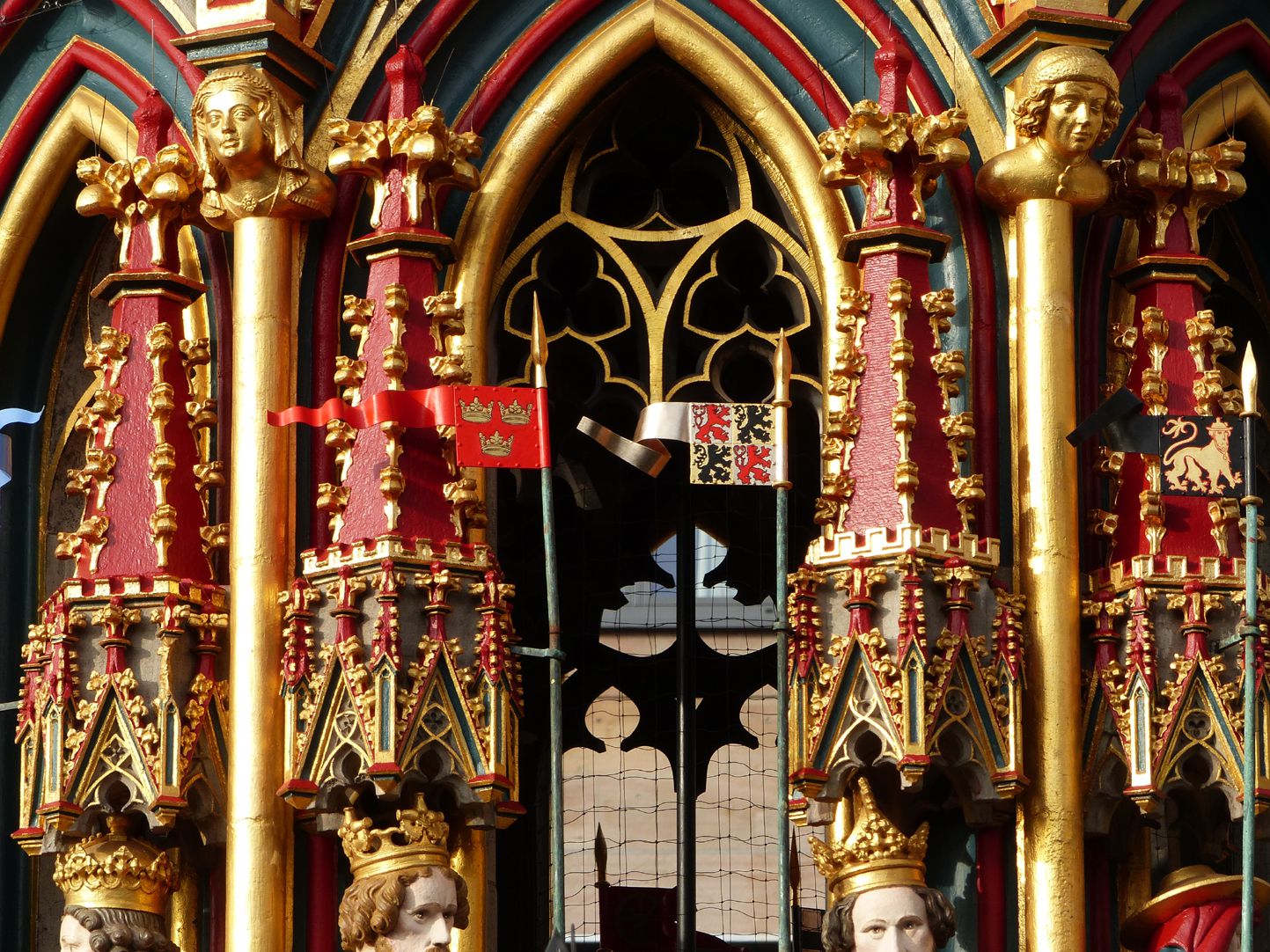
Main level with the Nine Good Heroes and the seven Electors
"Parlier" Heinrich is said to have been in charge of the overall design. The original sculptural parts are attributed to several masters. The fountain was repaired two times at the end of the 18th century. It was removed respectively renewed 1821-24, restored in 1835 and finally completely replaced by a valuable copy by Heinrich Wallraff 1897-1902. Original parts of the fountain have been preserved in the German National Museum as have parts of the sculptures in Bodemuseum in Berlin. Whereas the fountain architecture can be considered to be originally Gothic, the statues are but an echo of the originals. The original quality of these sculptures is evident by the fragments that have been preserved, it supersedes by far the quality of the sculptures of the previous period in Nuremberg, it is of much higher quality than the one of the figures at the West portal of St. Lorenz-Church and even of the portal of Our Lady´s Church (Frauenkirche) which was created under the Parlers. Regarding architectural history the tower-shaped fountain is a sensation, it is a micro-architecture, definitely with a secular purpose, but completely designed in sacred form-language. In the following time the fountain was adopted as far away as in the Norman Rouen. Relationships with tabernacles of the Late Gothic Period are evident. Concerning the iconographic program the design of the fountain is highly ambitious. The exclusively male figures are distributed over two tiers at the edge of the basin (allegories of Philosophy, the Seven Liberal Arts, the Four Evangelists and the Four Latin Fathers of the Church), apart from that the figures are distributed over two levels of the octagonal tower. The main level displays the Nine Good Heroes, and Seven Electors, over them the Prophets. The hollow octagon ends in an casing of buttresses with an open-worked tracery helmet. The fountain was explicitly mentioned in 1517 by the Italian Antonio de Beatis, correspondent of Cardinal Luigi d´Aragona. Dr. Pablo de la Riestra
Location: Nuremberg, Hauptmarkt
Design: Parlier (Heinrich Parlirer, Beheim, Bheiheim ), Heinrich
photo 2013, Pablo de la Riestra
Beautiful fountain
1385 1395
State today, detail: Pinnacles and little flags of the Electors and the Good Heroes with recognizable heraldic figures
"Parlier" Heinrich is said to have been in charge of the overall design. The original sculptural parts are attributed to several masters. The fountain was repaired two times at the end of the 18th century. It was removed respectively renewed 1821-24, restored in 1835 and finally completely replaced by a valuable copy by Heinrich Wallraff 1897-1902. Original parts of the fountain have been preserved in the German National Museum as have parts of the sculptures in Bodemuseum in Berlin. Whereas the fountain architecture can be considered to be originally Gothic, the statues are but an echo of the originals. The original quality of these sculptures is evident by the fragments that have been preserved, it supersedes by far the quality of the sculptures of the previous period in Nuremberg, it is of much higher quality than the one of the figures at the West portal of St. Lorenz-Church and even of the portal of Our Lady´s Church (Frauenkirche) which was created under the Parlers. Regarding architectural history the tower-shaped fountain is a sensation, it is a micro-architecture, definitely with a secular purpose, but completely designed in sacred form-language. In the following time the fountain was adopted as far away as in the Norman Rouen. Relationships with tabernacles of the Late Gothic Period are evident. Concerning the iconographic program the design of the fountain is highly ambitious. The exclusively male figures are distributed over two tiers at the edge of the basin (allegories of Philosophy, the Seven Liberal Arts, the Four Evangelists and the Four Latin Fathers of the Church), apart from that the figures are distributed over two levels of the octagonal tower. The main level displays the Nine Good Heroes, and Seven Electors, over them the Prophets. The hollow octagon ends in an casing of buttresses with an open-worked tracery helmet. The fountain was explicitly mentioned in 1517 by the Italian Antonio de Beatis, correspondent of Cardinal Luigi d´Aragona. Dr. Pablo de la Riestra
Location: Nuremberg, Hauptmarkt
Design: Parlier (Heinrich Parlirer, Beheim, Bheiheim ), Heinrich
photo 11. Nov 2016, Pablo de la Riestra
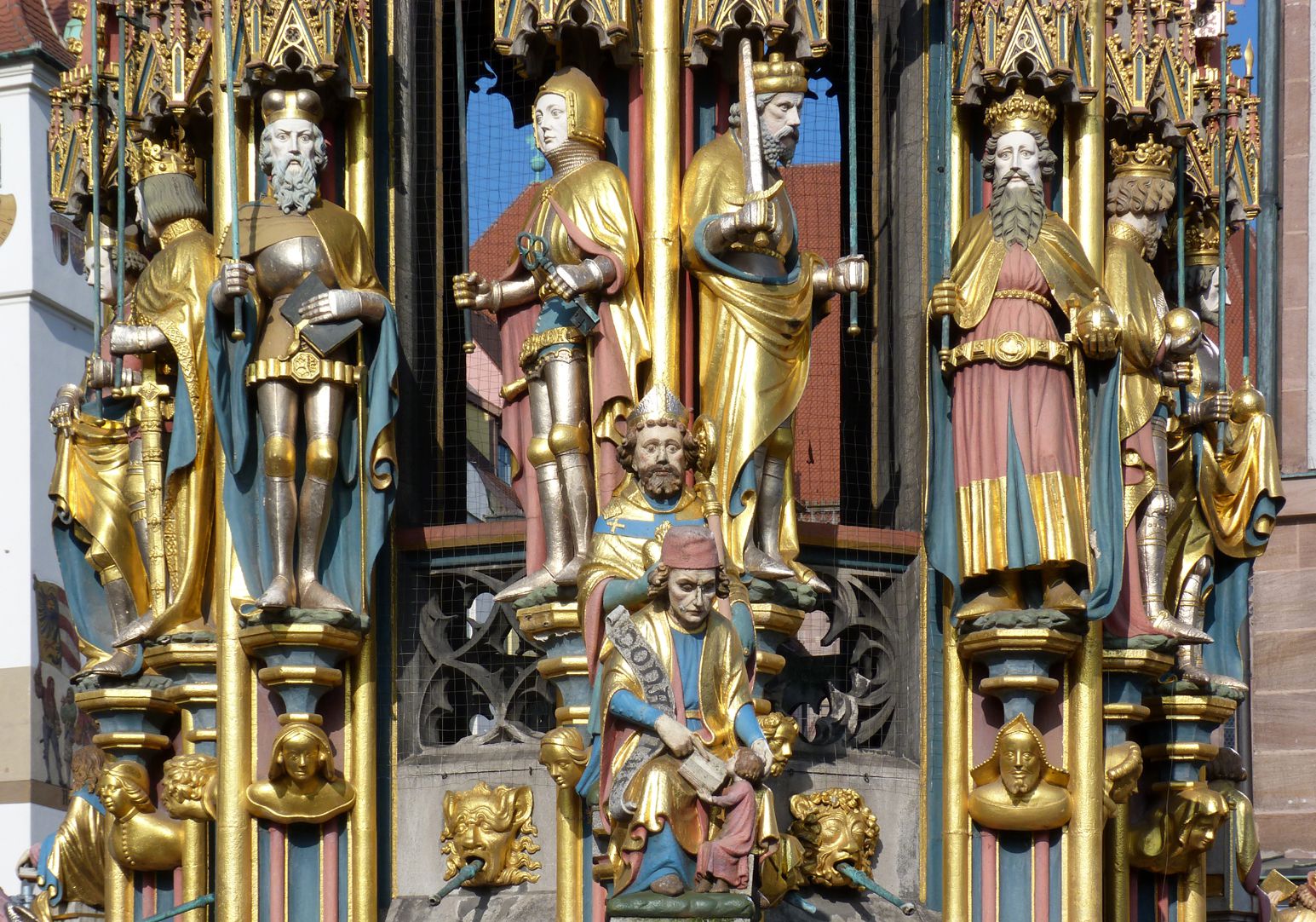
Beautiful fountain
1385 1395
Main level from left to right: King of Bohemia, Count Palatine of Rhine, Margrave of Brandenburg, Duke of Saxony, Charles the Great and King Arthur
photo Feb 2015, Pablo de la Riestra
"Parlier" Heinrich is said to have been in charge of the overall design. The original sculptural parts are attributed to several masters. The fountain was repaired two times at the end of the 18th century. It was removed respectively renewed 1821-24, restored in 1835 and finally completely replaced by a valuable copy by Heinrich Wallraff 1897-1902. Original parts of the fountain have been preserved in the German National Museum as have parts of the sculptures in Bodemuseum in Berlin. Whereas the fountain architecture can be considered to be originally Gothic, the statues are but an echo of the originals. The original quality of these sculptures is evident by the fragments that have been preserved, it supersedes by far the quality of the sculptures of the previous period in Nuremberg, it is of much higher quality than the one of the figures at the West portal of St. Lorenz-Church and even of the portal of Our Lady´s Church (Frauenkirche) which was created under the Parlers. Regarding architectural history the tower-shaped fountain is a sensation, it is a micro-architecture, definitely with a secular purpose, but completely designed in sacred form-language. In the following time the fountain was adopted as far away as in the Norman Rouen. Relationships with tabernacles of the Late Gothic Period are evident. Concerning the iconographic program the design of the fountain is highly ambitious. The exclusively male figures are distributed over two tiers at the edge of the basin (allegories of Philosophy, the Seven Liberal Arts, the Four Evangelists and the Four Latin Fathers of the Church), apart from that the figures are distributed over two levels of the octagonal tower. The main level displays the Nine Good Heroes, and Seven Electors, over them the Prophets. The hollow octagon ends in an casing of buttresses with an open-worked tracery helmet. The fountain was explicitly mentioned in 1517 by the Italian Antonio de Beatis, correspondent of Cardinal Luigi d´Aragona. Dr. Pablo de la Riestra
Location: Nuremberg, Hauptmarkt
Design: Parlier (Heinrich Parlirer, Beheim, Bheiheim ), Heinrich
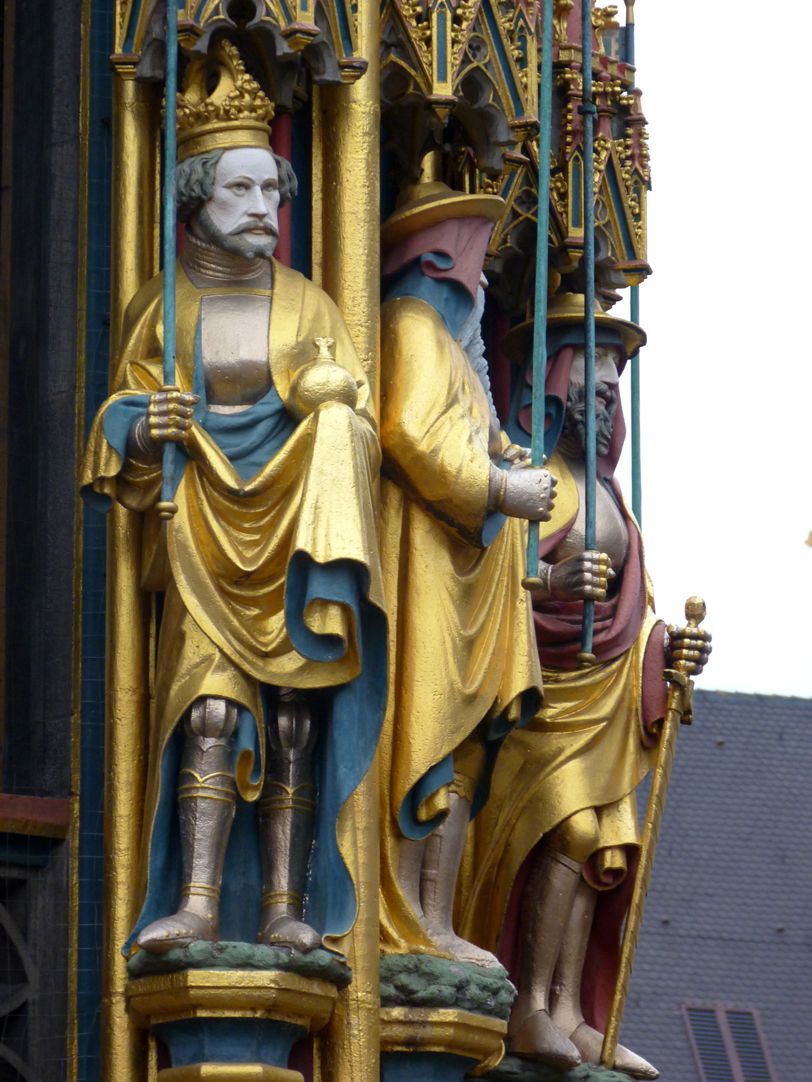
Beautiful fountain
1385 1395
Gottfried of Bouillon
"Parlier" Heinrich is said to have been in charge of the overall design. The original sculptural parts are attributed to several masters. The fountain was repaired two times at the end of the 18th century. It was removed respectively renewed 1821-24, restored in 1835 and finally completely replaced by a valuable copy by Heinrich Wallraff 1897-1902. Original parts of the fountain have been preserved in the German National Museum as have parts of the sculptures in Bodemuseum in Berlin. Whereas the fountain architecture can be considered to be originally Gothic, the statues are but an echo of the originals. The original quality of these sculptures is evident by the fragments that have been preserved, it supersedes by far the quality of the sculptures of the previous period in Nuremberg, it is of much higher quality than the one of the figures at the West portal of St. Lorenz-Church and even of the portal of Our Lady´s Church (Frauenkirche) which was created under the Parlers. Regarding architectural history the tower-shaped fountain is a sensation, it is a micro-architecture, definitely with a secular purpose, but completely designed in sacred form-language. In the following time the fountain was adopted as far away as in the Norman Rouen. Relationships with tabernacles of the Late Gothic Period are evident. Concerning the iconographic program the design of the fountain is highly ambitious. The exclusively male figures are distributed over two tiers at the edge of the basin (allegories of Philosophy, the Seven Liberal Arts, the Four Evangelists and the Four Latin Fathers of the Church), apart from that the figures are distributed over two levels of the octagonal tower. The main level displays the Nine Good Heroes, and Seven Electors, over them the Prophets. The hollow octagon ends in an casing of buttresses with an open-worked tracery helmet. The fountain was explicitly mentioned in 1517 by the Italian Antonio de Beatis, correspondent of Cardinal Luigi d´Aragona. Dr. Pablo de la Riestra
Location: Nuremberg, Hauptmarkt
Design: Parlier (Heinrich Parlirer, Beheim, Bheiheim ), Heinrich
photo Feb 2015, Theo Noll
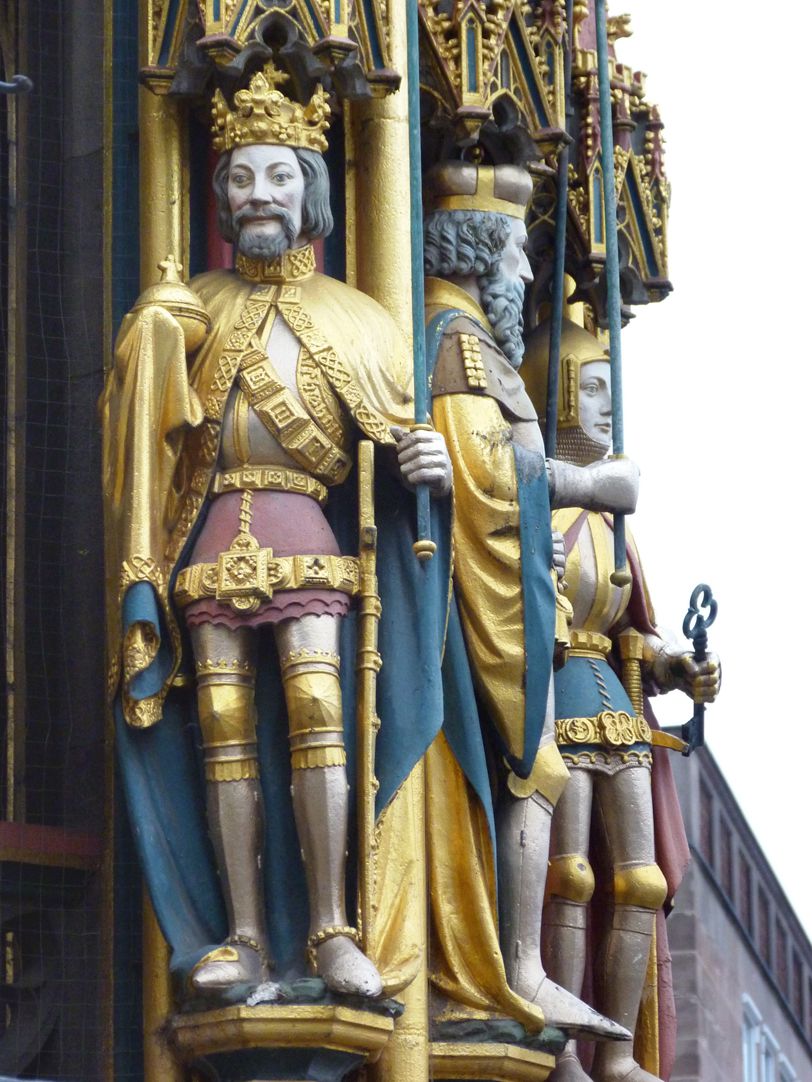
Beautiful fountain
1385 1395
King of Bohemia
"Parlier" Heinrich is said to have been in charge of the overall design. The original sculptural parts are attributed to several masters. The fountain was repaired two times at the end of the 18th century. It was removed respectively renewed 1821-24, restored in 1835 and finally completely replaced by a valuable copy by Heinrich Wallraff 1897-1902. Original parts of the fountain have been preserved in the German National Museum as have parts of the sculptures in Bodemuseum in Berlin. Whereas the fountain architecture can be considered to be originally Gothic, the statues are but an echo of the originals. The original quality of these sculptures is evident by the fragments that have been preserved, it supersedes by far the quality of the sculptures of the previous period in Nuremberg, it is of much higher quality than the one of the figures at the West portal of St. Lorenz-Church and even of the portal of Our Lady´s Church (Frauenkirche) which was created under the Parlers. Regarding architectural history the tower-shaped fountain is a sensation, it is a micro-architecture, definitely with a secular purpose, but completely designed in sacred form-language. In the following time the fountain was adopted as far away as in the Norman Rouen. Relationships with tabernacles of the Late Gothic Period are evident. Concerning the iconographic program the design of the fountain is highly ambitious. The exclusively male figures are distributed over two tiers at the edge of the basin (allegories of Philosophy, the Seven Liberal Arts, the Four Evangelists and the Four Latin Fathers of the Church), apart from that the figures are distributed over two levels of the octagonal tower. The main level displays the Nine Good Heroes, and Seven Electors, over them the Prophets. The hollow octagon ends in an casing of buttresses with an open-worked tracery helmet. The fountain was explicitly mentioned in 1517 by the Italian Antonio de Beatis, correspondent of Cardinal Luigi d´Aragona. Dr. Pablo de la Riestra
Location: Nuremberg, Hauptmarkt
Design: Parlier (Heinrich Parlirer, Beheim, Bheiheim ), Heinrich
photo Feb 2015, Theo Noll
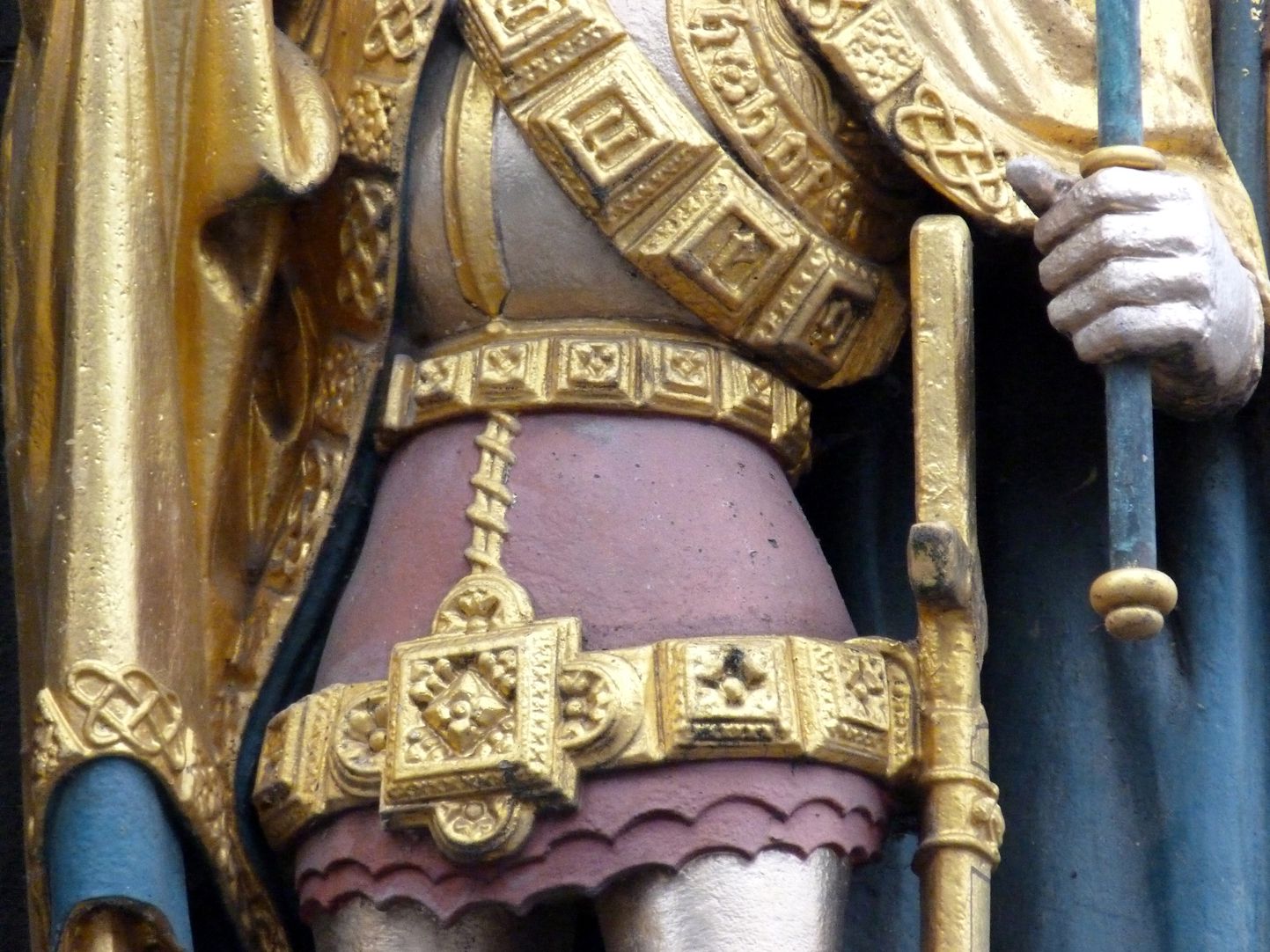
Beautiful fountain
1385 1395
King of Bohemia, detail
"Parlier" Heinrich is said to have been in charge of the overall design. The original sculptural parts are attributed to several masters. The fountain was repaired two times at the end of the 18th century. It was removed respectively renewed 1821-24, restored in 1835 and finally completely replaced by a valuable copy by Heinrich Wallraff 1897-1902. Original parts of the fountain have been preserved in the German National Museum as have parts of the sculptures in Bodemuseum in Berlin. Whereas the fountain architecture can be considered to be originally Gothic, the statues are but an echo of the originals. The original quality of these sculptures is evident by the fragments that have been preserved, it supersedes by far the quality of the sculptures of the previous period in Nuremberg, it is of much higher quality than the one of the figures at the West portal of St. Lorenz-Church and even of the portal of Our Lady´s Church (Frauenkirche) which was created under the Parlers. Regarding architectural history the tower-shaped fountain is a sensation, it is a micro-architecture, definitely with a secular purpose, but completely designed in sacred form-language. In the following time the fountain was adopted as far away as in the Norman Rouen. Relationships with tabernacles of the Late Gothic Period are evident. Concerning the iconographic program the design of the fountain is highly ambitious. The exclusively male figures are distributed over two tiers at the edge of the basin (allegories of Philosophy, the Seven Liberal Arts, the Four Evangelists and the Four Latin Fathers of the Church), apart from that the figures are distributed over two levels of the octagonal tower. The main level displays the Nine Good Heroes, and Seven Electors, over them the Prophets. The hollow octagon ends in an casing of buttresses with an open-worked tracery helmet. The fountain was explicitly mentioned in 1517 by the Italian Antonio de Beatis, correspondent of Cardinal Luigi d´Aragona. Dr. Pablo de la Riestra
Location: Nuremberg, Hauptmarkt
Design: Parlier (Heinrich Parlirer, Beheim, Bheiheim ), Heinrich
photo Feb 2015, Theo Noll
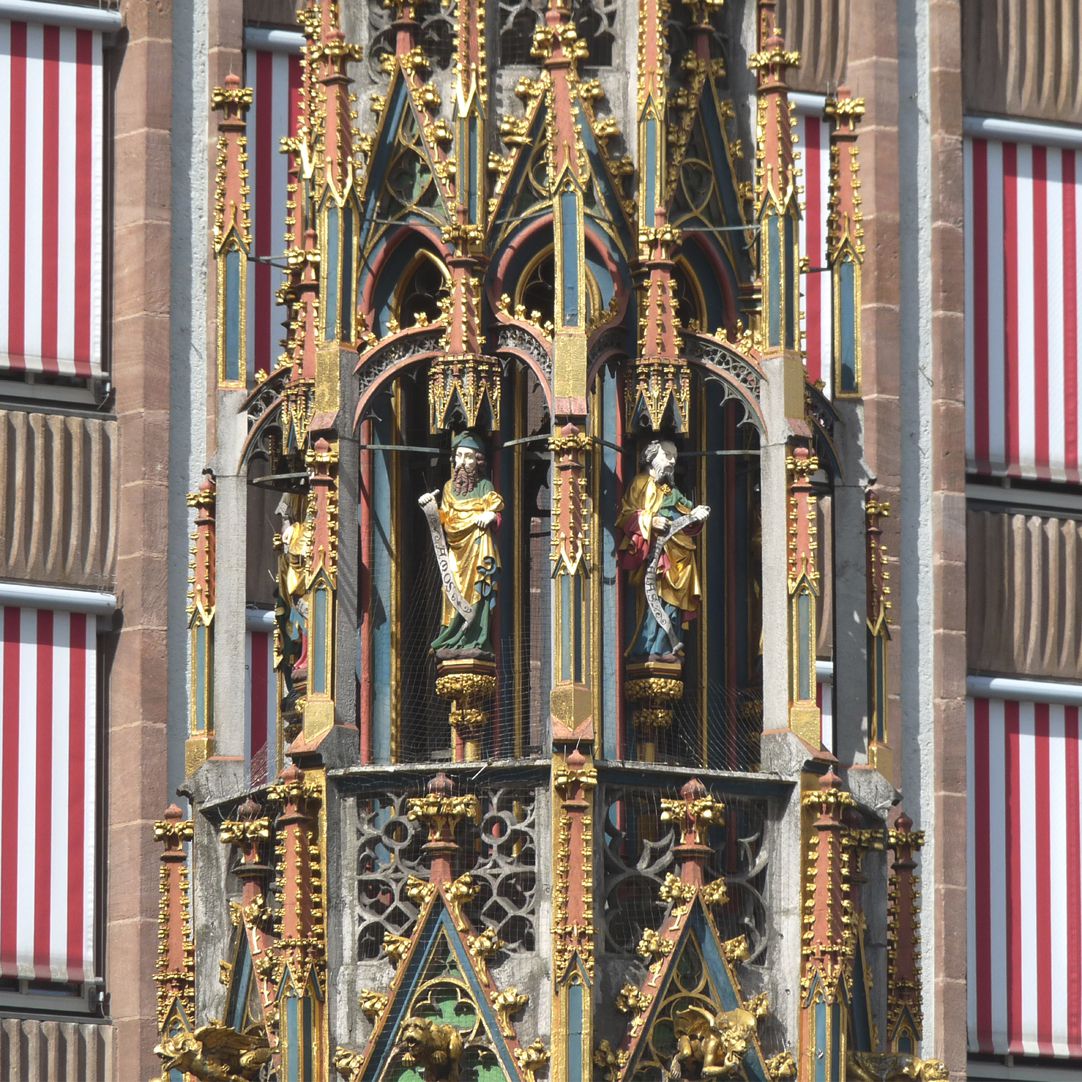
Beautiful fountain
1385 1395
Level of the prophets
"Parlier" Heinrich is said to have been in charge of the overall design. The original sculptural parts are attributed to several masters. The fountain was repaired two times at the end of the 18th century. It was removed respectively renewed 1821-24, restored in 1835 and finally completely replaced by a valuable copy by Heinrich Wallraff 1897-1902. Original parts of the fountain have been preserved in the German National Museum as have parts of the sculptures in Bodemuseum in Berlin. Whereas the fountain architecture can be considered to be originally Gothic, the statues are but an echo of the originals. The original quality of these sculptures is evident by the fragments that have been preserved, it supersedes by far the quality of the sculptures of the previous period in Nuremberg, it is of much higher quality than the one of the figures at the West portal of St. Lorenz-Church and even of the portal of Our Lady´s Church (Frauenkirche) which was created under the Parlers. Regarding architectural history the tower-shaped fountain is a sensation, it is a micro-architecture, definitely with a secular purpose, but completely designed in sacred form-language. In the following time the fountain was adopted as far away as in the Norman Rouen. Relationships with tabernacles of the Late Gothic Period are evident. Concerning the iconographic program the design of the fountain is highly ambitious. The exclusively male figures are distributed over two tiers at the edge of the basin (allegories of Philosophy, the Seven Liberal Arts, the Four Evangelists and the Four Latin Fathers of the Church), apart from that the figures are distributed over two levels of the octagonal tower. The main level displays the Nine Good Heroes, and Seven Electors, over them the Prophets. The hollow octagon ends in an casing of buttresses with an open-worked tracery helmet. The fountain was explicitly mentioned in 1517 by the Italian Antonio de Beatis, correspondent of Cardinal Luigi d´Aragona. Dr. Pablo de la Riestra
Location: Nuremberg, Hauptmarkt
Design: Parlier (Heinrich Parlirer, Beheim, Bheiheim ), Heinrich
photo 20. May 2012, Theo Noll
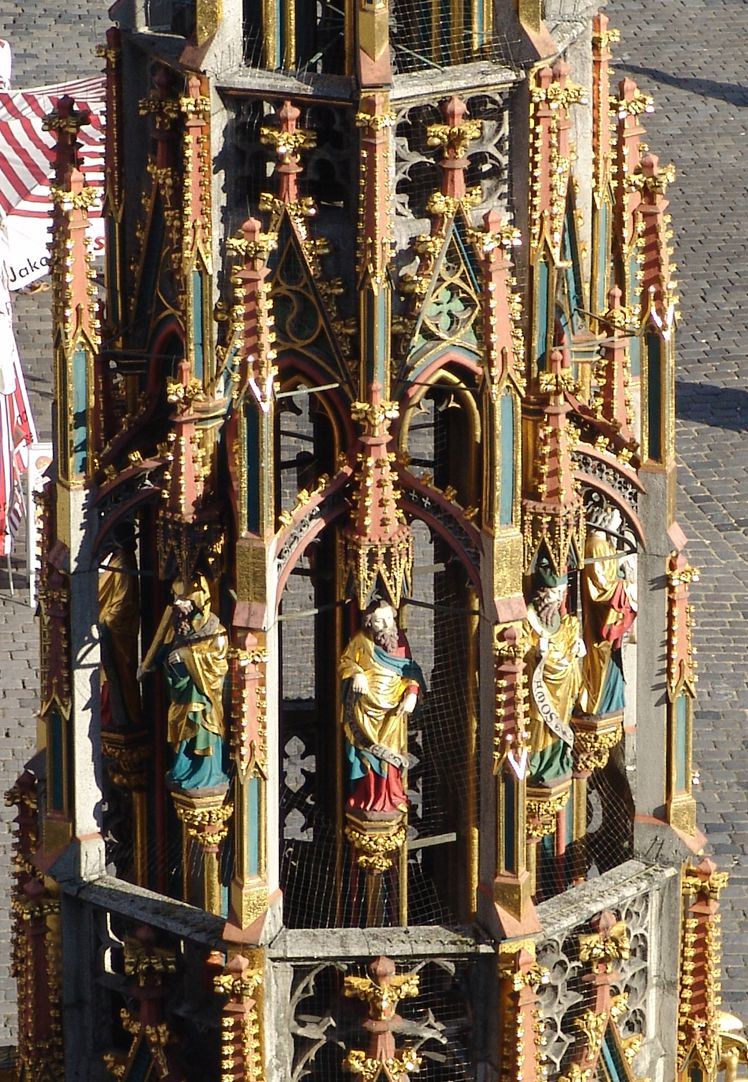
Beautiful fountain
1385 1395
Level of the prophets from above
"Parlier" Heinrich is said to have been in charge of the overall design. The original sculptural parts are attributed to several masters. The fountain was repaired two times at the end of the 18th century. It was removed respectively renewed 1821-24, restored in 1835 and finally completely replaced by a valuable copy by Heinrich Wallraff 1897-1902. Original parts of the fountain have been preserved in the German National Museum as have parts of the sculptures in Bodemuseum in Berlin. Whereas the fountain architecture can be considered to be originally Gothic, the statues are but an echo of the originals. The original quality of these sculptures is evident by the fragments that have been preserved, it supersedes by far the quality of the sculptures of the previous period in Nuremberg, it is of much higher quality than the one of the figures at the West portal of St. Lorenz-Church and even of the portal of Our Lady´s Church (Frauenkirche) which was created under the Parlers. Regarding architectural history the tower-shaped fountain is a sensation, it is a micro-architecture, definitely with a secular purpose, but completely designed in sacred form-language. In the following time the fountain was adopted as far away as in the Norman Rouen. Relationships with tabernacles of the Late Gothic Period are evident. Concerning the iconographic program the design of the fountain is highly ambitious. The exclusively male figures are distributed over two tiers at the edge of the basin (allegories of Philosophy, the Seven Liberal Arts, the Four Evangelists and the Four Latin Fathers of the Church), apart from that the figures are distributed over two levels of the octagonal tower. The main level displays the Nine Good Heroes, and Seven Electors, over them the Prophets. The hollow octagon ends in an casing of buttresses with an open-worked tracery helmet. The fountain was explicitly mentioned in 1517 by the Italian Antonio de Beatis, correspondent of Cardinal Luigi d´Aragona. Dr. Pablo de la Riestra
Location: Nuremberg, Hauptmarkt
Design: Parlier (Heinrich Parlirer, Beheim, Bheiheim ), Heinrich
photo 2007, Pablo de la Riestra
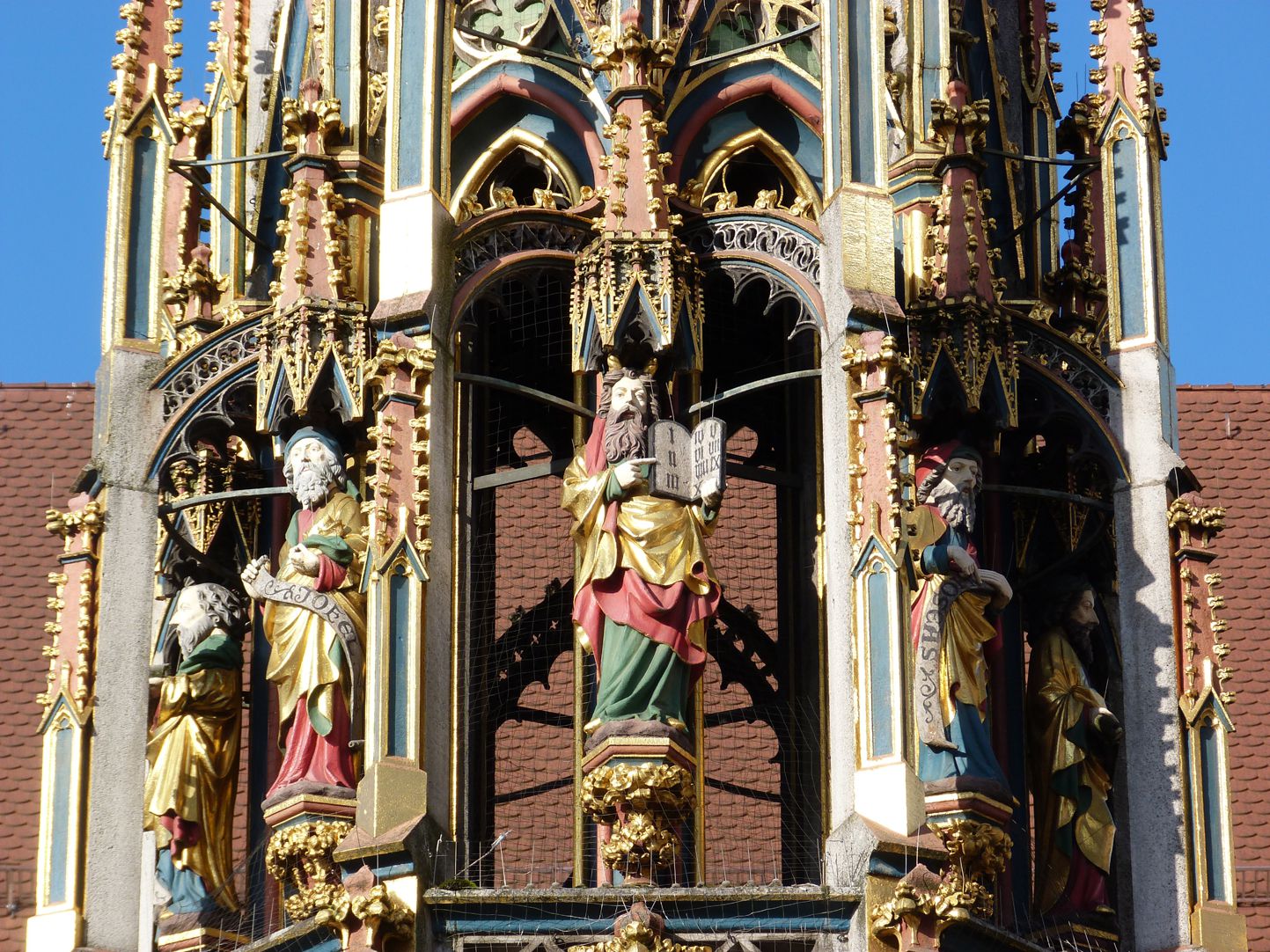
Beautiful fountain
1385 1395
Level of the prophets with Moses in the center
"Parlier" Heinrich is said to have been in charge of the overall design. The original sculptural parts are attributed to several masters. The fountain was repaired two times at the end of the 18th century. It was removed respectively renewed 1821-24, restored in 1835 and finally completely replaced by a valuable copy by Heinrich Wallraff 1897-1902. Original parts of the fountain have been preserved in the German National Museum as have parts of the sculptures in Bodemuseum in Berlin. Whereas the fountain architecture can be considered to be originally Gothic, the statues are but an echo of the originals. The original quality of these sculptures is evident by the fragments that have been preserved, it supersedes by far the quality of the sculptures of the previous period in Nuremberg, it is of much higher quality than the one of the figures at the West portal of St. Lorenz-Church and even of the portal of Our Lady´s Church (Frauenkirche) which was created under the Parlers. Regarding architectural history the tower-shaped fountain is a sensation, it is a micro-architecture, definitely with a secular purpose, but completely designed in sacred form-language. In the following time the fountain was adopted as far away as in the Norman Rouen. Relationships with tabernacles of the Late Gothic Period are evident. Concerning the iconographic program the design of the fountain is highly ambitious. The exclusively male figures are distributed over two tiers at the edge of the basin (allegories of Philosophy, the Seven Liberal Arts, the Four Evangelists and the Four Latin Fathers of the Church), apart from that the figures are distributed over two levels of the octagonal tower. The main level displays the Nine Good Heroes, and Seven Electors, over them the Prophets. The hollow octagon ends in an casing of buttresses with an open-worked tracery helmet. The fountain was explicitly mentioned in 1517 by the Italian Antonio de Beatis, correspondent of Cardinal Luigi d´Aragona. Dr. Pablo de la Riestra
Location: Nuremberg, Hauptmarkt
Design: Parlier (Heinrich Parlirer, Beheim, Bheiheim ), Heinrich
photo 2010, Theo Noll
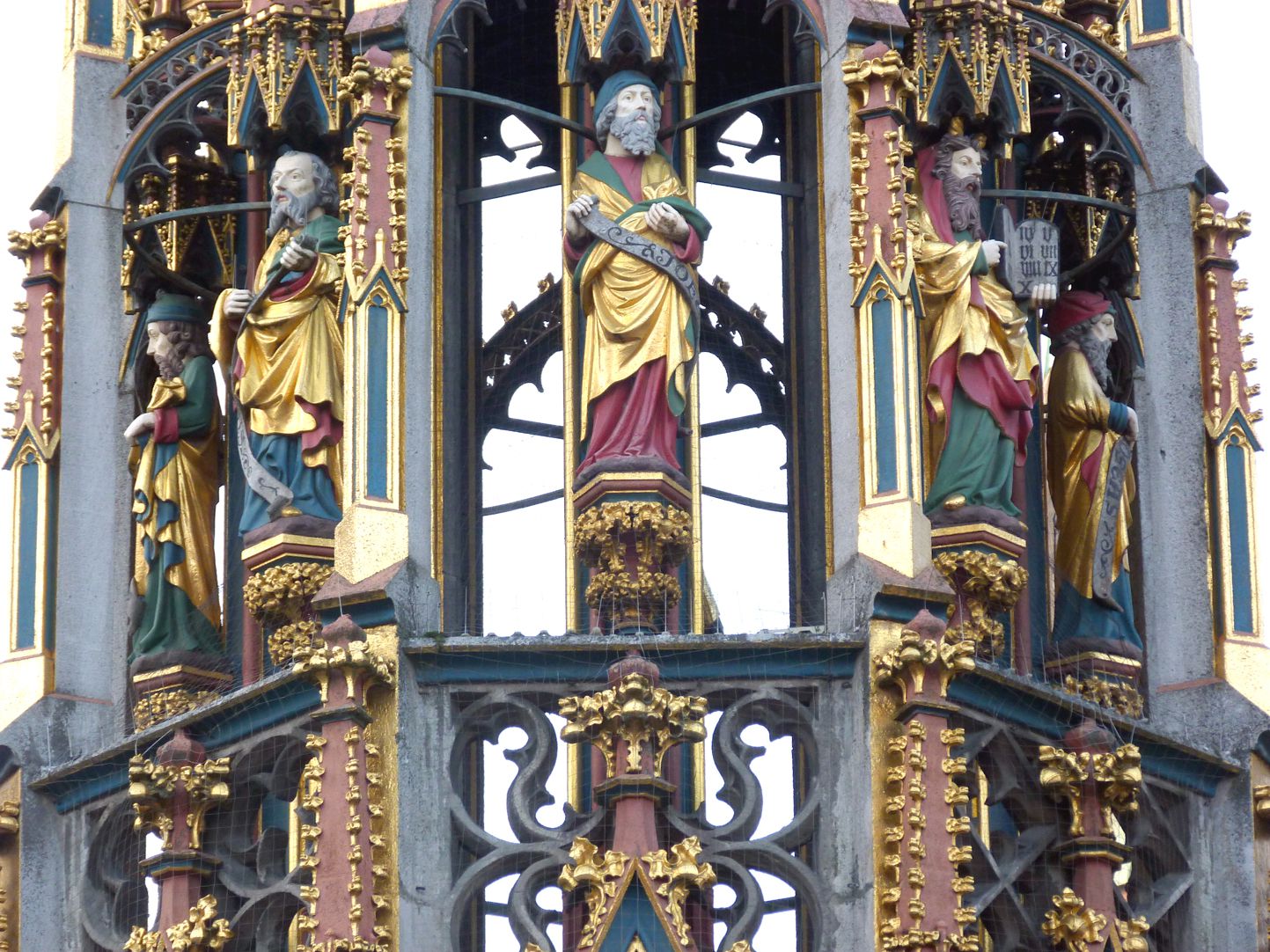
Beautiful fountain
1385 1395
Level of the prophets with Joel in the center
"Parlier" Heinrich is said to have been in charge of the overall design. The original sculptural parts are attributed to several masters. The fountain was repaired two times at the end of the 18th century. It was removed respectively renewed 1821-24, restored in 1835 and finally completely replaced by a valuable copy by Heinrich Wallraff 1897-1902. Original parts of the fountain have been preserved in the German National Museum as have parts of the sculptures in Bodemuseum in Berlin. Whereas the fountain architecture can be considered to be originally Gothic, the statues are but an echo of the originals. The original quality of these sculptures is evident by the fragments that have been preserved, it supersedes by far the quality of the sculptures of the previous period in Nuremberg, it is of much higher quality than the one of the figures at the West portal of St. Lorenz-Church and even of the portal of Our Lady´s Church (Frauenkirche) which was created under the Parlers. Regarding architectural history the tower-shaped fountain is a sensation, it is a micro-architecture, definitely with a secular purpose, but completely designed in sacred form-language. In the following time the fountain was adopted as far away as in the Norman Rouen. Relationships with tabernacles of the Late Gothic Period are evident. Concerning the iconographic program the design of the fountain is highly ambitious. The exclusively male figures are distributed over two tiers at the edge of the basin (allegories of Philosophy, the Seven Liberal Arts, the Four Evangelists and the Four Latin Fathers of the Church), apart from that the figures are distributed over two levels of the octagonal tower. The main level displays the Nine Good Heroes, and Seven Electors, over them the Prophets. The hollow octagon ends in an casing of buttresses with an open-worked tracery helmet. The fountain was explicitly mentioned in 1517 by the Italian Antonio de Beatis, correspondent of Cardinal Luigi d´Aragona. Dr. Pablo de la Riestra
Location: Nuremberg, Hauptmarkt
Design: Parlier (Heinrich Parlirer, Beheim, Bheiheim ), Heinrich
photo 2011, Theo Noll
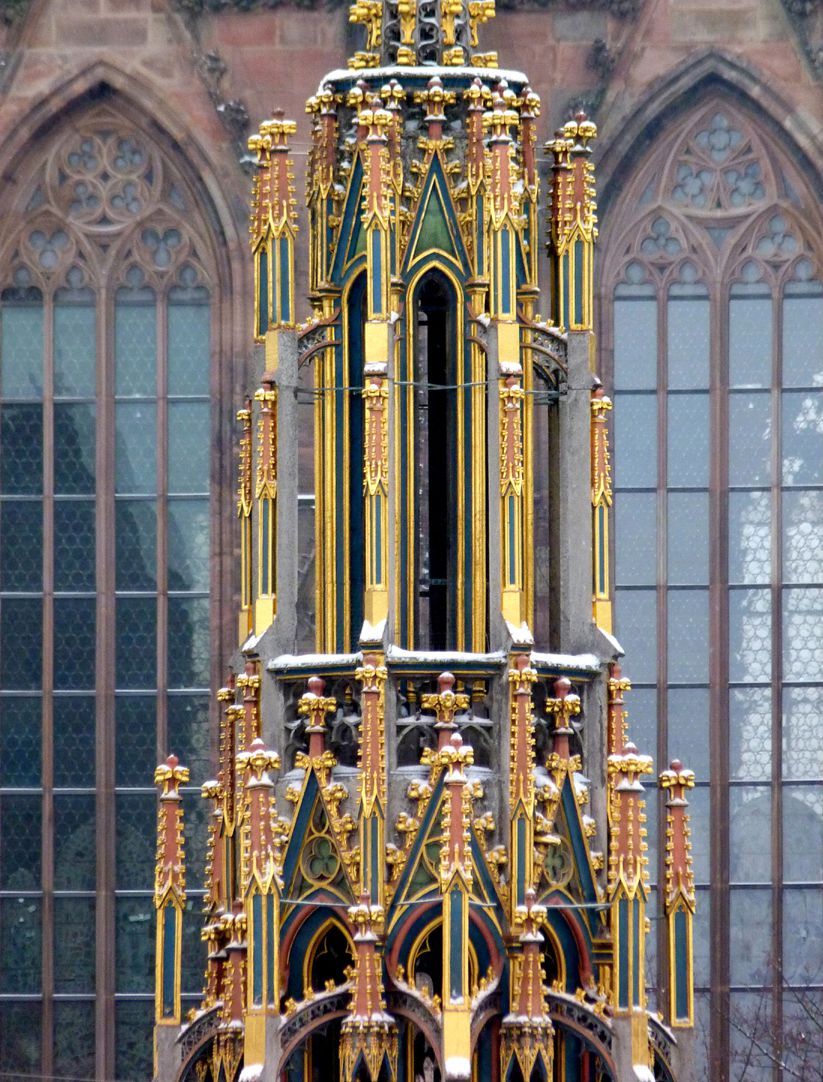
Beautiful fountain
1385 1395
Buttresses
"Parlier" Heinrich is said to have been in charge of the overall design. The original sculptural parts are attributed to several masters. The fountain was repaired two times at the end of the 18th century. It was removed respectively renewed 1821-24, restored in 1835 and finally completely replaced by a valuable copy by Heinrich Wallraff 1897-1902. Original parts of the fountain have been preserved in the German National Museum as have parts of the sculptures in Bodemuseum in Berlin. Whereas the fountain architecture can be considered to be originally Gothic, the statues are but an echo of the originals. The original quality of these sculptures is evident by the fragments that have been preserved, it supersedes by far the quality of the sculptures of the previous period in Nuremberg, it is of much higher quality than the one of the figures at the West portal of St. Lorenz-Church and even of the portal of Our Lady´s Church (Frauenkirche) which was created under the Parlers. Regarding architectural history the tower-shaped fountain is a sensation, it is a micro-architecture, definitely with a secular purpose, but completely designed in sacred form-language. In the following time the fountain was adopted as far away as in the Norman Rouen. Relationships with tabernacles of the Late Gothic Period are evident. Concerning the iconographic program the design of the fountain is highly ambitious. The exclusively male figures are distributed over two tiers at the edge of the basin (allegories of Philosophy, the Seven Liberal Arts, the Four Evangelists and the Four Latin Fathers of the Church), apart from that the figures are distributed over two levels of the octagonal tower. The main level displays the Nine Good Heroes, and Seven Electors, over them the Prophets. The hollow octagon ends in an casing of buttresses with an open-worked tracery helmet. The fountain was explicitly mentioned in 1517 by the Italian Antonio de Beatis, correspondent of Cardinal Luigi d´Aragona. Dr. Pablo de la Riestra
Location: Nuremberg, Hauptmarkt
Design: Parlier (Heinrich Parlirer, Beheim, Bheiheim ), Heinrich
photo Dec 2012, Theo Noll
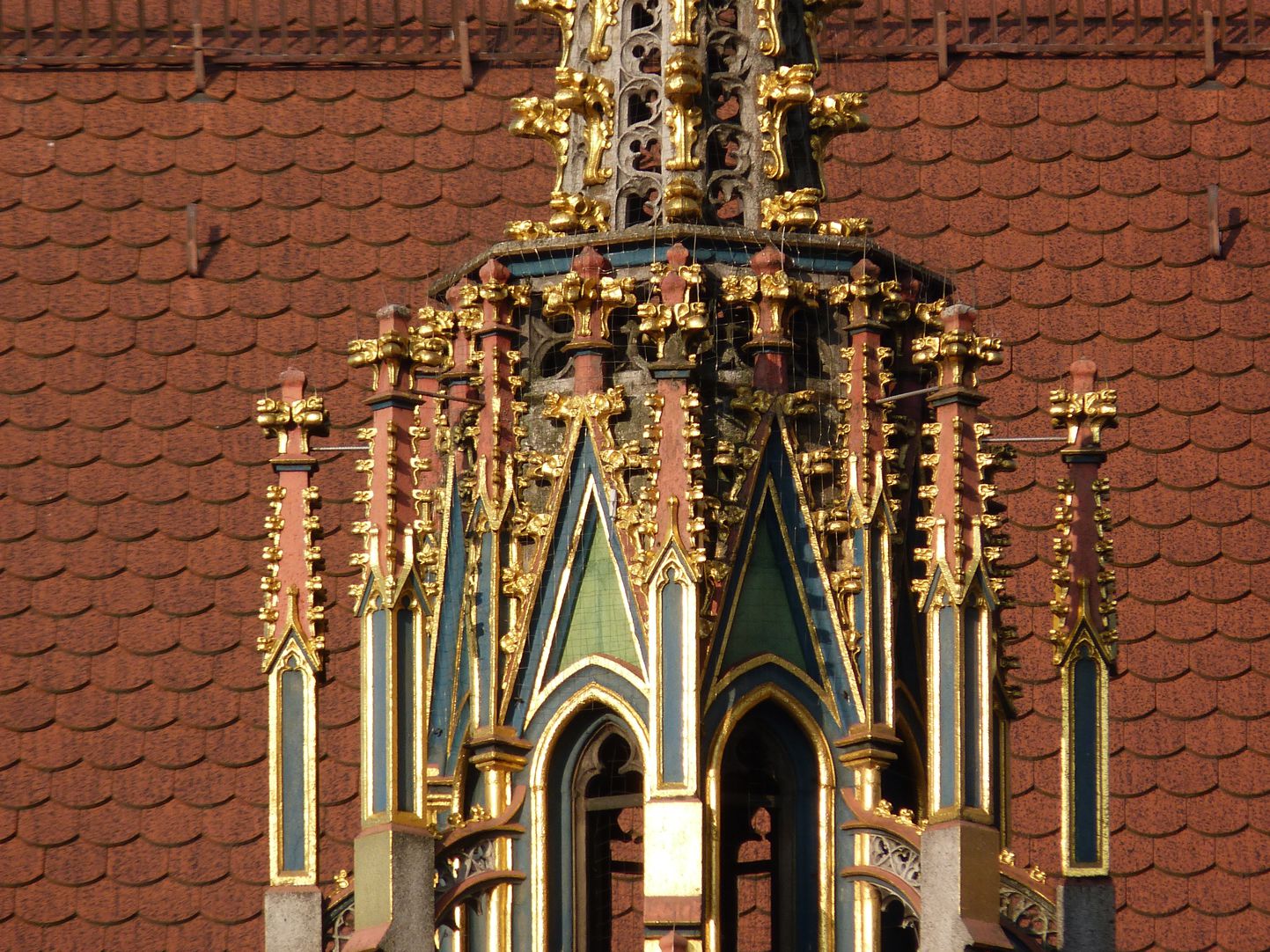
Beautiful fountain
1385 1395
Wimpergs (window gables with tracery) with buttresses
"Parlier" Heinrich is said to have been in charge of the overall design. The original sculptural parts are attributed to several masters. The fountain was repaired two times at the end of the 18th century. It was removed respectively renewed 1821-24, restored in 1835 and finally completely replaced by a valuable copy by Heinrich Wallraff 1897-1902. Original parts of the fountain have been preserved in the German National Museum as have parts of the sculptures in Bodemuseum in Berlin. Whereas the fountain architecture can be considered to be originally Gothic, the statues are but an echo of the originals. The original quality of these sculptures is evident by the fragments that have been preserved, it supersedes by far the quality of the sculptures of the previous period in Nuremberg, it is of much higher quality than the one of the figures at the West portal of St. Lorenz-Church and even of the portal of Our Lady´s Church (Frauenkirche) which was created under the Parlers. Regarding architectural history the tower-shaped fountain is a sensation, it is a micro-architecture, definitely with a secular purpose, but completely designed in sacred form-language. In the following time the fountain was adopted as far away as in the Norman Rouen. Relationships with tabernacles of the Late Gothic Period are evident. Concerning the iconographic program the design of the fountain is highly ambitious. The exclusively male figures are distributed over two tiers at the edge of the basin (allegories of Philosophy, the Seven Liberal Arts, the Four Evangelists and the Four Latin Fathers of the Church), apart from that the figures are distributed over two levels of the octagonal tower. The main level displays the Nine Good Heroes, and Seven Electors, over them the Prophets. The hollow octagon ends in an casing of buttresses with an open-worked tracery helmet. The fountain was explicitly mentioned in 1517 by the Italian Antonio de Beatis, correspondent of Cardinal Luigi d´Aragona. Dr. Pablo de la Riestra
Location: Nuremberg, Hauptmarkt
Design: Parlier (Heinrich Parlirer, Beheim, Bheiheim ), Heinrich
photo Oct 2010, Theo Noll
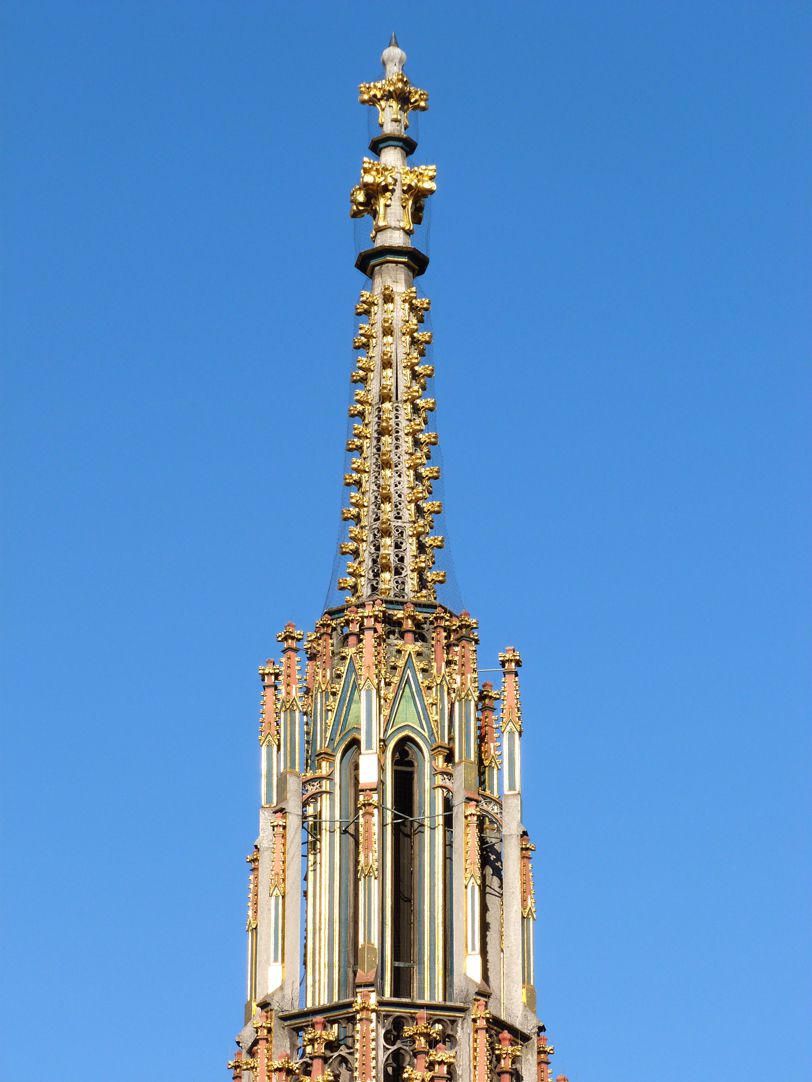
Beautiful fountain
1385 1395
Casing with tracery helmet
"Parlier" Heinrich is said to have been in charge of the overall design. The original sculptural parts are attributed to several masters. The fountain was repaired two times at the end of the 18th century. It was removed respectively renewed 1821-24, restored in 1835 and finally completely replaced by a valuable copy by Heinrich Wallraff 1897-1902. Original parts of the fountain have been preserved in the German National Museum as have parts of the sculptures in Bodemuseum in Berlin. Whereas the fountain architecture can be considered to be originally Gothic, the statues are but an echo of the originals. The original quality of these sculptures is evident by the fragments that have been preserved, it supersedes by far the quality of the sculptures of the previous period in Nuremberg, it is of much higher quality than the one of the figures at the West portal of St. Lorenz-Church and even of the portal of Our Lady´s Church (Frauenkirche) which was created under the Parlers. Regarding architectural history the tower-shaped fountain is a sensation, it is a micro-architecture, definitely with a secular purpose, but completely designed in sacred form-language. In the following time the fountain was adopted as far away as in the Norman Rouen. Relationships with tabernacles of the Late Gothic Period are evident. Concerning the iconographic program the design of the fountain is highly ambitious. The exclusively male figures are distributed over two tiers at the edge of the basin (allegories of Philosophy, the Seven Liberal Arts, the Four Evangelists and the Four Latin Fathers of the Church), apart from that the figures are distributed over two levels of the octagonal tower. The main level displays the Nine Good Heroes, and Seven Electors, over them the Prophets. The hollow octagon ends in an casing of buttresses with an open-worked tracery helmet. The fountain was explicitly mentioned in 1517 by the Italian Antonio de Beatis, correspondent of Cardinal Luigi d´Aragona. Dr. Pablo de la Riestra
Location: Nuremberg, Hauptmarkt
Design: Parlier (Heinrich Parlirer, Beheim, Bheiheim ), Heinrich
photo Oct 2010, Pablo de la Riestra
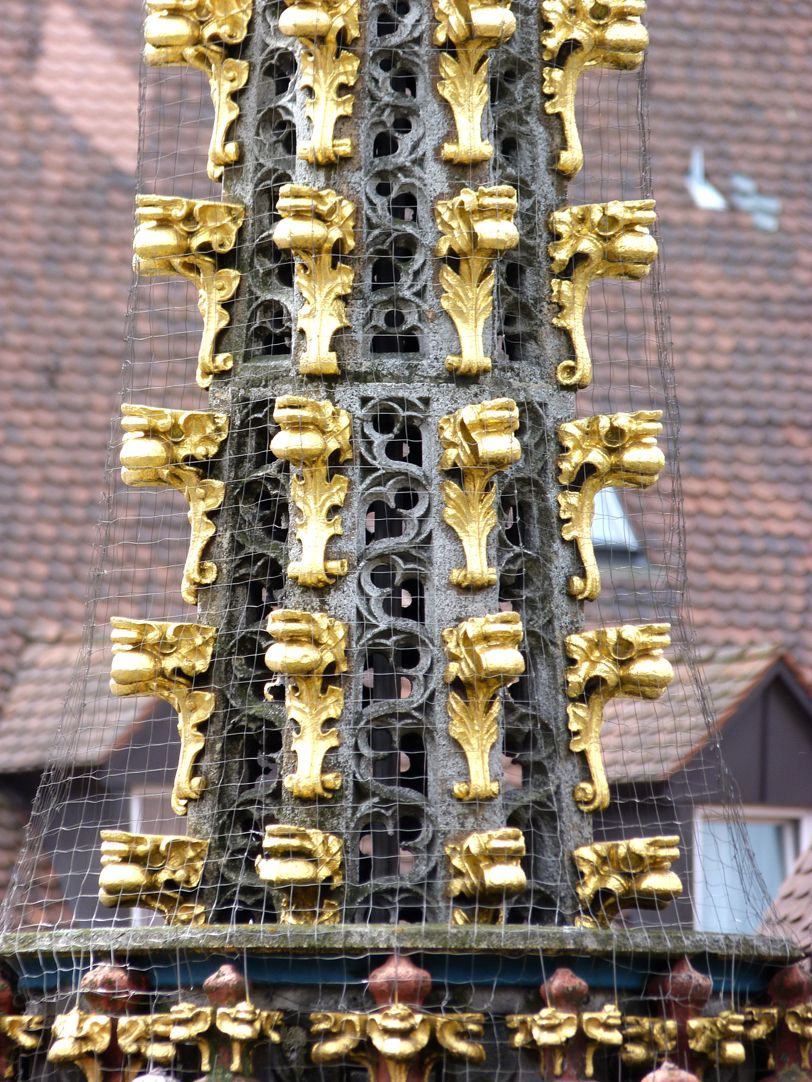
Beautiful fountain
1385 1395
Open-worked tracery helmet, detail with trefoil tracery ornaments
"Parlier" Heinrich is said to have been in charge of the overall design. The original sculptural parts are attributed to several masters. The fountain was repaired two times at the end of the 18th century. It was removed respectively renewed 1821-24, restored in 1835 and finally completely replaced by a valuable copy by Heinrich Wallraff 1897-1902. Original parts of the fountain have been preserved in the German National Museum as have parts of the sculptures in Bodemuseum in Berlin. Whereas the fountain architecture can be considered to be originally Gothic, the statues are but an echo of the originals. The original quality of these sculptures is evident by the fragments that have been preserved, it supersedes by far the quality of the sculptures of the previous period in Nuremberg, it is of much higher quality than the one of the figures at the West portal of St. Lorenz-Church and even of the portal of Our Lady´s Church (Frauenkirche) which was created under the Parlers. Regarding architectural history the tower-shaped fountain is a sensation, it is a micro-architecture, definitely with a secular purpose, but completely designed in sacred form-language. In the following time the fountain was adopted as far away as in the Norman Rouen. Relationships with tabernacles of the Late Gothic Period are evident. Concerning the iconographic program the design of the fountain is highly ambitious. The exclusively male figures are distributed over two tiers at the edge of the basin (allegories of Philosophy, the Seven Liberal Arts, the Four Evangelists and the Four Latin Fathers of the Church), apart from that the figures are distributed over two levels of the octagonal tower. The main level displays the Nine Good Heroes, and Seven Electors, over them the Prophets. The hollow octagon ends in an casing of buttresses with an open-worked tracery helmet. The fountain was explicitly mentioned in 1517 by the Italian Antonio de Beatis, correspondent of Cardinal Luigi d´Aragona. Dr. Pablo de la Riestra
Location: Nuremberg, Hauptmarkt
Design: Parlier (Heinrich Parlirer, Beheim, Bheiheim ), Heinrich
photo 2012, Pablo de la Riestra
Beautiful fountain
1385 1395
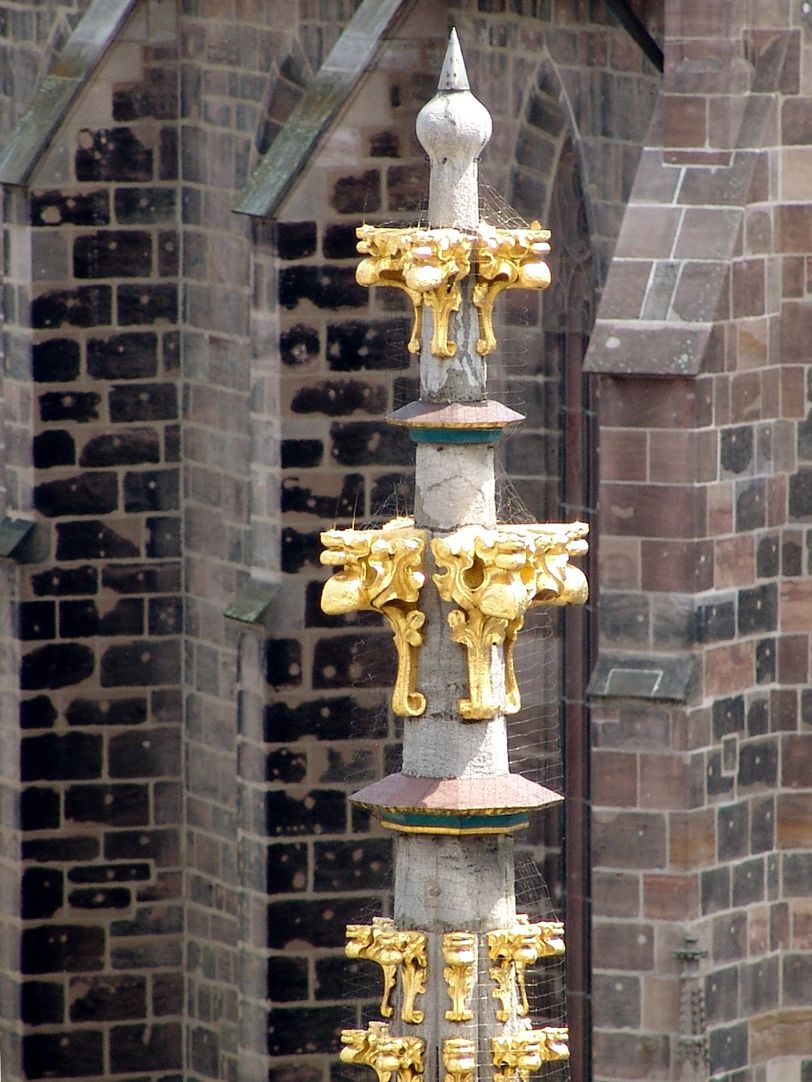
Double crocket
"Parlier" Heinrich is said to have been in charge of the overall design. The original sculptural parts are attributed to several masters. The fountain was repaired two times at the end of the 18th century. It was removed respectively renewed 1821-24, restored in 1835 and finally completely replaced by a valuable copy by Heinrich Wallraff 1897-1902. Original parts of the fountain have been preserved in the German National Museum as have parts of the sculptures in Bodemuseum in Berlin. Whereas the fountain architecture can be considered to be originally Gothic, the statues are but an echo of the originals. The original quality of these sculptures is evident by the fragments that have been preserved, it supersedes by far the quality of the sculptures of the previous period in Nuremberg, it is of much higher quality than the one of the figures at the West portal of St. Lorenz-Church and even of the portal of Our Lady´s Church (Frauenkirche) which was created under the Parlers. Regarding architectural history the tower-shaped fountain is a sensation, it is a micro-architecture, definitely with a secular purpose, but completely designed in sacred form-language. In the following time the fountain was adopted as far away as in the Norman Rouen. Relationships with tabernacles of the Late Gothic Period are evident. Concerning the iconographic program the design of the fountain is highly ambitious. The exclusively male figures are distributed over two tiers at the edge of the basin (allegories of Philosophy, the Seven Liberal Arts, the Four Evangelists and the Four Latin Fathers of the Church), apart from that the figures are distributed over two levels of the octagonal tower. The main level displays the Nine Good Heroes, and Seven Electors, over them the Prophets. The hollow octagon ends in an casing of buttresses with an open-worked tracery helmet. The fountain was explicitly mentioned in 1517 by the Italian Antonio de Beatis, correspondent of Cardinal Luigi d´Aragona. Dr. Pablo de la Riestra
Location: Nuremberg, Hauptmarkt
Design: Parlier (Heinrich Parlirer, Beheim, Bheiheim ), Heinrich
photo 2007, Pablo de la Riestra
Beautiful fountain
1385 1395
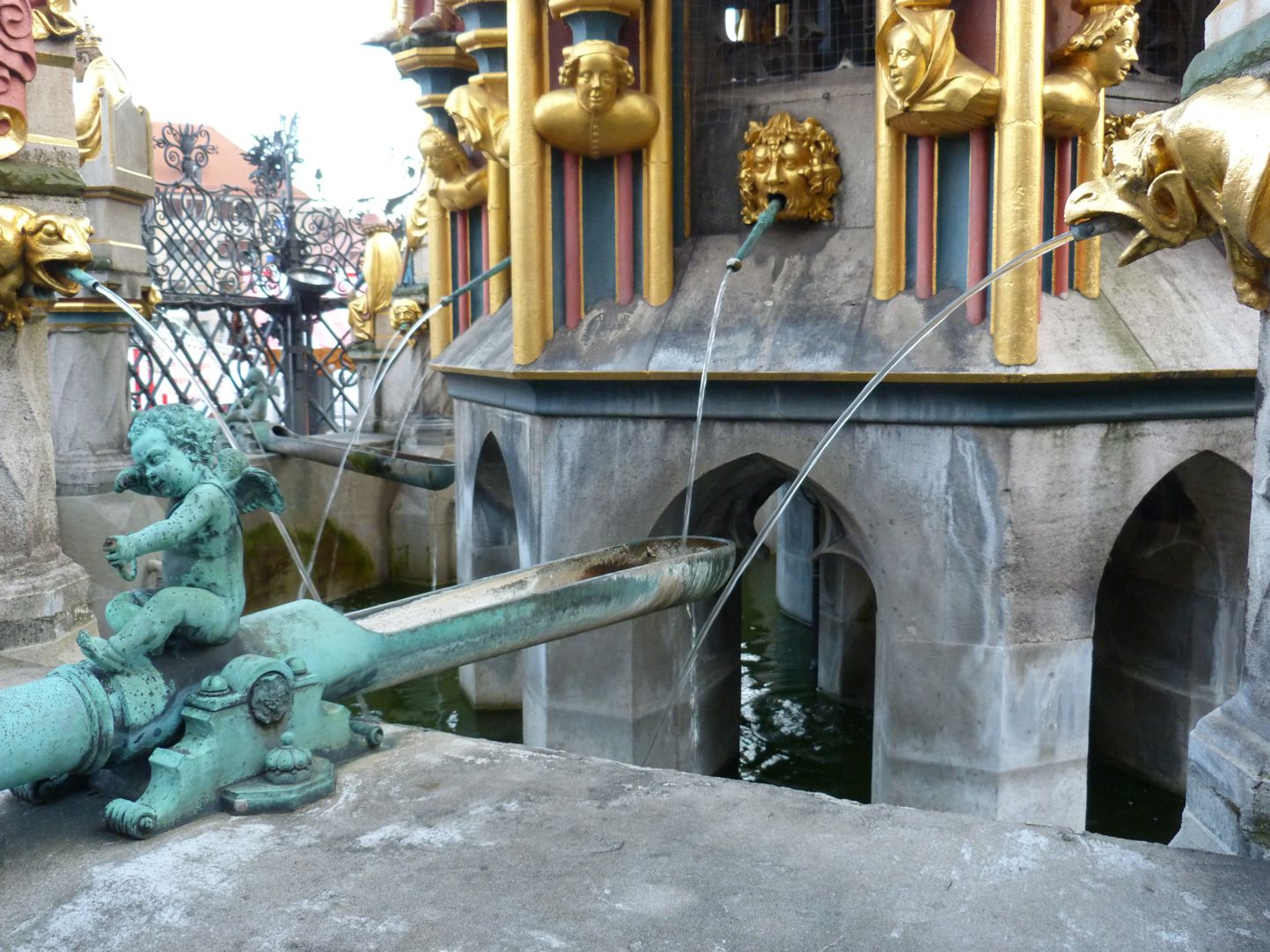
Tube at the basin edge with Renaissance putto
"Parlier" Heinrich is said to have been in charge of the overall design. The original sculptural parts are attributed to several masters. The fountain was repaired two times at the end of the 18th century. It was removed respectively renewed 1821-24, restored in 1835 and finally completely replaced by a valuable copy by Heinrich Wallraff 1897-1902. Original parts of the fountain have been preserved in the German National Museum as have parts of the sculptures in Bodemuseum in Berlin. Whereas the fountain architecture can be considered to be originally Gothic, the statues are but an echo of the originals. The original quality of these sculptures is evident by the fragments that have been preserved, it supersedes by far the quality of the sculptures of the previous period in Nuremberg, it is of much higher quality than the one of the figures at the West portal of St. Lorenz-Church and even of the portal of Our Lady´s Church (Frauenkirche) which was created under the Parlers. Regarding architectural history the tower-shaped fountain is a sensation, it is a micro-architecture, definitely with a secular purpose, but completely designed in sacred form-language. In the following time the fountain was adopted as far away as in the Norman Rouen. Relationships with tabernacles of the Late Gothic Period are evident. Concerning the iconographic program the design of the fountain is highly ambitious. The exclusively male figures are distributed over two tiers at the edge of the basin (allegories of Philosophy, the Seven Liberal Arts, the Four Evangelists and the Four Latin Fathers of the Church), apart from that the figures are distributed over two levels of the octagonal tower. The main level displays the Nine Good Heroes, and Seven Electors, over them the Prophets. The hollow octagon ends in an casing of buttresses with an open-worked tracery helmet. The fountain was explicitly mentioned in 1517 by the Italian Antonio de Beatis, correspondent of Cardinal Luigi d´Aragona. Dr. Pablo de la Riestra
Location: Nuremberg, Hauptmarkt
Design: Parlier (Heinrich Parlirer, Beheim, Bheiheim ), Heinrich
photo 2014, Theo Noll
Beautiful fountain
1385 1395
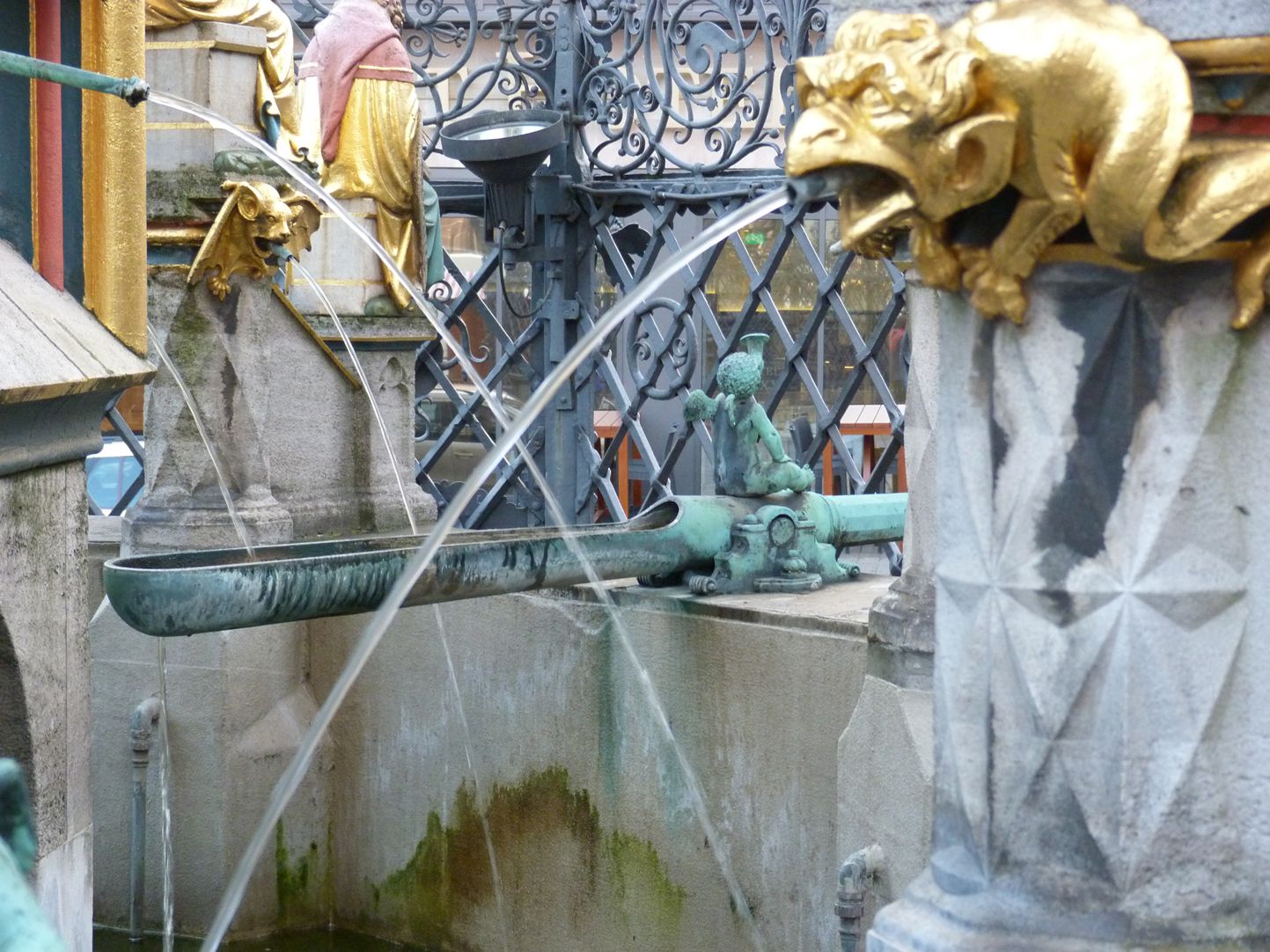
Basin with gargoyles
"Parlier" Heinrich is said to have been in charge of the overall design. The original sculptural parts are attributed to several masters. The fountain was repaired two times at the end of the 18th century. It was removed respectively renewed 1821-24, restored in 1835 and finally completely replaced by a valuable copy by Heinrich Wallraff 1897-1902. Original parts of the fountain have been preserved in the German National Museum as have parts of the sculptures in Bodemuseum in Berlin. Whereas the fountain architecture can be considered to be originally Gothic, the statues are but an echo of the originals. The original quality of these sculptures is evident by the fragments that have been preserved, it supersedes by far the quality of the sculptures of the previous period in Nuremberg, it is of much higher quality than the one of the figures at the West portal of St. Lorenz-Church and even of the portal of Our Lady´s Church (Frauenkirche) which was created under the Parlers. Regarding architectural history the tower-shaped fountain is a sensation, it is a micro-architecture, definitely with a secular purpose, but completely designed in sacred form-language. In the following time the fountain was adopted as far away as in the Norman Rouen. Relationships with tabernacles of the Late Gothic Period are evident. Concerning the iconographic program the design of the fountain is highly ambitious. The exclusively male figures are distributed over two tiers at the edge of the basin (allegories of Philosophy, the Seven Liberal Arts, the Four Evangelists and the Four Latin Fathers of the Church), apart from that the figures are distributed over two levels of the octagonal tower. The main level displays the Nine Good Heroes, and Seven Electors, over them the Prophets. The hollow octagon ends in an casing of buttresses with an open-worked tracery helmet. The fountain was explicitly mentioned in 1517 by the Italian Antonio de Beatis, correspondent of Cardinal Luigi d´Aragona. Dr. Pablo de la Riestra
Location: Nuremberg, Hauptmarkt
Design: Parlier (Heinrich Parlirer, Beheim, Bheiheim ), Heinrich
photo 2014, Theo Noll
Beautiful fountain
1385 1395
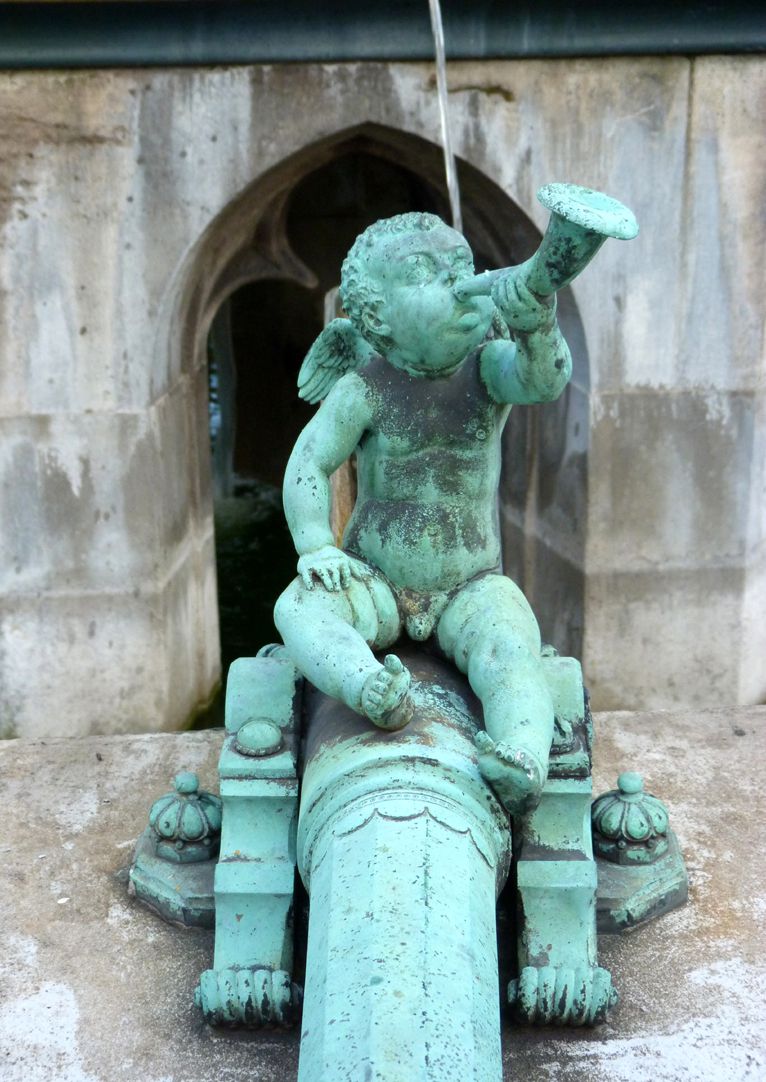
Tube with trumpet putto
"Parlier" Heinrich is said to have been in charge of the overall design. The original sculptural parts are attributed to several masters. The fountain was repaired two times at the end of the 18th century. It was removed respectively renewed 1821-24, restored in 1835 and finally completely replaced by a valuable copy by Heinrich Wallraff 1897-1902. Original parts of the fountain have been preserved in the German National Museum as have parts of the sculptures in Bodemuseum in Berlin. Whereas the fountain architecture can be considered to be originally Gothic, the statues are but an echo of the originals. The original quality of these sculptures is evident by the fragments that have been preserved, it supersedes by far the quality of the sculptures of the previous period in Nuremberg, it is of much higher quality than the one of the figures at the West portal of St. Lorenz-Church and even of the portal of Our Lady´s Church (Frauenkirche) which was created under the Parlers. Regarding architectural history the tower-shaped fountain is a sensation, it is a micro-architecture, definitely with a secular purpose, but completely designed in sacred form-language. In the following time the fountain was adopted as far away as in the Norman Rouen. Relationships with tabernacles of the Late Gothic Period are evident. Concerning the iconographic program the design of the fountain is highly ambitious. The exclusively male figures are distributed over two tiers at the edge of the basin (allegories of Philosophy, the Seven Liberal Arts, the Four Evangelists and the Four Latin Fathers of the Church), apart from that the figures are distributed over two levels of the octagonal tower. The main level displays the Nine Good Heroes, and Seven Electors, over them the Prophets. The hollow octagon ends in an casing of buttresses with an open-worked tracery helmet. The fountain was explicitly mentioned in 1517 by the Italian Antonio de Beatis, correspondent of Cardinal Luigi d´Aragona. Dr. Pablo de la Riestra
Location: Nuremberg, Hauptmarkt
Design: Parlier (Heinrich Parlirer, Beheim, Bheiheim ), Heinrich
photo 2014, Theo Noll
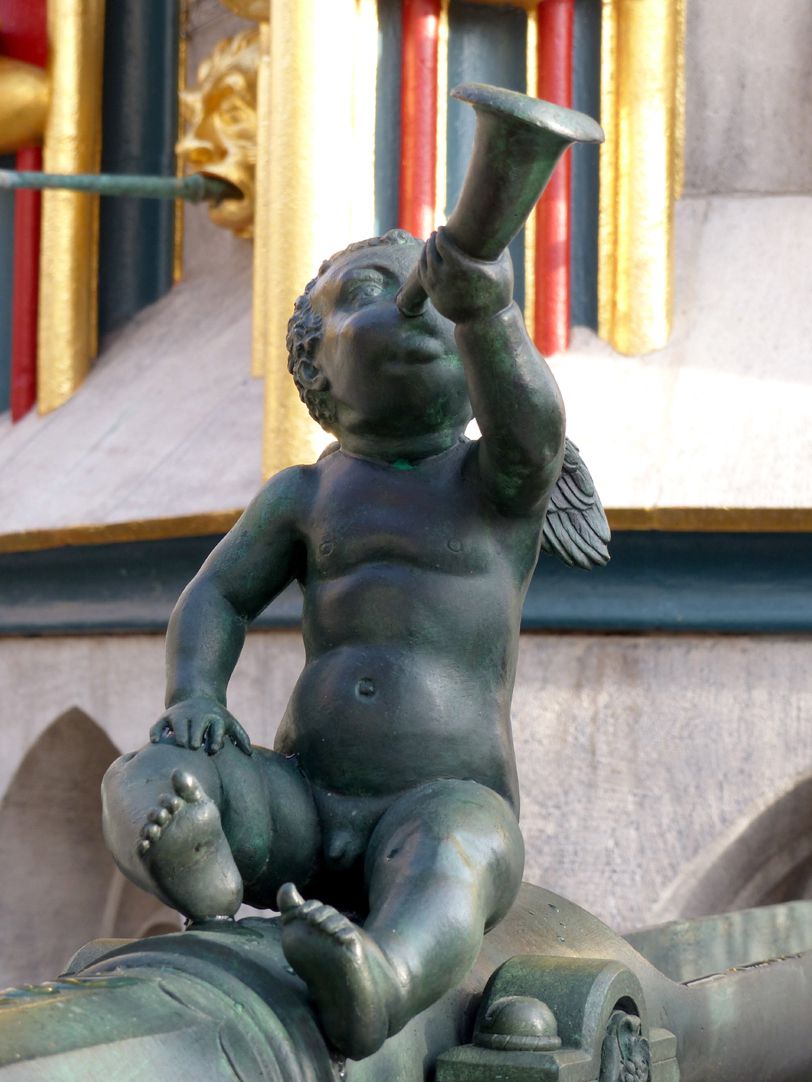
Beautiful fountain
1385 1395
Front view of the restored horn player (1587
"Parlier" Heinrich is said to have been in charge of the overall design. The original sculptural parts are attributed to several masters. The fountain was repaired two times at the end of the 18th century. It was removed respectively renewed 1821-24, restored in 1835 and finally completely replaced by a valuable copy by Heinrich Wallraff 1897-1902. Original parts of the fountain have been preserved in the German National Museum as have parts of the sculptures in Bodemuseum in Berlin. Whereas the fountain architecture can be considered to be originally Gothic, the statues are but an echo of the originals. The original quality of these sculptures is evident by the fragments that have been preserved, it supersedes by far the quality of the sculptures of the previous period in Nuremberg, it is of much higher quality than the one of the figures at the West portal of St. Lorenz-Church and even of the portal of Our Lady´s Church (Frauenkirche) which was created under the Parlers. Regarding architectural history the tower-shaped fountain is a sensation, it is a micro-architecture, definitely with a secular purpose, but completely designed in sacred form-language. In the following time the fountain was adopted as far away as in the Norman Rouen. Relationships with tabernacles of the Late Gothic Period are evident. Concerning the iconographic program the design of the fountain is highly ambitious. The exclusively male figures are distributed over two tiers at the edge of the basin (allegories of Philosophy, the Seven Liberal Arts, the Four Evangelists and the Four Latin Fathers of the Church), apart from that the figures are distributed over two levels of the octagonal tower. The main level displays the Nine Good Heroes, and Seven Electors, over them the Prophets. The hollow octagon ends in an casing of buttresses with an open-worked tracery helmet. The fountain was explicitly mentioned in 1517 by the Italian Antonio de Beatis, correspondent of Cardinal Luigi d´Aragona. Dr. Pablo de la Riestra
Location: Nuremberg, Hauptmarkt
Design: Parlier (Heinrich Parlirer, Beheim, Bheiheim ), Heinrich
photo 12. Nov 2016, Pablo de la Riestra
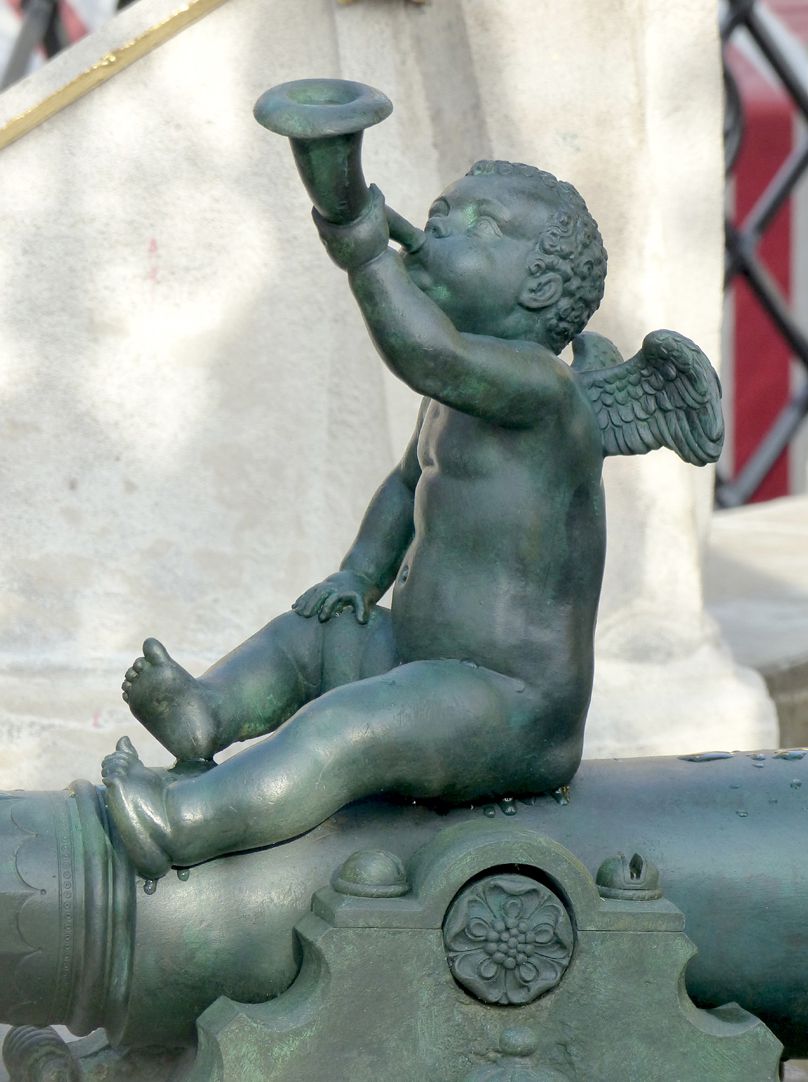
Beautiful fountain
1385 1395
Lateral view of the restored horn player (1587 ?)
"Parlier" Heinrich is said to have been in charge of the overall design. The original sculptural parts are attributed to several masters. The fountain was repaired two times at the end of the 18th century. It was removed respectively renewed 1821-24, restored in 1835 and finally completely replaced by a valuable copy by Heinrich Wallraff 1897-1902. Original parts of the fountain have been preserved in the German National Museum as have parts of the sculptures in Bodemuseum in Berlin. Whereas the fountain architecture can be considered to be originally Gothic, the statues are but an echo of the originals. The original quality of these sculptures is evident by the fragments that have been preserved, it supersedes by far the quality of the sculptures of the previous period in Nuremberg, it is of much higher quality than the one of the figures at the West portal of St. Lorenz-Church and even of the portal of Our Lady´s Church (Frauenkirche) which was created under the Parlers. Regarding architectural history the tower-shaped fountain is a sensation, it is a micro-architecture, definitely with a secular purpose, but completely designed in sacred form-language. In the following time the fountain was adopted as far away as in the Norman Rouen. Relationships with tabernacles of the Late Gothic Period are evident. Concerning the iconographic program the design of the fountain is highly ambitious. The exclusively male figures are distributed over two tiers at the edge of the basin (allegories of Philosophy, the Seven Liberal Arts, the Four Evangelists and the Four Latin Fathers of the Church), apart from that the figures are distributed over two levels of the octagonal tower. The main level displays the Nine Good Heroes, and Seven Electors, over them the Prophets. The hollow octagon ends in an casing of buttresses with an open-worked tracery helmet. The fountain was explicitly mentioned in 1517 by the Italian Antonio de Beatis, correspondent of Cardinal Luigi d´Aragona. Dr. Pablo de la Riestra
Location: Nuremberg, Hauptmarkt
Design: Parlier (Heinrich Parlirer, Beheim, Bheiheim ), Heinrich
photo 12. Nov 2016, Pablo de la Riestra
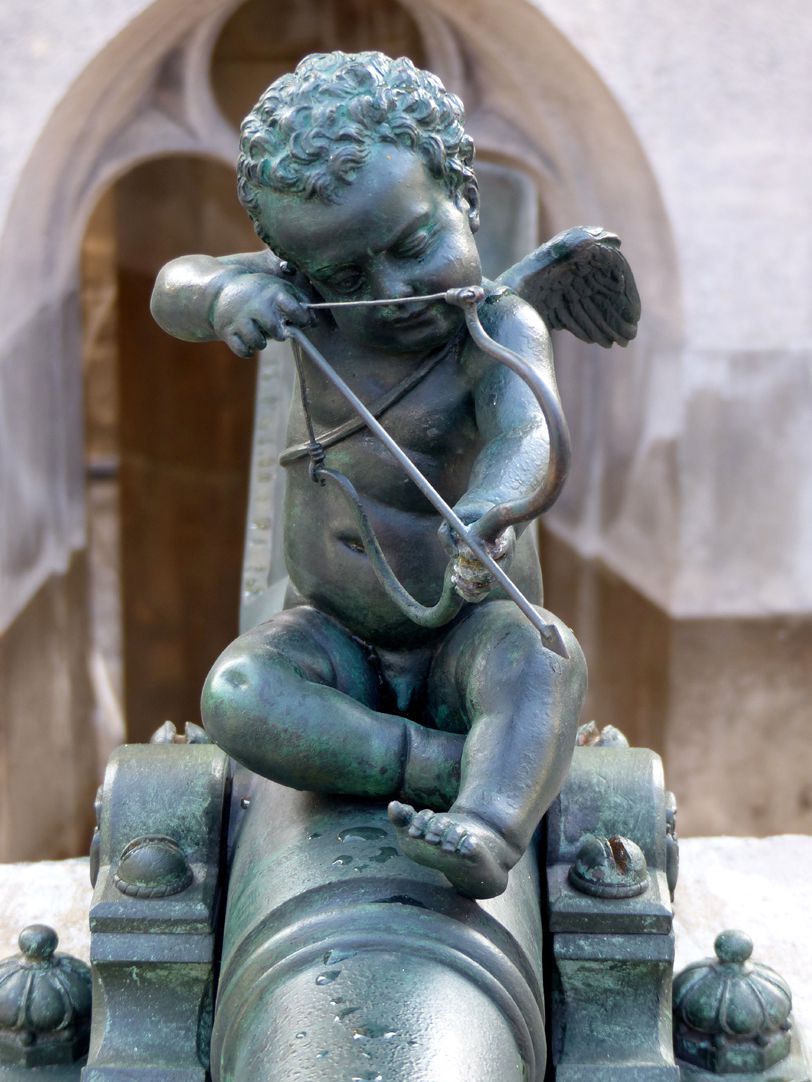
Beautiful fountain
1385 1395
Front view of the restored Cupid (1587?)
"Parlier" Heinrich is said to have been in charge of the overall design. The original sculptural parts are attributed to several masters. The fountain was repaired two times at the end of the 18th century. It was removed respectively renewed 1821-24, restored in 1835 and finally completely replaced by a valuable copy by Heinrich Wallraff 1897-1902. Original parts of the fountain have been preserved in the German National Museum as have parts of the sculptures in Bodemuseum in Berlin. Whereas the fountain architecture can be considered to be originally Gothic, the statues are but an echo of the originals. The original quality of these sculptures is evident by the fragments that have been preserved, it supersedes by far the quality of the sculptures of the previous period in Nuremberg, it is of much higher quality than the one of the figures at the West portal of St. Lorenz-Church and even of the portal of Our Lady´s Church (Frauenkirche) which was created under the Parlers. Regarding architectural history the tower-shaped fountain is a sensation, it is a micro-architecture, definitely with a secular purpose, but completely designed in sacred form-language. In the following time the fountain was adopted as far away as in the Norman Rouen. Relationships with tabernacles of the Late Gothic Period are evident. Concerning the iconographic program the design of the fountain is highly ambitious. The exclusively male figures are distributed over two tiers at the edge of the basin (allegories of Philosophy, the Seven Liberal Arts, the Four Evangelists and the Four Latin Fathers of the Church), apart from that the figures are distributed over two levels of the octagonal tower. The main level displays the Nine Good Heroes, and Seven Electors, over them the Prophets. The hollow octagon ends in an casing of buttresses with an open-worked tracery helmet. The fountain was explicitly mentioned in 1517 by the Italian Antonio de Beatis, correspondent of Cardinal Luigi d´Aragona. Dr. Pablo de la Riestra
Location: Nuremberg, Hauptmarkt
Design: Parlier (Heinrich Parlirer, Beheim, Bheiheim ), Heinrich
photo 12. Nov 2016,
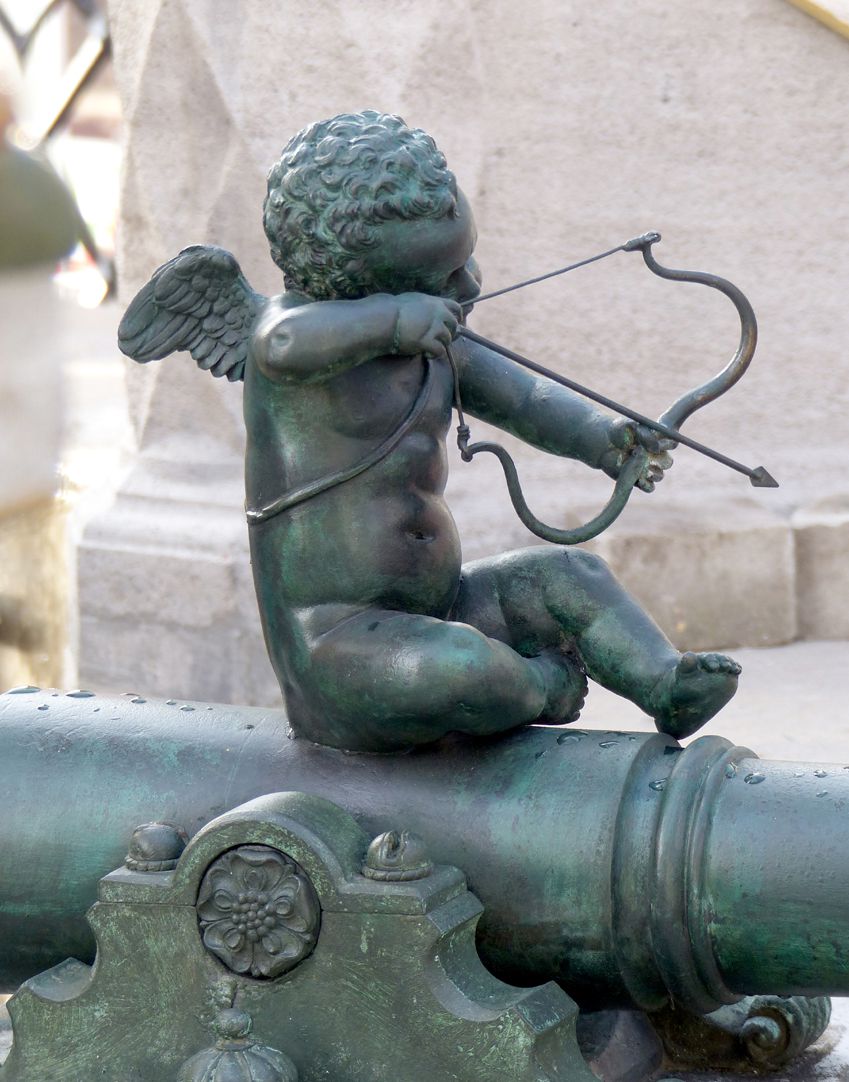
Beautiful fountain
1385 1395
Profile of the restored Cupid (1587?)
"Parlier" Heinrich is said to have been in charge of the overall design. The original sculptural parts are attributed to several masters. The fountain was repaired two times at the end of the 18th century. It was removed respectively renewed 1821-24, restored in 1835 and finally completely replaced by a valuable copy by Heinrich Wallraff 1897-1902. Original parts of the fountain have been preserved in the German National Museum as have parts of the sculptures in Bodemuseum in Berlin. Whereas the fountain architecture can be considered to be originally Gothic, the statues are but an echo of the originals. The original quality of these sculptures is evident by the fragments that have been preserved, it supersedes by far the quality of the sculptures of the previous period in Nuremberg, it is of much higher quality than the one of the figures at the West portal of St. Lorenz-Church and even of the portal of Our Lady´s Church (Frauenkirche) which was created under the Parlers. Regarding architectural history the tower-shaped fountain is a sensation, it is a micro-architecture, definitely with a secular purpose, but completely designed in sacred form-language. In the following time the fountain was adopted as far away as in the Norman Rouen. Relationships with tabernacles of the Late Gothic Period are evident. Concerning the iconographic program the design of the fountain is highly ambitious. The exclusively male figures are distributed over two tiers at the edge of the basin (allegories of Philosophy, the Seven Liberal Arts, the Four Evangelists and the Four Latin Fathers of the Church), apart from that the figures are distributed over two levels of the octagonal tower. The main level displays the Nine Good Heroes, and Seven Electors, over them the Prophets. The hollow octagon ends in an casing of buttresses with an open-worked tracery helmet. The fountain was explicitly mentioned in 1517 by the Italian Antonio de Beatis, correspondent of Cardinal Luigi d´Aragona. Dr. Pablo de la Riestra
Location: Nuremberg, Hauptmarkt
Design: Parlier (Heinrich Parlirer, Beheim, Bheiheim ), Heinrich
photo 12. Nov 2016, Pablo de la Riestra
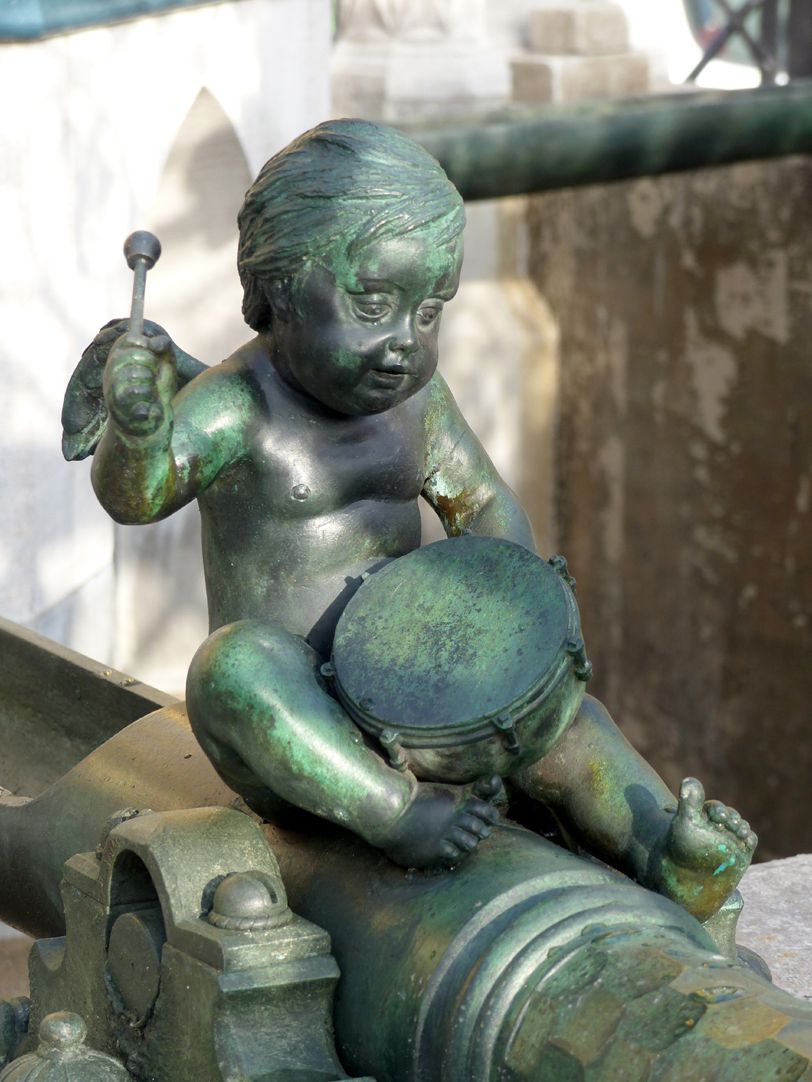
Beautiful fountain
1385 1395
Diagonal view of the restored drum player (1587?)
"Parlier" Heinrich is said to have been in charge of the overall design. The original sculptural parts are attributed to several masters. The fountain was repaired two times at the end of the 18th century. It was removed respectively renewed 1821-24, restored in 1835 and finally completely replaced by a valuable copy by Heinrich Wallraff 1897-1902. Original parts of the fountain have been preserved in the German National Museum as have parts of the sculptures in Bodemuseum in Berlin. Whereas the fountain architecture can be considered to be originally Gothic, the statues are but an echo of the originals. The original quality of these sculptures is evident by the fragments that have been preserved, it supersedes by far the quality of the sculptures of the previous period in Nuremberg, it is of much higher quality than the one of the figures at the West portal of St. Lorenz-Church and even of the portal of Our Lady´s Church (Frauenkirche) which was created under the Parlers. Regarding architectural history the tower-shaped fountain is a sensation, it is a micro-architecture, definitely with a secular purpose, but completely designed in sacred form-language. In the following time the fountain was adopted as far away as in the Norman Rouen. Relationships with tabernacles of the Late Gothic Period are evident. Concerning the iconographic program the design of the fountain is highly ambitious. The exclusively male figures are distributed over two tiers at the edge of the basin (allegories of Philosophy, the Seven Liberal Arts, the Four Evangelists and the Four Latin Fathers of the Church), apart from that the figures are distributed over two levels of the octagonal tower. The main level displays the Nine Good Heroes, and Seven Electors, over them the Prophets. The hollow octagon ends in an casing of buttresses with an open-worked tracery helmet. The fountain was explicitly mentioned in 1517 by the Italian Antonio de Beatis, correspondent of Cardinal Luigi d´Aragona. Dr. Pablo de la Riestra
Location: Nuremberg, Hauptmarkt
Design: Parlier (Heinrich Parlirer, Beheim, Bheiheim ), Heinrich
photo 12. Nov 2016, Pablo de la Riestra
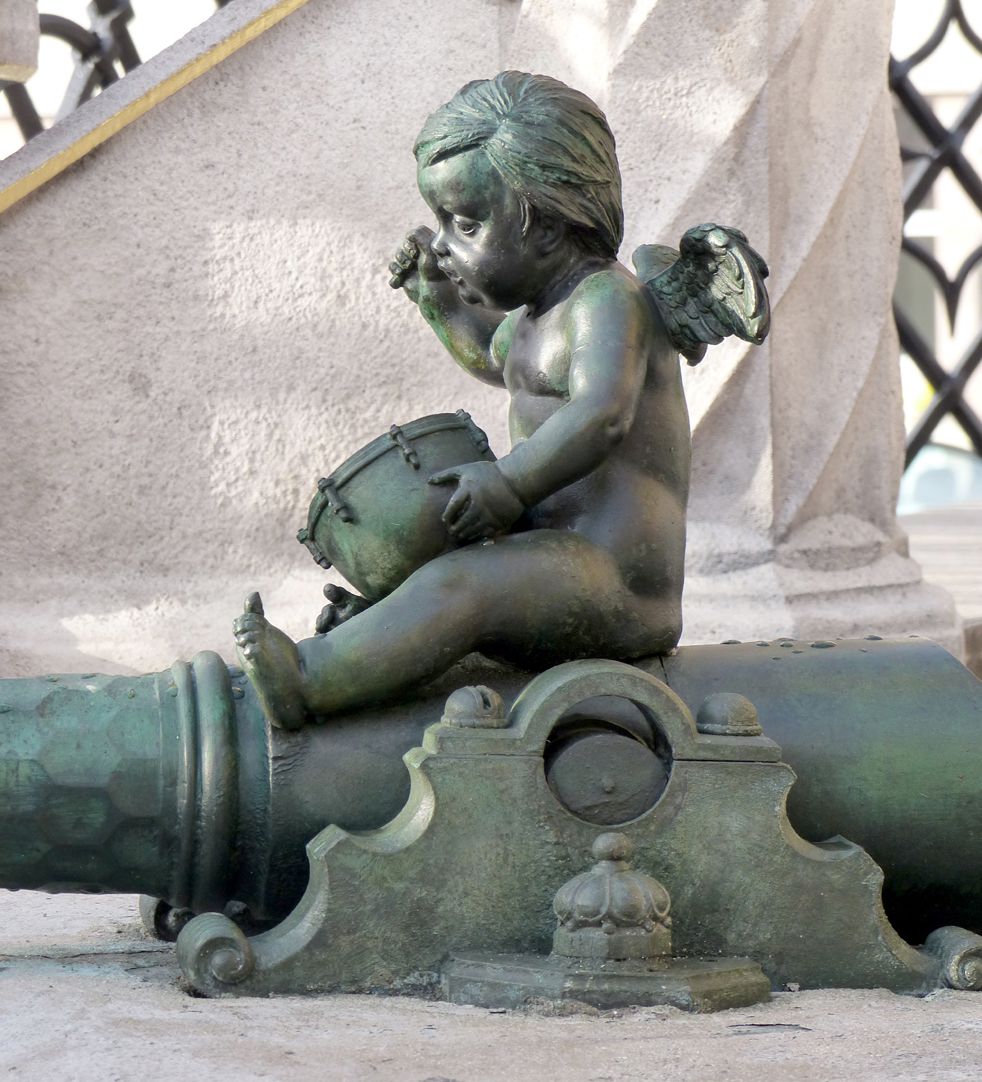
Beautiful fountain
1385 1395
Lateral view of the restored drum player (1587 ?)
"Parlier" Heinrich is said to have been in charge of the overall design. The original sculptural parts are attributed to several masters. The fountain was repaired two times at the end of the 18th century. It was removed respectively renewed 1821-24, restored in 1835 and finally completely replaced by a valuable copy by Heinrich Wallraff 1897-1902. Original parts of the fountain have been preserved in the German National Museum as have parts of the sculptures in Bodemuseum in Berlin. Whereas the fountain architecture can be considered to be originally Gothic, the statues are but an echo of the originals. The original quality of these sculptures is evident by the fragments that have been preserved, it supersedes by far the quality of the sculptures of the previous period in Nuremberg, it is of much higher quality than the one of the figures at the West portal of St. Lorenz-Church and even of the portal of Our Lady´s Church (Frauenkirche) which was created under the Parlers. Regarding architectural history the tower-shaped fountain is a sensation, it is a micro-architecture, definitely with a secular purpose, but completely designed in sacred form-language. In the following time the fountain was adopted as far away as in the Norman Rouen. Relationships with tabernacles of the Late Gothic Period are evident. Concerning the iconographic program the design of the fountain is highly ambitious. The exclusively male figures are distributed over two tiers at the edge of the basin (allegories of Philosophy, the Seven Liberal Arts, the Four Evangelists and the Four Latin Fathers of the Church), apart from that the figures are distributed over two levels of the octagonal tower. The main level displays the Nine Good Heroes, and Seven Electors, over them the Prophets. The hollow octagon ends in an casing of buttresses with an open-worked tracery helmet. The fountain was explicitly mentioned in 1517 by the Italian Antonio de Beatis, correspondent of Cardinal Luigi d´Aragona. Dr. Pablo de la Riestra
Location: Nuremberg, Hauptmarkt
Design: Parlier (Heinrich Parlirer, Beheim, Bheiheim ), Heinrich
photo 2016, Pablo de la Riestra
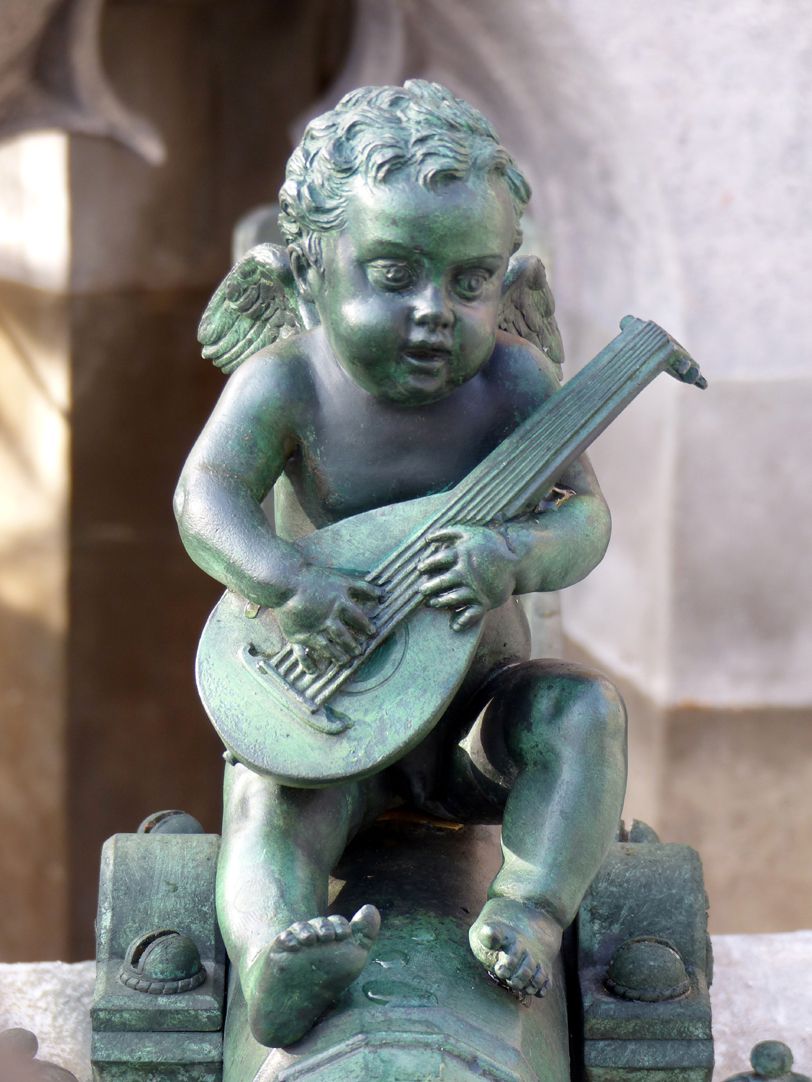
Beautiful fountain
1385 1395
Front view of the lute player (1587?)
"Parlier" Heinrich is said to have been in charge of the overall design. The original sculptural parts are attributed to several masters. The fountain was repaired two times at the end of the 18th century. It was removed respectively renewed 1821-24, restored in 1835 and finally completely replaced by a valuable copy by Heinrich Wallraff 1897-1902. Original parts of the fountain have been preserved in the German National Museum as have parts of the sculptures in Bodemuseum in Berlin. Whereas the fountain architecture can be considered to be originally Gothic, the statues are but an echo of the originals. The original quality of these sculptures is evident by the fragments that have been preserved, it supersedes by far the quality of the sculptures of the previous period in Nuremberg, it is of much higher quality than the one of the figures at the West portal of St. Lorenz-Church and even of the portal of Our Lady´s Church (Frauenkirche) which was created under the Parlers. Regarding architectural history the tower-shaped fountain is a sensation, it is a micro-architecture, definitely with a secular purpose, but completely designed in sacred form-language. In the following time the fountain was adopted as far away as in the Norman Rouen. Relationships with tabernacles of the Late Gothic Period are evident. Concerning the iconographic program the design of the fountain is highly ambitious. The exclusively male figures are distributed over two tiers at the edge of the basin (allegories of Philosophy, the Seven Liberal Arts, the Four Evangelists and the Four Latin Fathers of the Church), apart from that the figures are distributed over two levels of the octagonal tower. The main level displays the Nine Good Heroes, and Seven Electors, over them the Prophets. The hollow octagon ends in an casing of buttresses with an open-worked tracery helmet. The fountain was explicitly mentioned in 1517 by the Italian Antonio de Beatis, correspondent of Cardinal Luigi d´Aragona. Dr. Pablo de la Riestra
Location: Nuremberg, Hauptmarkt
Design: Parlier (Heinrich Parlirer, Beheim, Bheiheim ), Heinrich
photo 12. Nov 2016, Pablo de la Riestra
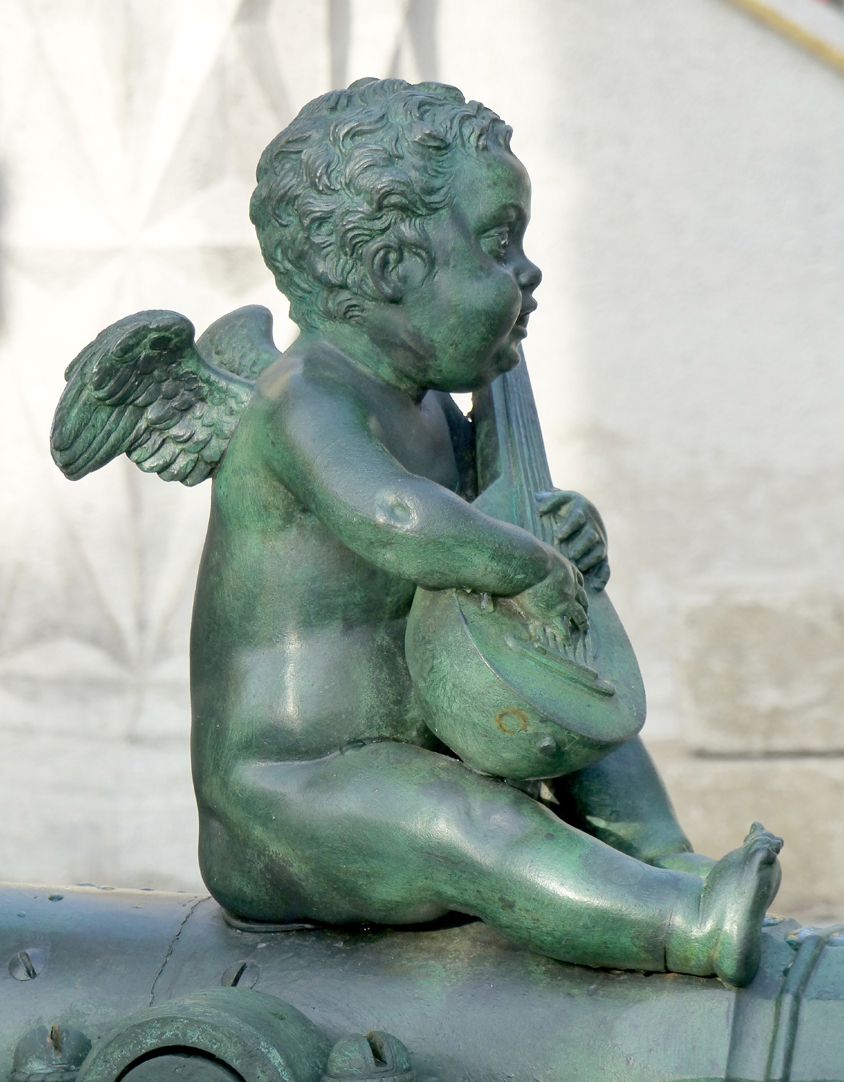
Beautiful fountain
1385 1395
Profile of the lute player (1587?)
"Parlier" Heinrich is said to have been in charge of the overall design. The original sculptural parts are attributed to several masters. The fountain was repaired two times at the end of the 18th century. It was removed respectively renewed 1821-24, restored in 1835 and finally completely replaced by a valuable copy by Heinrich Wallraff 1897-1902. Original parts of the fountain have been preserved in the German National Museum as have parts of the sculptures in Bodemuseum in Berlin. Whereas the fountain architecture can be considered to be originally Gothic, the statues are but an echo of the originals. The original quality of these sculptures is evident by the fragments that have been preserved, it supersedes by far the quality of the sculptures of the previous period in Nuremberg, it is of much higher quality than the one of the figures at the West portal of St. Lorenz-Church and even of the portal of Our Lady´s Church (Frauenkirche) which was created under the Parlers. Regarding architectural history the tower-shaped fountain is a sensation, it is a micro-architecture, definitely with a secular purpose, but completely designed in sacred form-language. In the following time the fountain was adopted as far away as in the Norman Rouen. Relationships with tabernacles of the Late Gothic Period are evident. Concerning the iconographic program the design of the fountain is highly ambitious. The exclusively male figures are distributed over two tiers at the edge of the basin (allegories of Philosophy, the Seven Liberal Arts, the Four Evangelists and the Four Latin Fathers of the Church), apart from that the figures are distributed over two levels of the octagonal tower. The main level displays the Nine Good Heroes, and Seven Electors, over them the Prophets. The hollow octagon ends in an casing of buttresses with an open-worked tracery helmet. The fountain was explicitly mentioned in 1517 by the Italian Antonio de Beatis, correspondent of Cardinal Luigi d´Aragona. Dr. Pablo de la Riestra
Location: Nuremberg, Hauptmarkt
Design: Parlier (Heinrich Parlirer, Beheim, Bheiheim ), Heinrich
photo 12. Nov 2016, Pablo de la Riestra
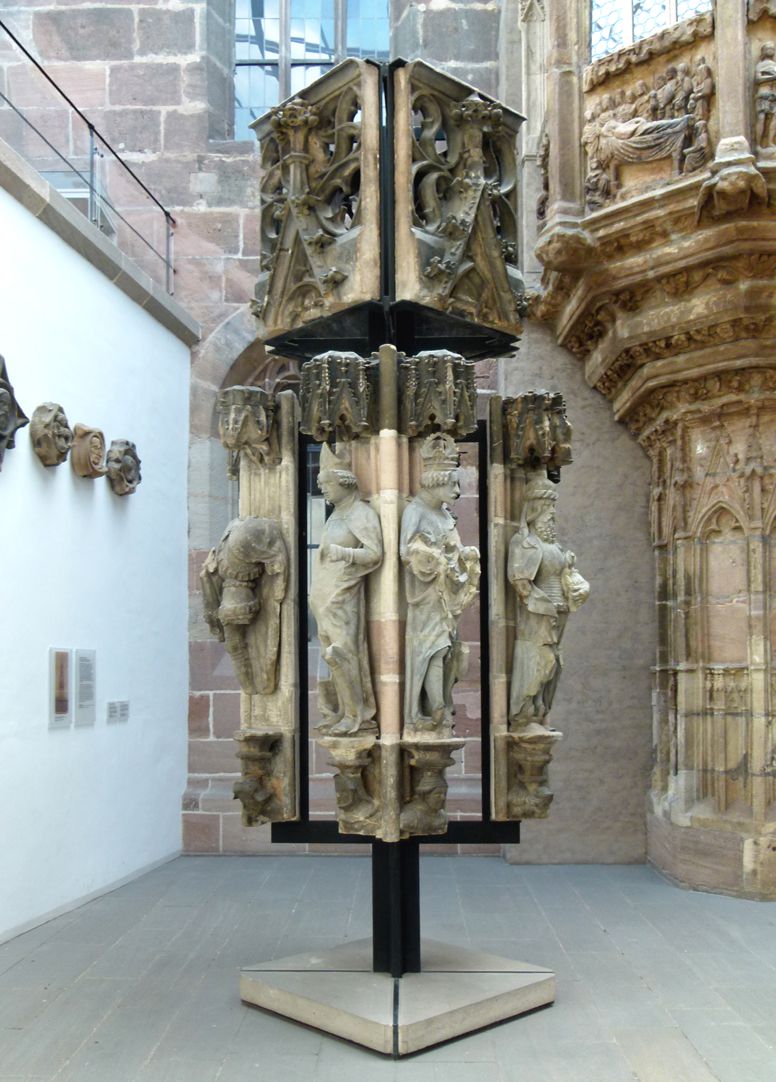
Beautiful fountain
1385 1395
Original parts of the level of the Heroes and the Electors
"Parlier" Heinrich is said to have been in charge of the overall design. The original sculptural parts are attributed to several masters. The fountain was repaired two times at the end of the 18th century. It was removed respectively renewed 1821-24, restored in 1835 and finally completely replaced by a valuable copy by Heinrich Wallraff 1897-1902. Original parts of the fountain have been preserved in the German National Museum as have parts of the sculptures in Bodemuseum in Berlin. Whereas the fountain architecture can be considered to be originally Gothic, the statues are but an echo of the originals. The original quality of these sculptures is evident by the fragments that have been preserved, it supersedes by far the quality of the sculptures of the previous period in Nuremberg, it is of much higher quality than the one of the figures at the West portal of St. Lorenz-Church and even of the portal of Our Lady´s Church (Frauenkirche) which was created under the Parlers. Regarding architectural history the tower-shaped fountain is a sensation, it is a micro-architecture, definitely with a secular purpose, but completely designed in sacred form-language. In the following time the fountain was adopted as far away as in the Norman Rouen. Relationships with tabernacles of the Late Gothic Period are evident. Concerning the iconographic program the design of the fountain is highly ambitious. The exclusively male figures are distributed over two tiers at the edge of the basin (allegories of Philosophy, the Seven Liberal Arts, the Four Evangelists and the Four Latin Fathers of the Church), apart from that the figures are distributed over two levels of the octagonal tower. The main level displays the Nine Good Heroes, and Seven Electors, over them the Prophets. The hollow octagon ends in an casing of buttresses with an open-worked tracery helmet. The fountain was explicitly mentioned in 1517 by the Italian Antonio de Beatis, correspondent of Cardinal Luigi d´Aragona. Dr. Pablo de la Riestra
Location: Nuremberg, German National Museum
Design: Parlier (Heinrich Parlirer, Beheim, Bheiheim ), Heinrich
photo 2013, Pablo de la Riestra
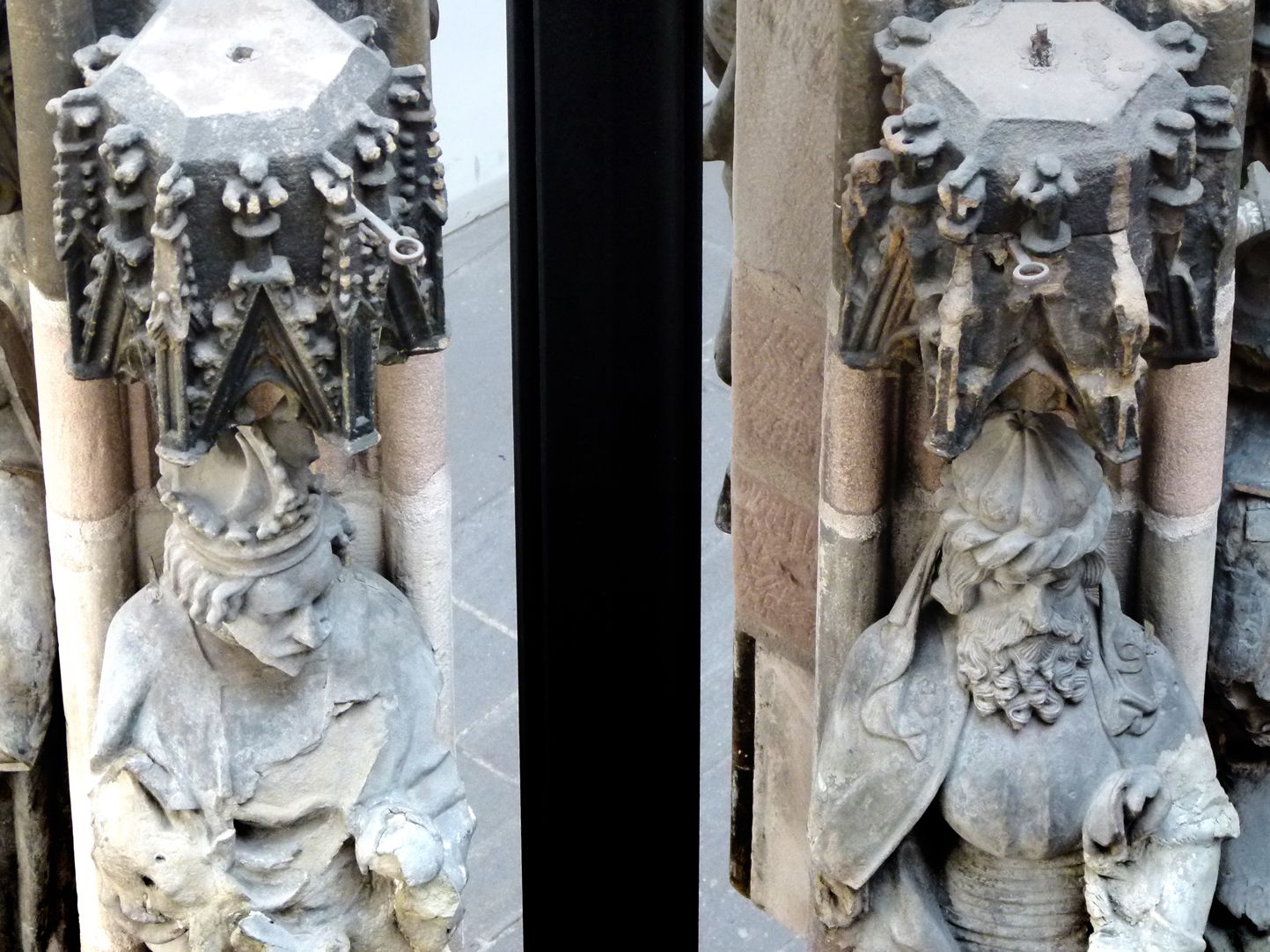
Beautiful fountain
1385 1395
Original parts of the level of the Heroes and the Electors with canopies
"Parlier" Heinrich is said to have been in charge of the overall design. The original sculptural parts are attributed to several masters. The fountain was repaired two times at the end of the 18th century. It was removed respectively renewed 1821-24, restored in 1835 and finally completely replaced by a valuable copy by Heinrich Wallraff 1897-1902. Original parts of the fountain have been preserved in the German National Museum as have parts of the sculptures in Bodemuseum in Berlin. Whereas the fountain architecture can be considered to be originally Gothic, the statues are but an echo of the originals. The original quality of these sculptures is evident by the fragments that have been preserved, it supersedes by far the quality of the sculptures of the previous period in Nuremberg, it is of much higher quality than the one of the figures at the West portal of St. Lorenz-Church and even of the portal of Our Lady´s Church (Frauenkirche) which was created under the Parlers. Regarding architectural history the tower-shaped fountain is a sensation, it is a micro-architecture, definitely with a secular purpose, but completely designed in sacred form-language. In the following time the fountain was adopted as far away as in the Norman Rouen. Relationships with tabernacles of the Late Gothic Period are evident. Concerning the iconographic program the design of the fountain is highly ambitious. The exclusively male figures are distributed over two tiers at the edge of the basin (allegories of Philosophy, the Seven Liberal Arts, the Four Evangelists and the Four Latin Fathers of the Church), apart from that the figures are distributed over two levels of the octagonal tower. The main level displays the Nine Good Heroes, and Seven Electors, over them the Prophets. The hollow octagon ends in an casing of buttresses with an open-worked tracery helmet. The fountain was explicitly mentioned in 1517 by the Italian Antonio de Beatis, correspondent of Cardinal Luigi d´Aragona. Dr. Pablo de la Riestra
Location: Nuremberg, German National Museum
Design: Parlier (Heinrich Parlirer, Beheim, Bheiheim ), Heinrich
photo 2013, Pablo de la Riestra
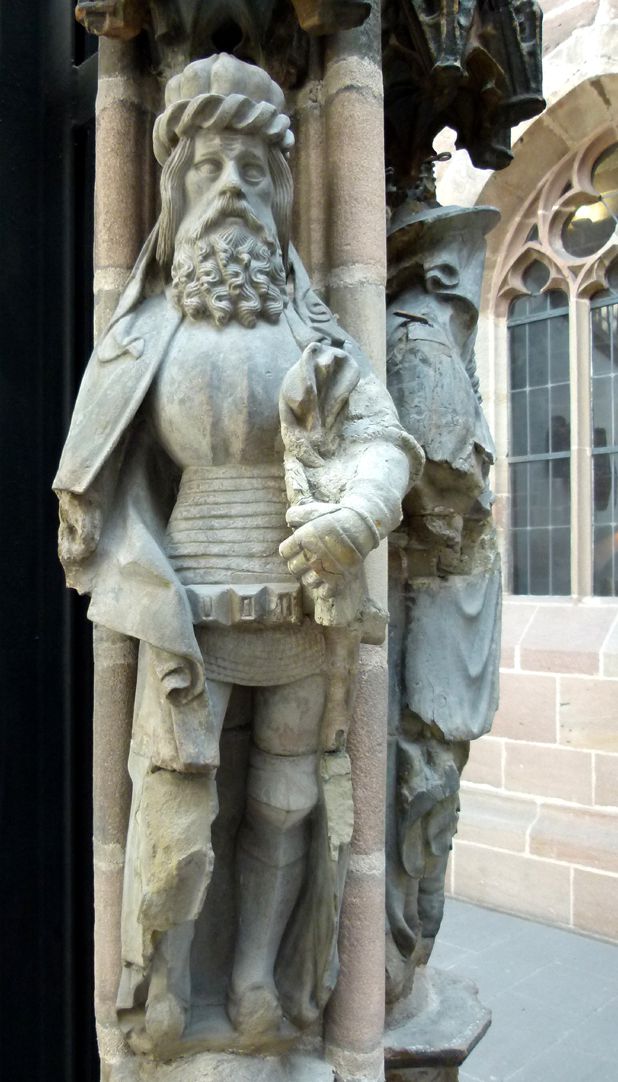
Beautiful fountain
1385 1395
Cesar
"Parlier" Heinrich is said to have been in charge of the overall design. The original sculptural parts are attributed to several masters. The fountain was repaired two times at the end of the 18th century. It was removed respectively renewed 1821-24, restored in 1835 and finally completely replaced by a valuable copy by Heinrich Wallraff 1897-1902. Original parts of the fountain have been preserved in the German National Museum as have parts of the sculptures in Bodemuseum in Berlin. Whereas the fountain architecture can be considered to be originally Gothic, the statues are but an echo of the originals. The original quality of these sculptures is evident by the fragments that have been preserved, it supersedes by far the quality of the sculptures of the previous period in Nuremberg, it is of much higher quality than the one of the figures at the West portal of St. Lorenz-Church and even of the portal of Our Lady´s Church (Frauenkirche) which was created under the Parlers. Regarding architectural history the tower-shaped fountain is a sensation, it is a micro-architecture, definitely with a secular purpose, but completely designed in sacred form-language. In the following time the fountain was adopted as far away as in the Norman Rouen. Relationships with tabernacles of the Late Gothic Period are evident. Concerning the iconographic program the design of the fountain is highly ambitious. The exclusively male figures are distributed over two tiers at the edge of the basin (allegories of Philosophy, the Seven Liberal Arts, the Four Evangelists and the Four Latin Fathers of the Church), apart from that the figures are distributed over two levels of the octagonal tower. The main level displays the Nine Good Heroes, and Seven Electors, over them the Prophets. The hollow octagon ends in an casing of buttresses with an open-worked tracery helmet. The fountain was explicitly mentioned in 1517 by the Italian Antonio de Beatis, correspondent of Cardinal Luigi d´Aragona. Dr. Pablo de la Riestra
Location: Nuremberg, German National Museum
Design: Parlier (Heinrich Parlirer, Beheim, Bheiheim ), Heinrich
photo 2013, Pablo de la Riestra
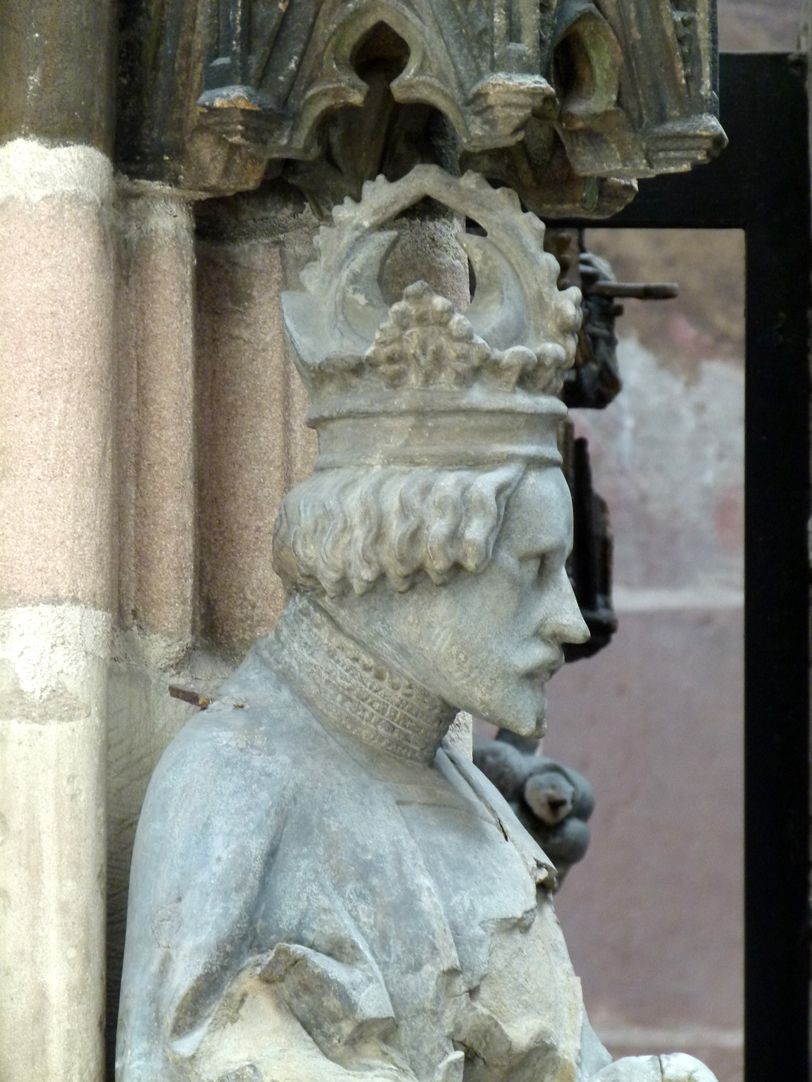
Beautiful fountain
1385 1395
Gottfried of Bouillon
"Parlier" Heinrich is said to have been in charge of the overall design. The original sculptural parts are attributed to several masters. The fountain was repaired two times at the end of the 18th century. It was removed respectively renewed 1821-24, restored in 1835 and finally completely replaced by a valuable copy by Heinrich Wallraff 1897-1902. Original parts of the fountain have been preserved in the German National Museum as have parts of the sculptures in Bodemuseum in Berlin. Whereas the fountain architecture can be considered to be originally Gothic, the statues are but an echo of the originals. The original quality of these sculptures is evident by the fragments that have been preserved, it supersedes by far the quality of the sculptures of the previous period in Nuremberg, it is of much higher quality than the one of the figures at the West portal of St. Lorenz-Church and even of the portal of Our Lady´s Church (Frauenkirche) which was created under the Parlers. Regarding architectural history the tower-shaped fountain is a sensation, it is a micro-architecture, definitely with a secular purpose, but completely designed in sacred form-language. In the following time the fountain was adopted as far away as in the Norman Rouen. Relationships with tabernacles of the Late Gothic Period are evident. Concerning the iconographic program the design of the fountain is highly ambitious. The exclusively male figures are distributed over two tiers at the edge of the basin (allegories of Philosophy, the Seven Liberal Arts, the Four Evangelists and the Four Latin Fathers of the Church), apart from that the figures are distributed over two levels of the octagonal tower. The main level displays the Nine Good Heroes, and Seven Electors, over them the Prophets. The hollow octagon ends in an casing of buttresses with an open-worked tracery helmet. The fountain was explicitly mentioned in 1517 by the Italian Antonio de Beatis, correspondent of Cardinal Luigi d´Aragona. Dr. Pablo de la Riestra
Location: Nuremberg, German National Museum
Design: Parlier (Heinrich Parlirer, Beheim, Bheiheim ), Heinrich
photo 2013, Pablo de la Riestra
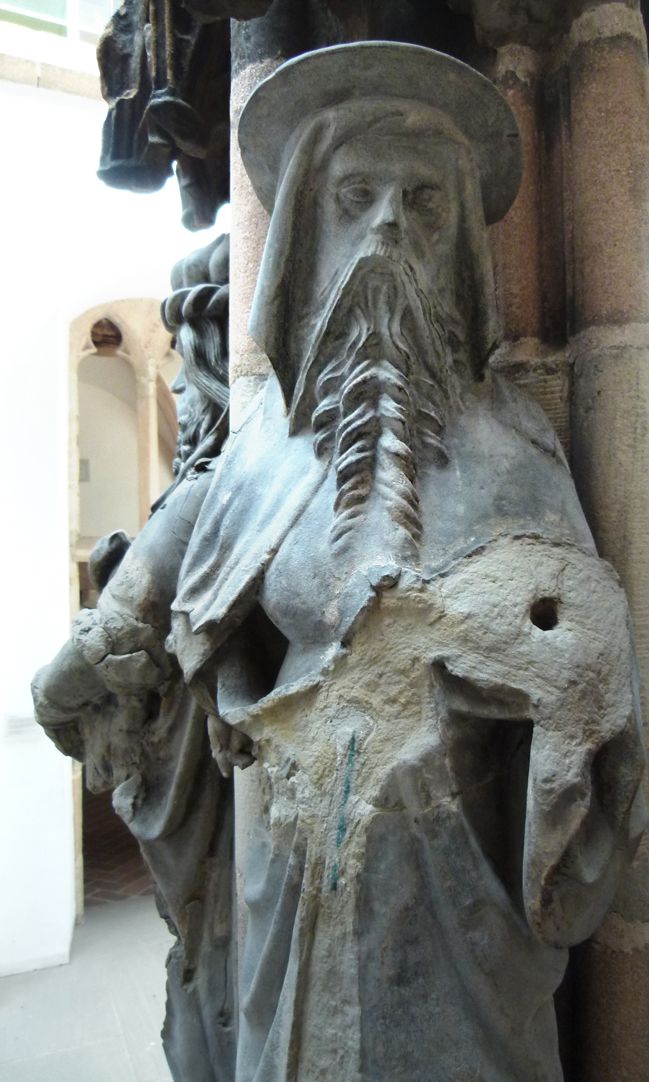
Beautiful fountain
1385 1395
Joshua
"Parlier" Heinrich is said to have been in charge of the overall design. The original sculptural parts are attributed to several masters. The fountain was repaired two times at the end of the 18th century. It was removed respectively renewed 1821-24, restored in 1835 and finally completely replaced by a valuable copy by Heinrich Wallraff 1897-1902. Original parts of the fountain have been preserved in the German National Museum as have parts of the sculptures in Bodemuseum in Berlin. Whereas the fountain architecture can be considered to be originally Gothic, the statues are but an echo of the originals. The original quality of these sculptures is evident by the fragments that have been preserved, it supersedes by far the quality of the sculptures of the previous period in Nuremberg, it is of much higher quality than the one of the figures at the West portal of St. Lorenz-Church and even of the portal of Our Lady´s Church (Frauenkirche) which was created under the Parlers. Regarding architectural history the tower-shaped fountain is a sensation, it is a micro-architecture, definitely with a secular purpose, but completely designed in sacred form-language. In the following time the fountain was adopted as far away as in the Norman Rouen. Relationships with tabernacles of the Late Gothic Period are evident. Concerning the iconographic program the design of the fountain is highly ambitious. The exclusively male figures are distributed over two tiers at the edge of the basin (allegories of Philosophy, the Seven Liberal Arts, the Four Evangelists and the Four Latin Fathers of the Church), apart from that the figures are distributed over two levels of the octagonal tower. The main level displays the Nine Good Heroes, and Seven Electors, over them the Prophets. The hollow octagon ends in an casing of buttresses with an open-worked tracery helmet. The fountain was explicitly mentioned in 1517 by the Italian Antonio de Beatis, correspondent of Cardinal Luigi d´Aragona. Dr. Pablo de la Riestra
Location: Nuremberg, German National Museum
Design: Parlier (Heinrich Parlirer, Beheim, Bheiheim ), Heinrich
photo 2013, Pablo de la Riestra
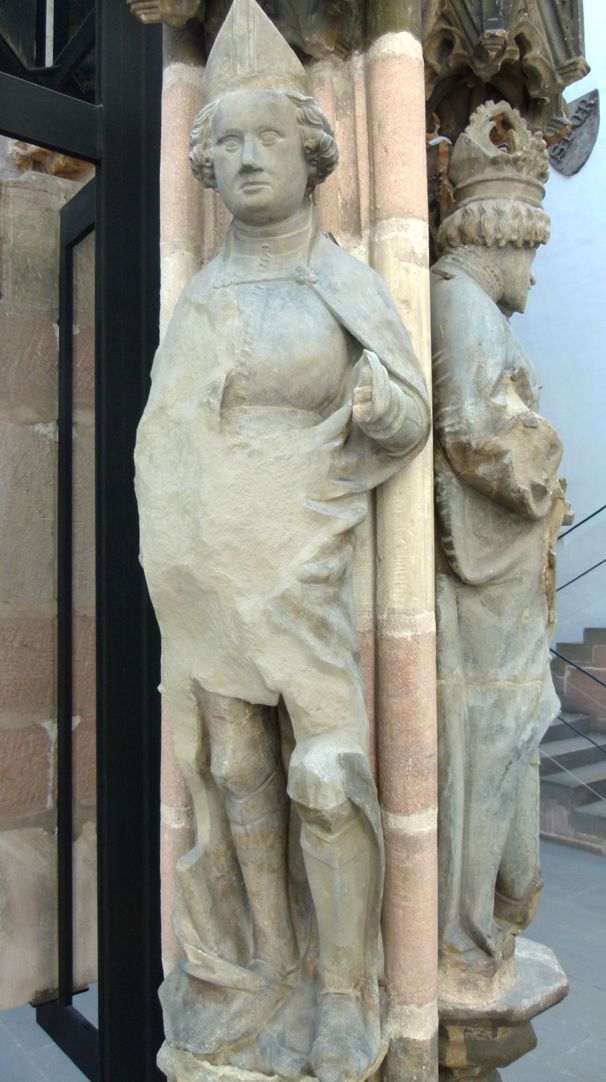
Beautiful fountain
1385 1395
Judas Maccabäus
"Parlier" Heinrich is said to have been in charge of the overall design. The original sculptural parts are attributed to several masters. The fountain was repaired two times at the end of the 18th century. It was removed respectively renewed 1821-24, restored in 1835 and finally completely replaced by a valuable copy by Heinrich Wallraff 1897-1902. Original parts of the fountain have been preserved in the German National Museum as have parts of the sculptures in Bodemuseum in Berlin. Whereas the fountain architecture can be considered to be originally Gothic, the statues are but an echo of the originals. The original quality of these sculptures is evident by the fragments that have been preserved, it supersedes by far the quality of the sculptures of the previous period in Nuremberg, it is of much higher quality than the one of the figures at the West portal of St. Lorenz-Church and even of the portal of Our Lady´s Church (Frauenkirche) which was created under the Parlers. Regarding architectural history the tower-shaped fountain is a sensation, it is a micro-architecture, definitely with a secular purpose, but completely designed in sacred form-language. In the following time the fountain was adopted as far away as in the Norman Rouen. Relationships with tabernacles of the Late Gothic Period are evident. Concerning the iconographic program the design of the fountain is highly ambitious. The exclusively male figures are distributed over two tiers at the edge of the basin (allegories of Philosophy, the Seven Liberal Arts, the Four Evangelists and the Four Latin Fathers of the Church), apart from that the figures are distributed over two levels of the octagonal tower. The main level displays the Nine Good Heroes, and Seven Electors, over them the Prophets. The hollow octagon ends in an casing of buttresses with an open-worked tracery helmet. The fountain was explicitly mentioned in 1517 by the Italian Antonio de Beatis, correspondent of Cardinal Luigi d´Aragona. Dr. Pablo de la Riestra
Location: Nuremberg, German National Museum
Design: Parlier (Heinrich Parlirer, Beheim, Bheiheim ), Heinrich
photo 2013, Pablo de la Riestra
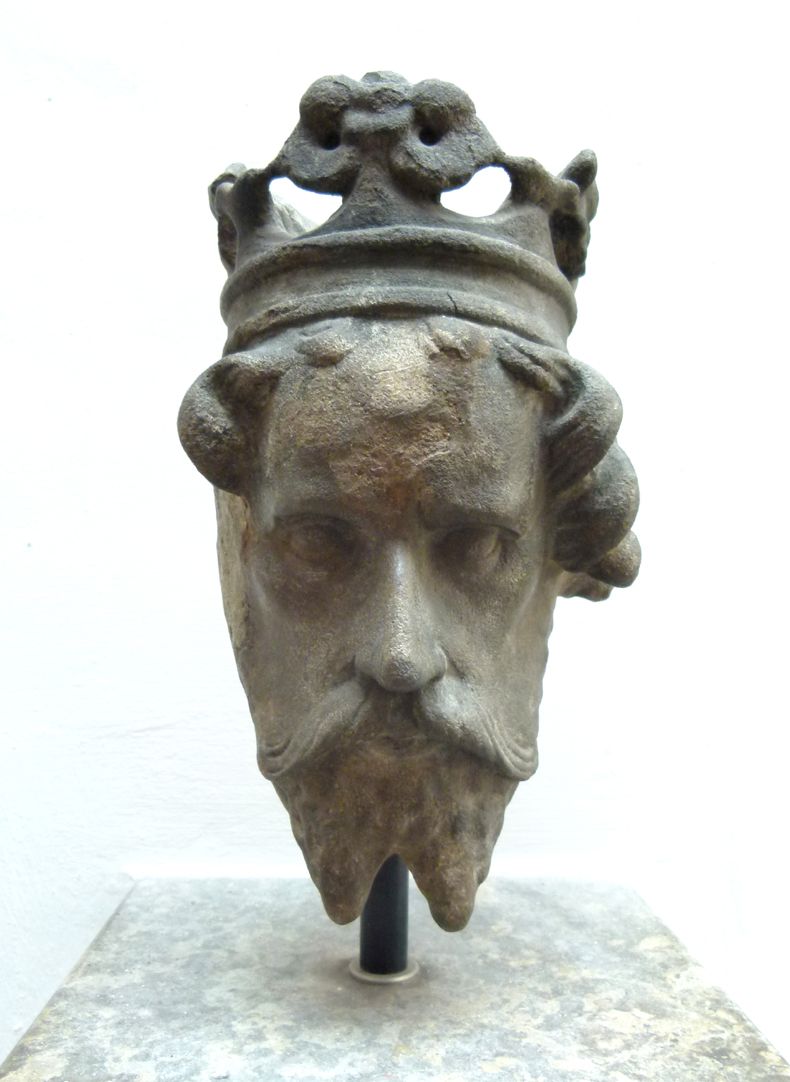
Beautiful fountain
1385 1395
King Arthur
"Parlier" Heinrich is said to have been in charge of the overall design. The original sculptural parts are attributed to several masters. The fountain was repaired two times at the end of the 18th century. It was removed respectively renewed 1821-24, restored in 1835 and finally completely replaced by a valuable copy by Heinrich Wallraff 1897-1902. Original parts of the fountain have been preserved in the German National Museum as have parts of the sculptures in Bodemuseum in Berlin. Whereas the fountain architecture can be considered to be originally Gothic, the statues are but an echo of the originals. The original quality of these sculptures is evident by the fragments that have been preserved, it supersedes by far the quality of the sculptures of the previous period in Nuremberg, it is of much higher quality than the one of the figures at the West portal of St. Lorenz-Church and even of the portal of Our Lady´s Church (Frauenkirche) which was created under the Parlers. Regarding architectural history the tower-shaped fountain is a sensation, it is a micro-architecture, definitely with a secular purpose, but completely designed in sacred form-language. In the following time the fountain was adopted as far away as in the Norman Rouen. Relationships with tabernacles of the Late Gothic Period are evident. Concerning the iconographic program the design of the fountain is highly ambitious. The exclusively male figures are distributed over two tiers at the edge of the basin (allegories of Philosophy, the Seven Liberal Arts, the Four Evangelists and the Four Latin Fathers of the Church), apart from that the figures are distributed over two levels of the octagonal tower. The main level displays the Nine Good Heroes, and Seven Electors, over them the Prophets. The hollow octagon ends in an casing of buttresses with an open-worked tracery helmet. The fountain was explicitly mentioned in 1517 by the Italian Antonio de Beatis, correspondent of Cardinal Luigi d´Aragona. Dr. Pablo de la Riestra
Location: Nuremberg, German National Museum
Design: Parlier (Heinrich Parlirer, Beheim, Bheiheim ), Heinrich
photo 2013, Pablo de la Riestra
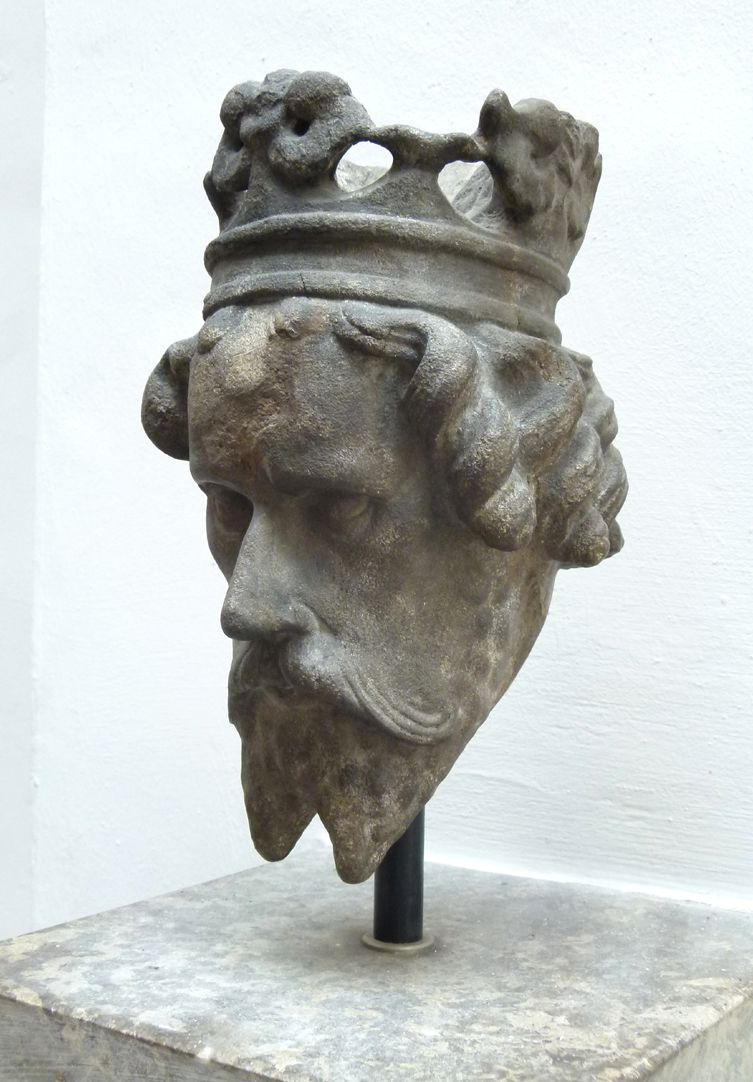
Beautiful fountain
1385 1395
King Arthur, lateral view
"Parlier" Heinrich is said to have been in charge of the overall design. The original sculptural parts are attributed to several masters. The fountain was repaired two times at the end of the 18th century. It was removed respectively renewed 1821-24, restored in 1835 and finally completely replaced by a valuable copy by Heinrich Wallraff 1897-1902. Original parts of the fountain have been preserved in the German National Museum as have parts of the sculptures in Bodemuseum in Berlin. Whereas the fountain architecture can be considered to be originally Gothic, the statues are but an echo of the originals. The original quality of these sculptures is evident by the fragments that have been preserved, it supersedes by far the quality of the sculptures of the previous period in Nuremberg, it is of much higher quality than the one of the figures at the West portal of St. Lorenz-Church and even of the portal of Our Lady´s Church (Frauenkirche) which was created under the Parlers. Regarding architectural history the tower-shaped fountain is a sensation, it is a micro-architecture, definitely with a secular purpose, but completely designed in sacred form-language. In the following time the fountain was adopted as far away as in the Norman Rouen. Relationships with tabernacles of the Late Gothic Period are evident. Concerning the iconographic program the design of the fountain is highly ambitious. The exclusively male figures are distributed over two tiers at the edge of the basin (allegories of Philosophy, the Seven Liberal Arts, the Four Evangelists and the Four Latin Fathers of the Church), apart from that the figures are distributed over two levels of the octagonal tower. The main level displays the Nine Good Heroes, and Seven Electors, over them the Prophets. The hollow octagon ends in an casing of buttresses with an open-worked tracery helmet. The fountain was explicitly mentioned in 1517 by the Italian Antonio de Beatis, correspondent of Cardinal Luigi d´Aragona. Dr. Pablo de la Riestra
Location: Nuremberg, German National Museum
Design: Parlier (Heinrich Parlirer, Beheim, Bheiheim ), Heinrich
photo 2013, Pablo de la Riestra
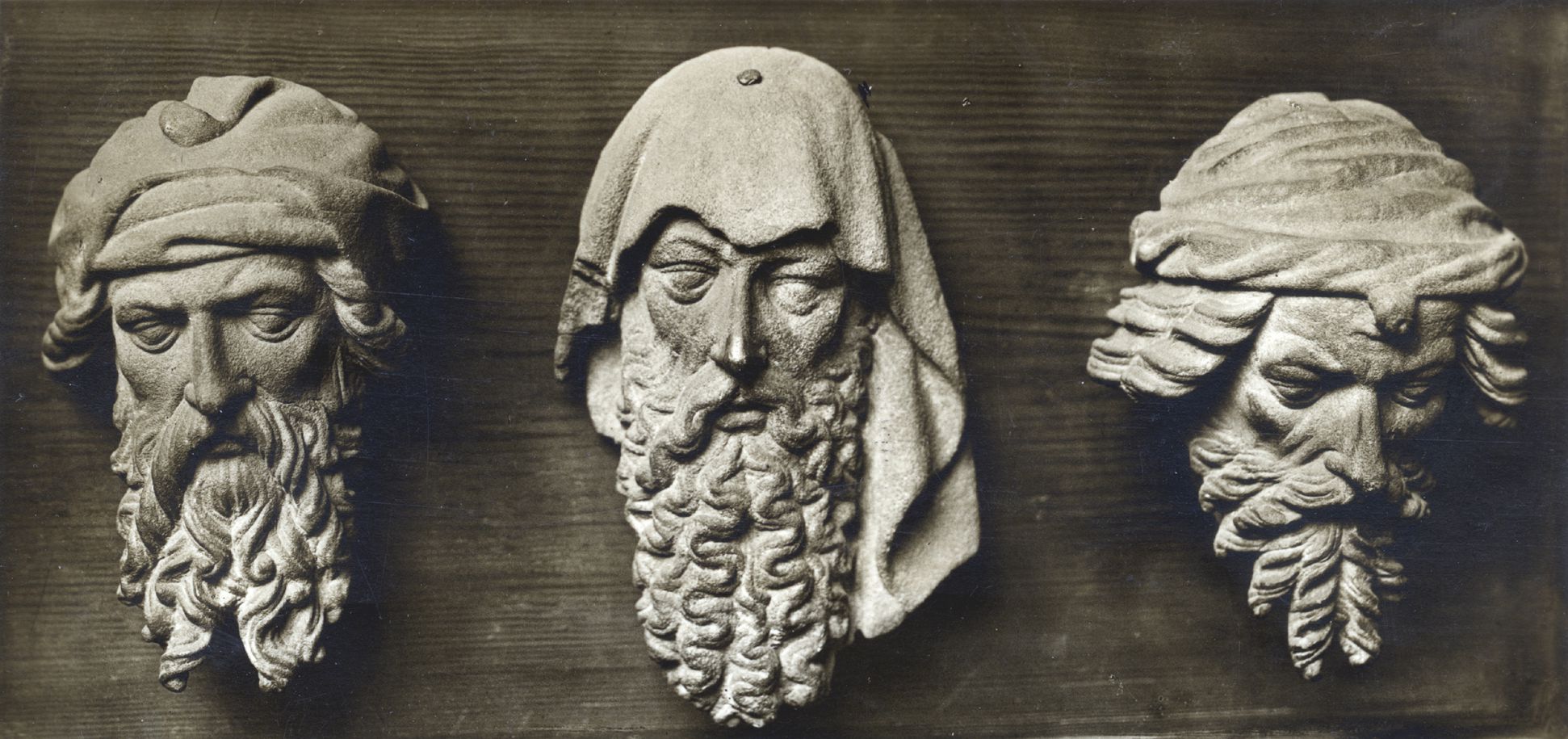
Beautiful fountain
1385 1395
Berlin Bode-Museum, three prohets´heads, photo of the 1920s, Deutscher Kunstverlag
photo
"Parlier" Heinrich is said to have been in charge of the overall design. The original sculptural parts are attributed to several masters. The fountain was repaired two times at the end of the 18th century. It was removed respectively renewed 1821-24, restored in 1835 and finally completely replaced by a valuable copy by Heinrich Wallraff 1897-1902. Original parts of the fountain have been preserved in the German National Museum as have parts of the sculptures in Bodemuseum in Berlin. Whereas the fountain architecture can be considered to be originally Gothic, the statues are but an echo of the originals. The original quality of these sculptures is evident by the fragments that have been preserved, it supersedes by far the quality of the sculptures of the previous period in Nuremberg, it is of much higher quality than the one of the figures at the West portal of St. Lorenz-Church and even of the portal of Our Lady´s Church (Frauenkirche) which was created under the Parlers. Regarding architectural history the tower-shaped fountain is a sensation, it is a micro-architecture, definitely with a secular purpose, but completely designed in sacred form-language. In the following time the fountain was adopted as far away as in the Norman Rouen. Relationships with tabernacles of the Late Gothic Period are evident. Concerning the iconographic program the design of the fountain is highly ambitious. The exclusively male figures are distributed over two tiers at the edge of the basin (allegories of Philosophy, the Seven Liberal Arts, the Four Evangelists and the Four Latin Fathers of the Church), apart from that the figures are distributed over two levels of the octagonal tower. The main level displays the Nine Good Heroes, and Seven Electors, over them the Prophets. The hollow octagon ends in an casing of buttresses with an open-worked tracery helmet. The fountain was explicitly mentioned in 1517 by the Italian Antonio de Beatis, correspondent of Cardinal Luigi d´Aragona. Dr. Pablo de la Riestra
Location: Nuremberg, Hauptmarkt
Design: Parlier (Heinrich Parlirer, Beheim, Bheiheim ), Heinrich