Resurrection of Christ
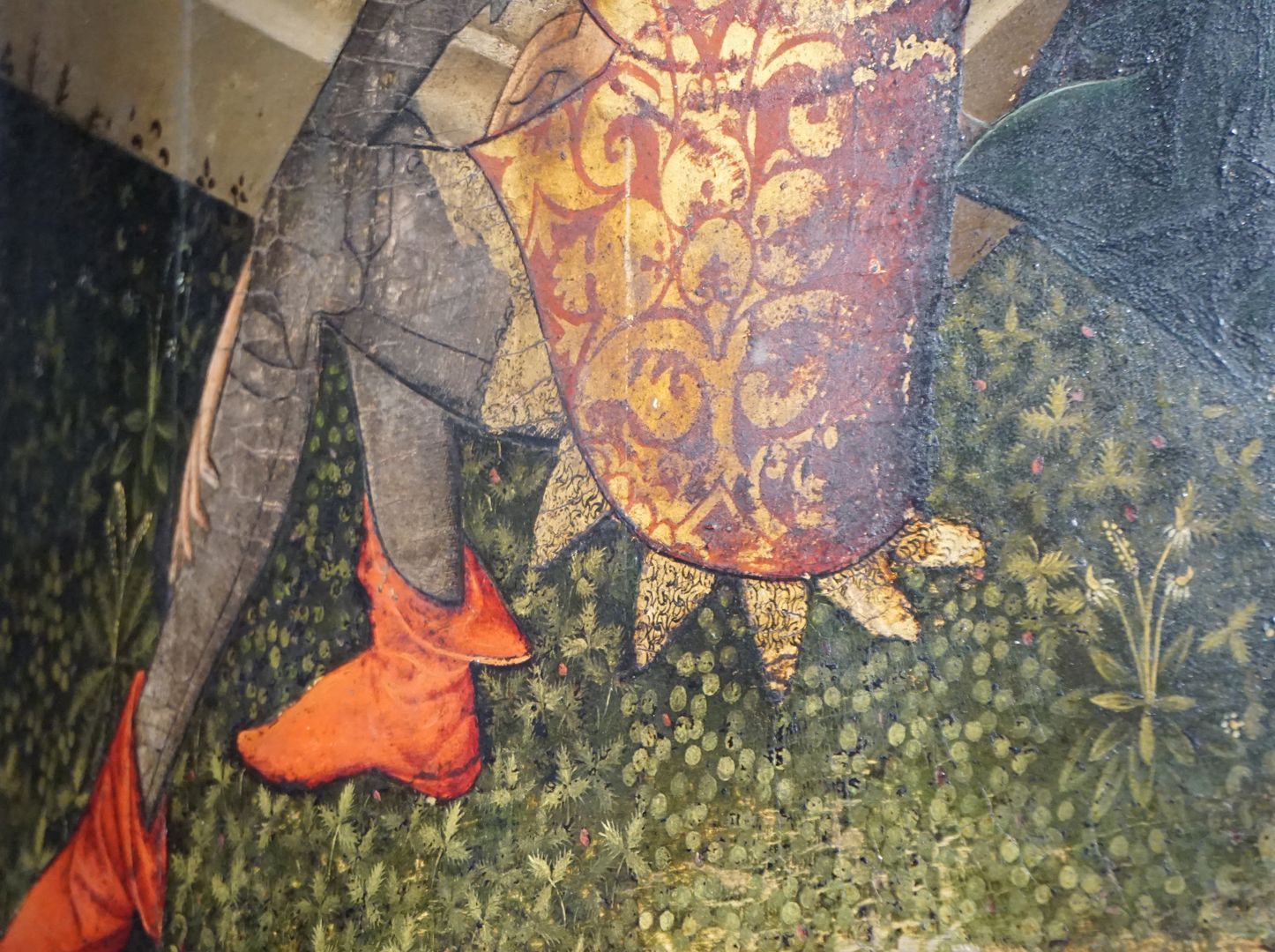
Resurrection of Christ
around 1445
Detail view
With the adoring donor couple, along with their patron saint Johannes Ev. and Empress Kunigunde (formerly in the Dominican Church) The epitaph was attributed by researchers to a painter's workshop that created the epitaph of Brigitta Deichsler, who died in 1438, today in the Berkshire Museum, Pittsfield (The paintings of the late Middle Ages in the Germanisches Nationalmuseum, Franken 1, 2019, pp. 249-250, note 44 and 47 and p. 320, note 50). This epitaph was also previously located in the Nuremberg Dominican Church (Frank Matthias Kammel: Nuremberg 1420. The Deichsler Altar and the beautiful style, in: Der Deichsler Altar, Nuremberg 2016, pp. 15-16 with illustrations 13 and 14). The donor couple depicted in the scene, but without a coat of arms, was tentatively identified with Hans and Kunigunde Steinlinger. In 1444, Hans Steinlinger ordered that he be buried with his wife Kunigunde in the Dominican monastery (Kammel, p. 15). Hans Steinlinger, who acquired Nuremberg citizenship in 1428 (The Nuremberg Citizens' Books. I. The Parchmentenen New Citizens' Lists 1302-1448, Nuremberg 1974, p. 90, no. 1768), was named in the Greater Council in 1430-1449. In 1441/1442, the highwayman Hans Vogler von Neuenmuhr sued Hans Steinlinger, bailiff of the Nuremberg citizen and bailiff Franz Rummel in Höchstadt, as well as the council and the entire population of Höchstadt at the Femegericht in Westphalia, because they had extradited him to Nuremberg. Vogler was released through the intercession of several princes in exchange for fulfilling the primal feud (a sworn obligation to renounce revenge), whereupon he filed a lawsuit in Westphalia (Ludwig Veit: Nuremberg and the Feme, Nuremberg 1955, p. 163 and p. 241-242, note 1013 ). At the end of October 1459, the death knell was rung for Hans Steinlingerin von Höchstadt in both St. Sebald and St. Lorenz.Feedback gebenSeitenleisten
Location: Nuremberg, Frauenkirche, northern pillar image
photo 2023, Theo Noll
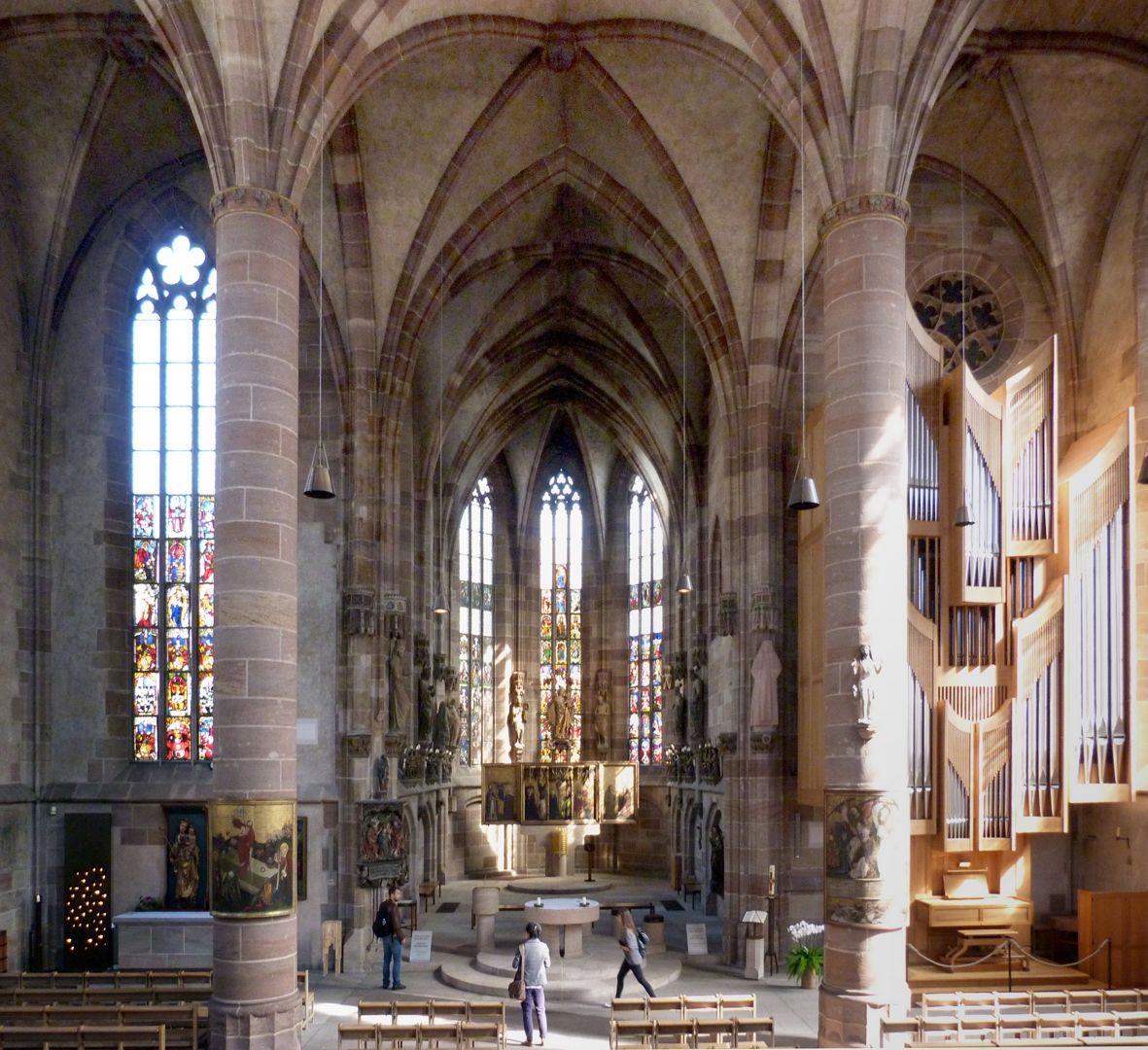
Resurrection of Christ
around 1445
View to the east into the church interior
With the adoring donor couple, along with their patron saint Johannes Ev. and Empress Kunigunde (formerly in the Dominican Church) The epitaph was attributed by researchers to a painter's workshop that created the epitaph of Brigitta Deichsler, who died in 1438, today in the Berkshire Museum, Pittsfield (The paintings of the late Middle Ages in the Germanisches Nationalmuseum, Franken 1, 2019, pp. 249-250, note 44 and 47 and p. 320, note 50). This epitaph was also previously located in the Nuremberg Dominican Church (Frank Matthias Kammel: Nuremberg 1420. The Deichsler Altar and the beautiful style, in: Der Deichsler Altar, Nuremberg 2016, pp. 15-16 with illustrations 13 and 14). The donor couple depicted in the scene, but without a coat of arms, was tentatively identified with Hans and Kunigunde Steinlinger. In 1444, Hans Steinlinger ordered that he be buried with his wife Kunigunde in the Dominican monastery (Kammel, p. 15). Hans Steinlinger, who acquired Nuremberg citizenship in 1428 (The Nuremberg Citizens' Books. I. The Parchmentenen New Citizens' Lists 1302-1448, Nuremberg 1974, p. 90, no. 1768), was named in the Greater Council in 1430-1449. In 1441/1442, the highwayman Hans Vogler von Neuenmuhr sued Hans Steinlinger, bailiff of the Nuremberg citizen and bailiff Franz Rummel in Höchstadt, as well as the council and the entire population of Höchstadt at the Femegericht in Westphalia, because they had extradited him to Nuremberg. Vogler was released through the intercession of several princes in exchange for fulfilling the primal feud (a sworn obligation to renounce revenge), whereupon he filed a lawsuit in Westphalia (Ludwig Veit: Nuremberg and the Feme, Nuremberg 1955, p. 163 and p. 241-242, note 1013 ). At the end of October 1459, the death knell was rung for Hans Steinlingerin von Höchstadt in both St. Sebald and St. Lorenz.Feedback gebenSeitenleisten
Location: Nuremberg, Frauenkirche, northern pillar image
photo 2013, Theo Noll
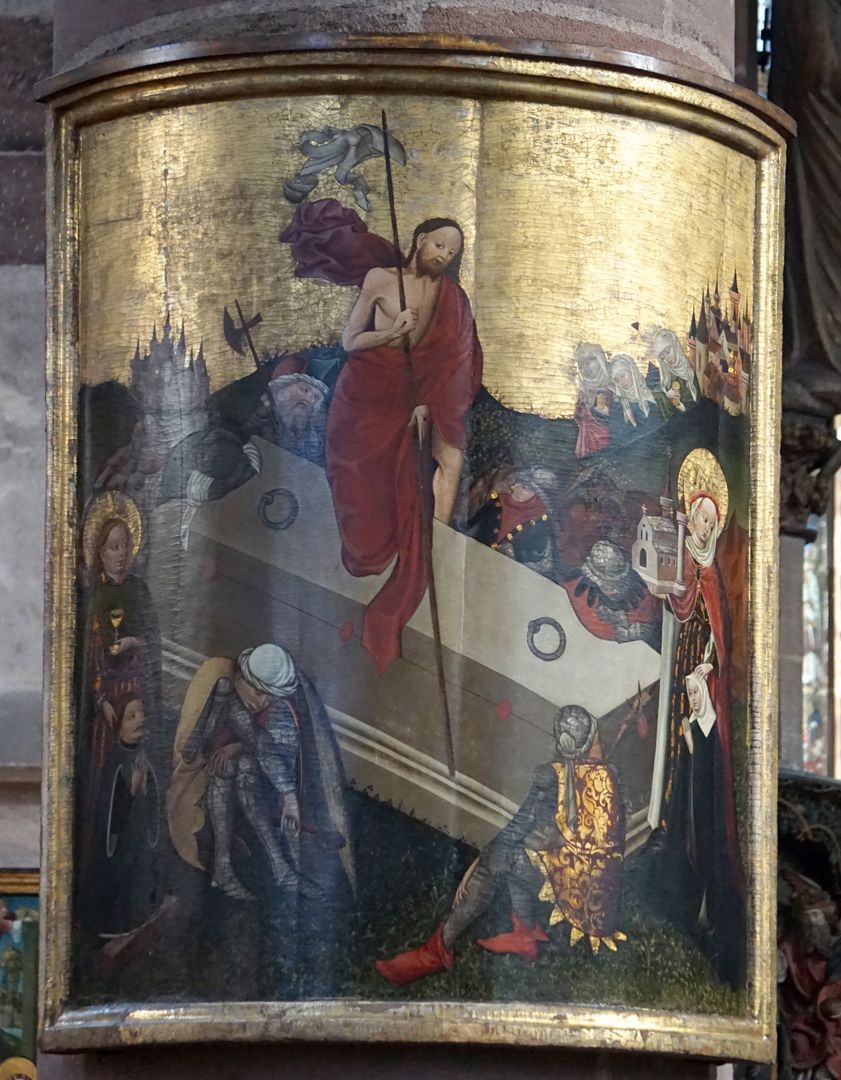
Resurrection of Christ
around 1445
Pillar image
With the adoring donor couple, along with their patron saint Johannes Ev. and Empress Kunigunde (formerly in the Dominican Church) The epitaph was attributed by researchers to a painter's workshop that created the epitaph of Brigitta Deichsler, who died in 1438, today in the Berkshire Museum, Pittsfield (The paintings of the late Middle Ages in the Germanisches Nationalmuseum, Franken 1, 2019, pp. 249-250, note 44 and 47 and p. 320, note 50). This epitaph was also previously located in the Nuremberg Dominican Church (Frank Matthias Kammel: Nuremberg 1420. The Deichsler Altar and the beautiful style, in: Der Deichsler Altar, Nuremberg 2016, pp. 15-16 with illustrations 13 and 14). The donor couple depicted in the scene, but without a coat of arms, was tentatively identified with Hans and Kunigunde Steinlinger. In 1444, Hans Steinlinger ordered that he be buried with his wife Kunigunde in the Dominican monastery (Kammel, p. 15). Hans Steinlinger, who acquired Nuremberg citizenship in 1428 (The Nuremberg Citizens' Books. I. The Parchmentenen New Citizens' Lists 1302-1448, Nuremberg 1974, p. 90, no. 1768), was named in the Greater Council in 1430-1449. In 1441/1442, the highwayman Hans Vogler von Neuenmuhr sued Hans Steinlinger, bailiff of the Nuremberg citizen and bailiff Franz Rummel in Höchstadt, as well as the council and the entire population of Höchstadt at the Femegericht in Westphalia, because they had extradited him to Nuremberg. Vogler was released through the intercession of several princes in exchange for fulfilling the primal feud (a sworn obligation to renounce revenge), whereupon he filed a lawsuit in Westphalia (Ludwig Veit: Nuremberg and the Feme, Nuremberg 1955, p. 163 and p. 241-242, note 1013 ). At the end of October 1459, the death knell was rung for Hans Steinlingerin von Höchstadt in both St. Sebald and St. Lorenz.Feedback gebenSeitenleisten
Location: Nuremberg, Frauenkirche, northern pillar image
photo 2021, Theo Noll
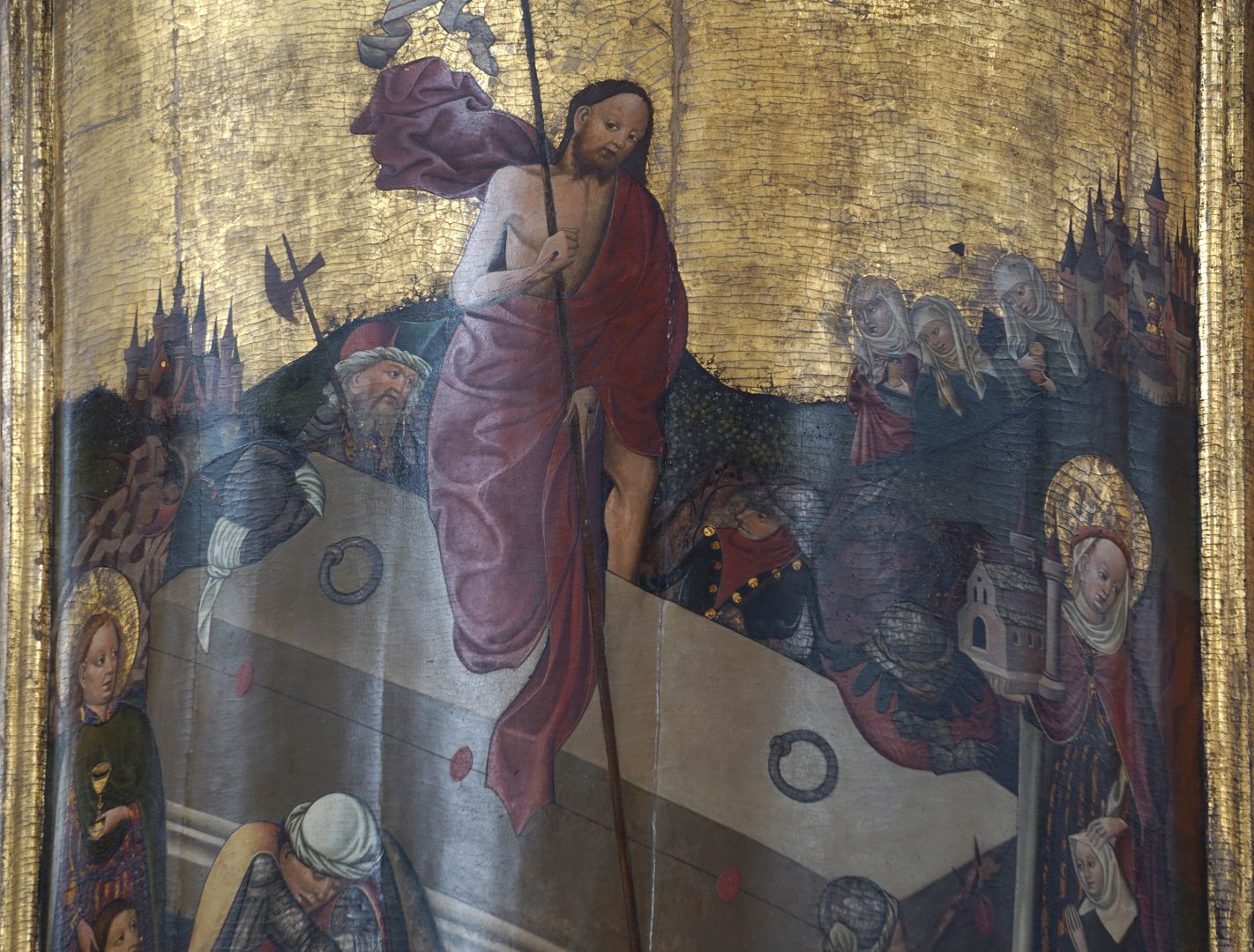
Resurrection of Christ
around 1445
Detail view
With the adoring donor couple, along with their patron saint Johannes Ev. and Empress Kunigunde (formerly in the Dominican Church) The epitaph was attributed by researchers to a painter's workshop that created the epitaph of Brigitta Deichsler, who died in 1438, today in the Berkshire Museum, Pittsfield (The paintings of the late Middle Ages in the Germanisches Nationalmuseum, Franken 1, 2019, pp. 249-250, note 44 and 47 and p. 320, note 50). This epitaph was also previously located in the Nuremberg Dominican Church (Frank Matthias Kammel: Nuremberg 1420. The Deichsler Altar and the beautiful style, in: Der Deichsler Altar, Nuremberg 2016, pp. 15-16 with illustrations 13 and 14). The donor couple depicted in the scene, but without a coat of arms, was tentatively identified with Hans and Kunigunde Steinlinger. In 1444, Hans Steinlinger ordered that he be buried with his wife Kunigunde in the Dominican monastery (Kammel, p. 15). Hans Steinlinger, who acquired Nuremberg citizenship in 1428 (The Nuremberg Citizens' Books. I. The Parchmentenen New Citizens' Lists 1302-1448, Nuremberg 1974, p. 90, no. 1768), was named in the Greater Council in 1430-1449. In 1441/1442, the highwayman Hans Vogler von Neuenmuhr sued Hans Steinlinger, bailiff of the Nuremberg citizen and bailiff Franz Rummel in Höchstadt, as well as the council and the entire population of Höchstadt at the Femegericht in Westphalia, because they had extradited him to Nuremberg. Vogler was released through the intercession of several princes in exchange for fulfilling the primal feud (a sworn obligation to renounce revenge), whereupon he filed a lawsuit in Westphalia (Ludwig Veit: Nuremberg and the Feme, Nuremberg 1955, p. 163 and p. 241-242, note 1013 ). At the end of October 1459, the death knell was rung for Hans Steinlingerin von Höchstadt in both St. Sebald and St. Lorenz.Feedback gebenSeitenleisten
Location: Nuremberg, Frauenkirche, northern pillar image
photo 2021, Theo Noll
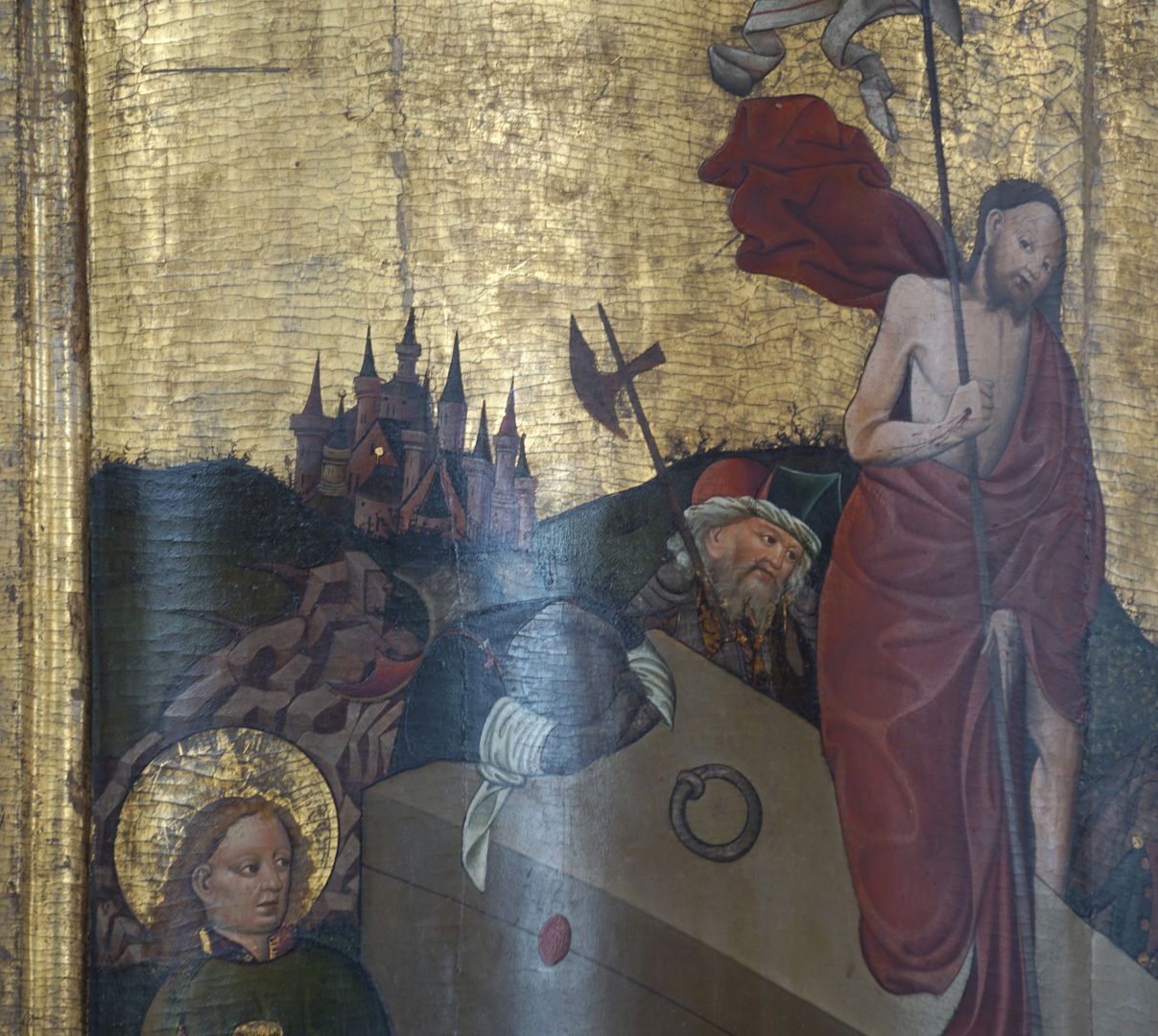
Resurrection of Christ
around 1445
Detail view
With the adoring donor couple, along with their patron saint Johannes Ev. and Empress Kunigunde (formerly in the Dominican Church) The epitaph was attributed by researchers to a painter's workshop that created the epitaph of Brigitta Deichsler, who died in 1438, today in the Berkshire Museum, Pittsfield (The paintings of the late Middle Ages in the Germanisches Nationalmuseum, Franken 1, 2019, pp. 249-250, note 44 and 47 and p. 320, note 50). This epitaph was also previously located in the Nuremberg Dominican Church (Frank Matthias Kammel: Nuremberg 1420. The Deichsler Altar and the beautiful style, in: Der Deichsler Altar, Nuremberg 2016, pp. 15-16 with illustrations 13 and 14). The donor couple depicted in the scene, but without a coat of arms, was tentatively identified with Hans and Kunigunde Steinlinger. In 1444, Hans Steinlinger ordered that he be buried with his wife Kunigunde in the Dominican monastery (Kammel, p. 15). Hans Steinlinger, who acquired Nuremberg citizenship in 1428 (The Nuremberg Citizens' Books. I. The Parchmentenen New Citizens' Lists 1302-1448, Nuremberg 1974, p. 90, no. 1768), was named in the Greater Council in 1430-1449. In 1441/1442, the highwayman Hans Vogler von Neuenmuhr sued Hans Steinlinger, bailiff of the Nuremberg citizen and bailiff Franz Rummel in Höchstadt, as well as the council and the entire population of Höchstadt at the Femegericht in Westphalia, because they had extradited him to Nuremberg. Vogler was released through the intercession of several princes in exchange for fulfilling the primal feud (a sworn obligation to renounce revenge), whereupon he filed a lawsuit in Westphalia (Ludwig Veit: Nuremberg and the Feme, Nuremberg 1955, p. 163 and p. 241-242, note 1013 ). At the end of October 1459, the death knell was rung for Hans Steinlingerin von Höchstadt in both St. Sebald and St. Lorenz.Feedback gebenSeitenleisten
Location: Nuremberg, Frauenkirche, northern pillar image
photo 2021, Theo Noll
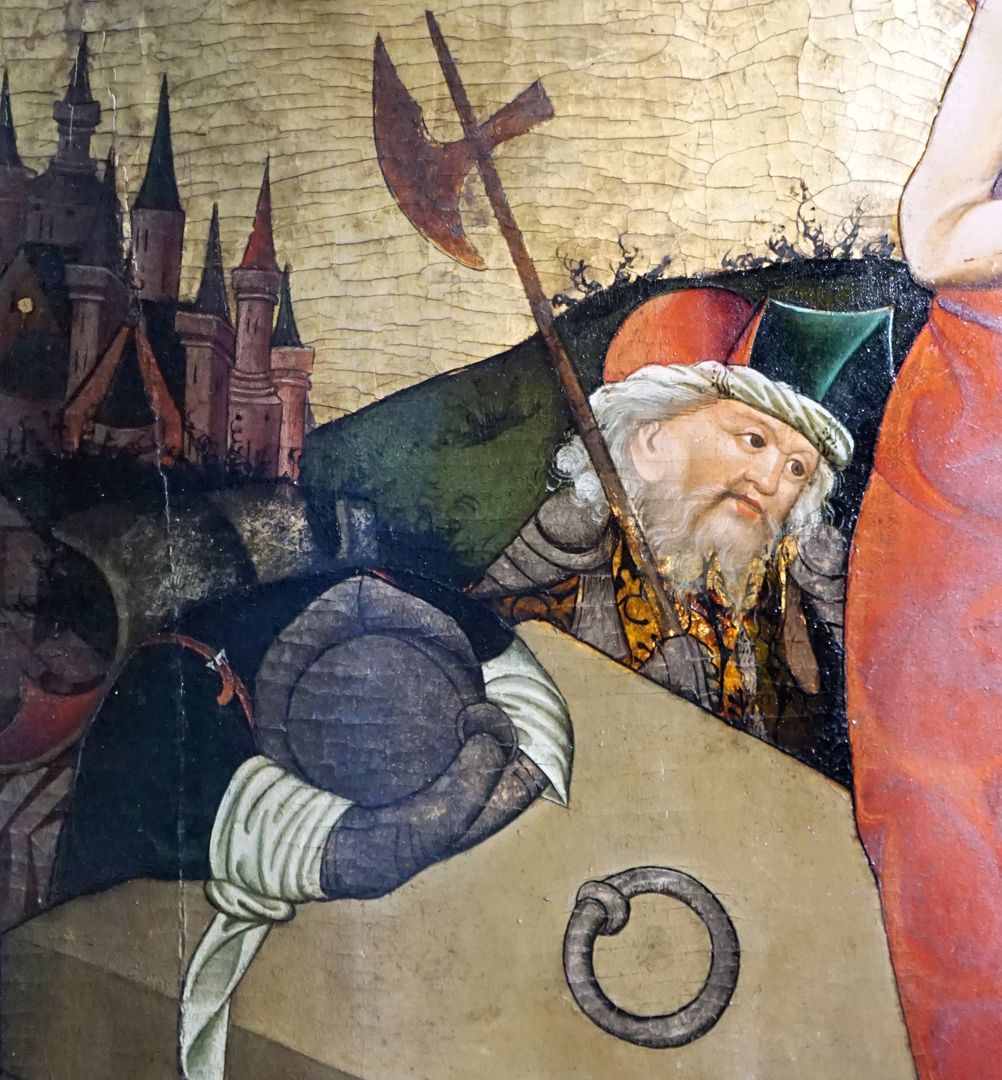
Resurrection of Christ
around 1445
Detail view
With the adoring donor couple, along with their patron saint Johannes Ev. and Empress Kunigunde (formerly in the Dominican Church) The epitaph was attributed by researchers to a painter's workshop that created the epitaph of Brigitta Deichsler, who died in 1438, today in the Berkshire Museum, Pittsfield (The paintings of the late Middle Ages in the Germanisches Nationalmuseum, Franken 1, 2019, pp. 249-250, note 44 and 47 and p. 320, note 50). This epitaph was also previously located in the Nuremberg Dominican Church (Frank Matthias Kammel: Nuremberg 1420. The Deichsler Altar and the beautiful style, in: Der Deichsler Altar, Nuremberg 2016, pp. 15-16 with illustrations 13 and 14). The donor couple depicted in the scene, but without a coat of arms, was tentatively identified with Hans and Kunigunde Steinlinger. In 1444, Hans Steinlinger ordered that he be buried with his wife Kunigunde in the Dominican monastery (Kammel, p. 15). Hans Steinlinger, who acquired Nuremberg citizenship in 1428 (The Nuremberg Citizens' Books. I. The Parchmentenen New Citizens' Lists 1302-1448, Nuremberg 1974, p. 90, no. 1768), was named in the Greater Council in 1430-1449. In 1441/1442, the highwayman Hans Vogler von Neuenmuhr sued Hans Steinlinger, bailiff of the Nuremberg citizen and bailiff Franz Rummel in Höchstadt, as well as the council and the entire population of Höchstadt at the Femegericht in Westphalia, because they had extradited him to Nuremberg. Vogler was released through the intercession of several princes in exchange for fulfilling the primal feud (a sworn obligation to renounce revenge), whereupon he filed a lawsuit in Westphalia (Ludwig Veit: Nuremberg and the Feme, Nuremberg 1955, p. 163 and p. 241-242, note 1013 ). At the end of October 1459, the death knell was rung for Hans Steinlingerin von Höchstadt in both St. Sebald and St. Lorenz.Feedback gebenSeitenleisten
Location: Nuremberg, Frauenkirche, northern pillar image
photo 2021, Theo Noll
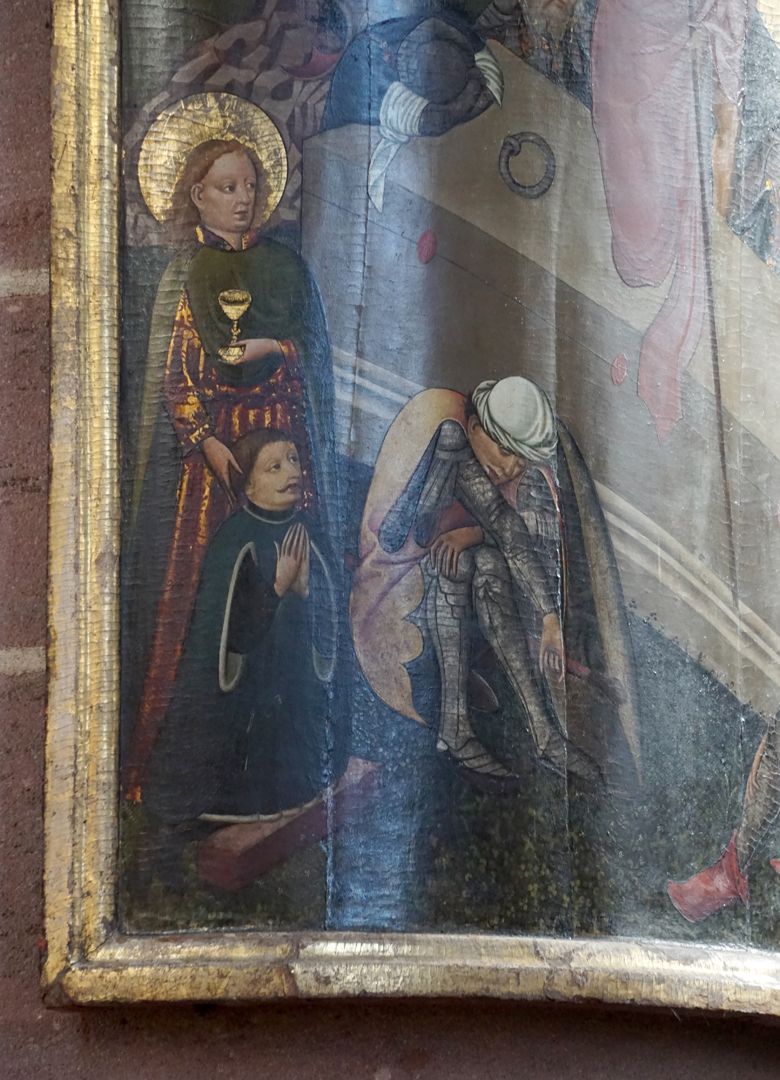
Resurrection of Christ
around 1445
Detail view
With the adoring donor couple, along with their patron saint Johannes Ev. and Empress Kunigunde (formerly in the Dominican Church) The epitaph was attributed by researchers to a painter's workshop that created the epitaph of Brigitta Deichsler, who died in 1438, today in the Berkshire Museum, Pittsfield (The paintings of the late Middle Ages in the Germanisches Nationalmuseum, Franken 1, 2019, pp. 249-250, note 44 and 47 and p. 320, note 50). This epitaph was also previously located in the Nuremberg Dominican Church (Frank Matthias Kammel: Nuremberg 1420. The Deichsler Altar and the beautiful style, in: Der Deichsler Altar, Nuremberg 2016, pp. 15-16 with illustrations 13 and 14). The donor couple depicted in the scene, but without a coat of arms, was tentatively identified with Hans and Kunigunde Steinlinger. In 1444, Hans Steinlinger ordered that he be buried with his wife Kunigunde in the Dominican monastery (Kammel, p. 15). Hans Steinlinger, who acquired Nuremberg citizenship in 1428 (The Nuremberg Citizens' Books. I. The Parchmentenen New Citizens' Lists 1302-1448, Nuremberg 1974, p. 90, no. 1768), was named in the Greater Council in 1430-1449. In 1441/1442, the highwayman Hans Vogler von Neuenmuhr sued Hans Steinlinger, bailiff of the Nuremberg citizen and bailiff Franz Rummel in Höchstadt, as well as the council and the entire population of Höchstadt at the Femegericht in Westphalia, because they had extradited him to Nuremberg. Vogler was released through the intercession of several princes in exchange for fulfilling the primal feud (a sworn obligation to renounce revenge), whereupon he filed a lawsuit in Westphalia (Ludwig Veit: Nuremberg and the Feme, Nuremberg 1955, p. 163 and p. 241-242, note 1013 ). At the end of October 1459, the death knell was rung for Hans Steinlingerin von Höchstadt in both St. Sebald and St. Lorenz.Feedback gebenSeitenleisten
Location: Nuremberg, Frauenkirche, northern pillar image
photo 2021, Theo Noll
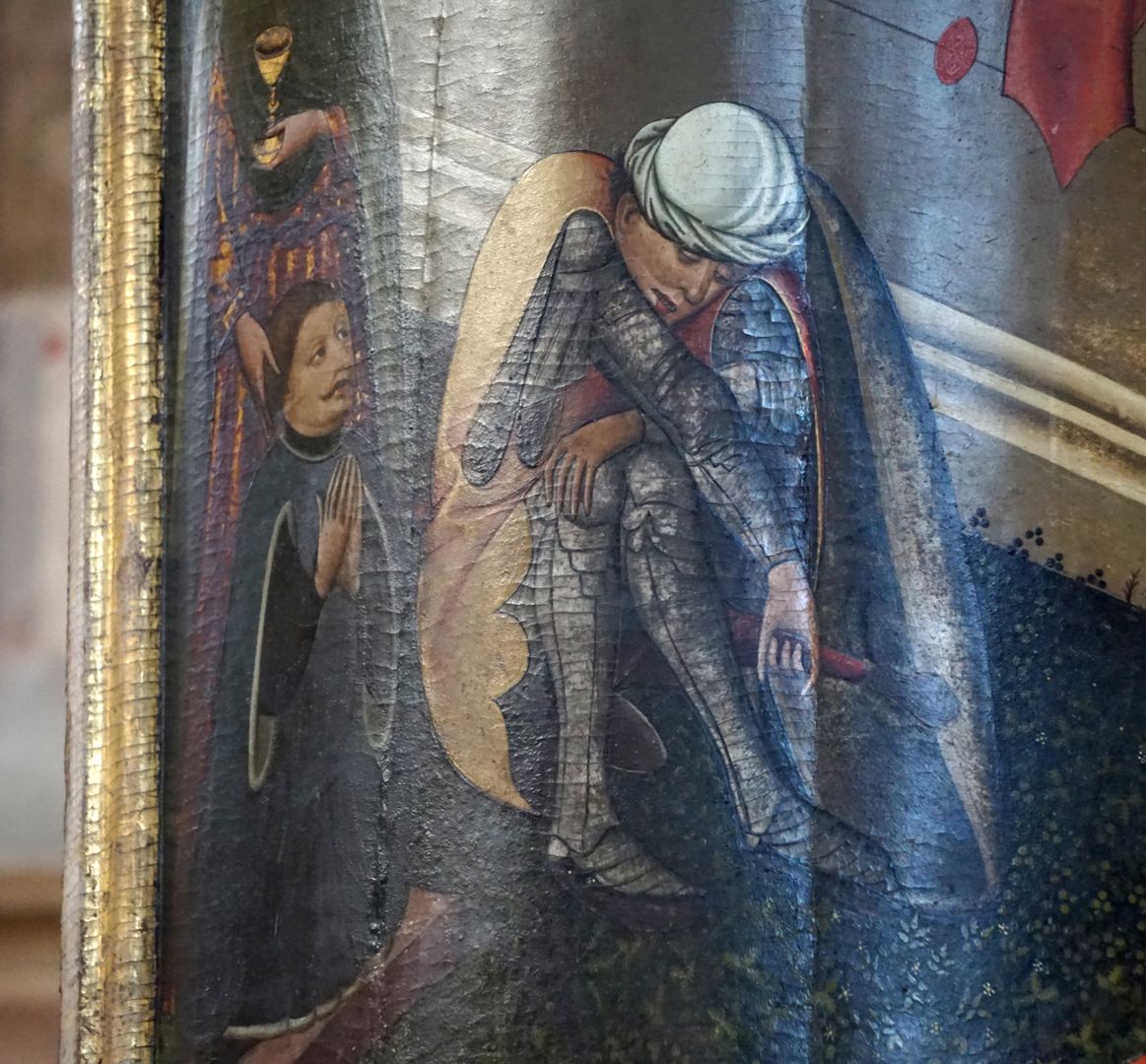
Resurrection of Christ
around 1445
Detail view
With the adoring donor couple, along with their patron saint Johannes Ev. and Empress Kunigunde (formerly in the Dominican Church) The epitaph was attributed by researchers to a painter's workshop that created the epitaph of Brigitta Deichsler, who died in 1438, today in the Berkshire Museum, Pittsfield (The paintings of the late Middle Ages in the Germanisches Nationalmuseum, Franken 1, 2019, pp. 249-250, note 44 and 47 and p. 320, note 50). This epitaph was also previously located in the Nuremberg Dominican Church (Frank Matthias Kammel: Nuremberg 1420. The Deichsler Altar and the beautiful style, in: Der Deichsler Altar, Nuremberg 2016, pp. 15-16 with illustrations 13 and 14). The donor couple depicted in the scene, but without a coat of arms, was tentatively identified with Hans and Kunigunde Steinlinger. In 1444, Hans Steinlinger ordered that he be buried with his wife Kunigunde in the Dominican monastery (Kammel, p. 15). Hans Steinlinger, who acquired Nuremberg citizenship in 1428 (The Nuremberg Citizens' Books. I. The Parchmentenen New Citizens' Lists 1302-1448, Nuremberg 1974, p. 90, no. 1768), was named in the Greater Council in 1430-1449. In 1441/1442, the highwayman Hans Vogler von Neuenmuhr sued Hans Steinlinger, bailiff of the Nuremberg citizen and bailiff Franz Rummel in Höchstadt, as well as the council and the entire population of Höchstadt at the Femegericht in Westphalia, because they had extradited him to Nuremberg. Vogler was released through the intercession of several princes in exchange for fulfilling the primal feud (a sworn obligation to renounce revenge), whereupon he filed a lawsuit in Westphalia (Ludwig Veit: Nuremberg and the Feme, Nuremberg 1955, p. 163 and p. 241-242, note 1013 ). At the end of October 1459, the death knell was rung for Hans Steinlingerin von Höchstadt in both St. Sebald and St. Lorenz.Feedback gebenSeitenleisten
Location: Nuremberg, Frauenkirche, northern pillar image
photo 2021, Theo Noll
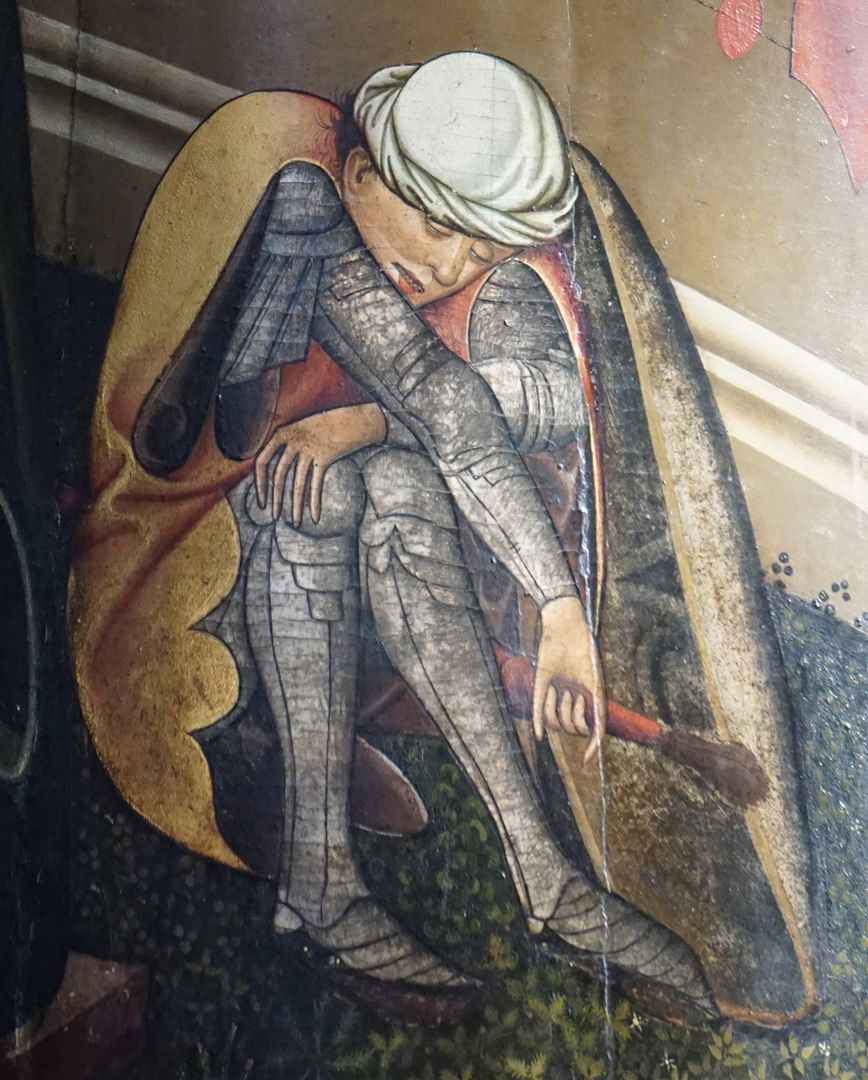
Resurrection of Christ
around 1445
Detail view
With the adoring donor couple, along with their patron saint Johannes Ev. and Empress Kunigunde (formerly in the Dominican Church) The epitaph was attributed by researchers to a painter's workshop that created the epitaph of Brigitta Deichsler, who died in 1438, today in the Berkshire Museum, Pittsfield (The paintings of the late Middle Ages in the Germanisches Nationalmuseum, Franken 1, 2019, pp. 249-250, note 44 and 47 and p. 320, note 50). This epitaph was also previously located in the Nuremberg Dominican Church (Frank Matthias Kammel: Nuremberg 1420. The Deichsler Altar and the beautiful style, in: Der Deichsler Altar, Nuremberg 2016, pp. 15-16 with illustrations 13 and 14). The donor couple depicted in the scene, but without a coat of arms, was tentatively identified with Hans and Kunigunde Steinlinger. In 1444, Hans Steinlinger ordered that he be buried with his wife Kunigunde in the Dominican monastery (Kammel, p. 15). Hans Steinlinger, who acquired Nuremberg citizenship in 1428 (The Nuremberg Citizens' Books. I. The Parchmentenen New Citizens' Lists 1302-1448, Nuremberg 1974, p. 90, no. 1768), was named in the Greater Council in 1430-1449. In 1441/1442, the highwayman Hans Vogler von Neuenmuhr sued Hans Steinlinger, bailiff of the Nuremberg citizen and bailiff Franz Rummel in Höchstadt, as well as the council and the entire population of Höchstadt at the Femegericht in Westphalia, because they had extradited him to Nuremberg. Vogler was released through the intercession of several princes in exchange for fulfilling the primal feud (a sworn obligation to renounce revenge), whereupon he filed a lawsuit in Westphalia (Ludwig Veit: Nuremberg and the Feme, Nuremberg 1955, p. 163 and p. 241-242, note 1013 ). At the end of October 1459, the death knell was rung for Hans Steinlingerin von Höchstadt in both St. Sebald and St. Lorenz.Feedback gebenSeitenleisten
Location: Nuremberg, Frauenkirche, northern pillar image
photo 2021, Theo Noll
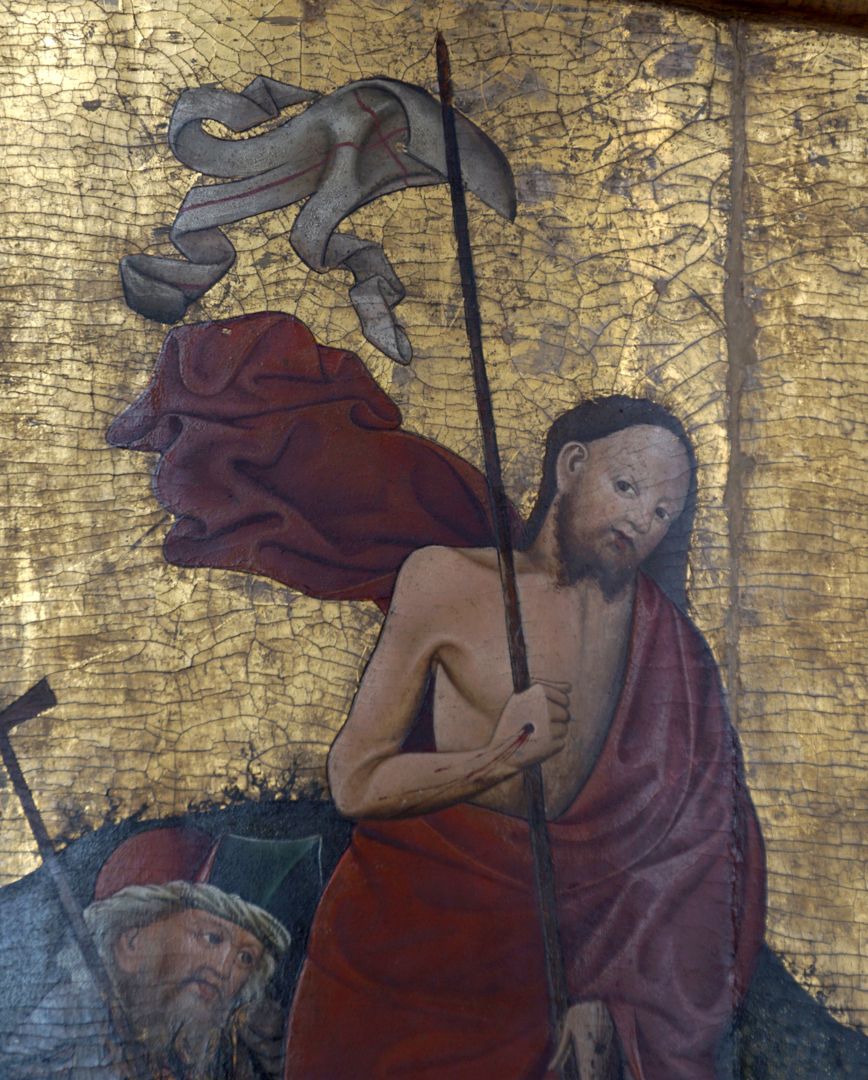
Resurrection of Christ
around 1445
Detail view
With the adoring donor couple, along with their patron saint Johannes Ev. and Empress Kunigunde (formerly in the Dominican Church) The epitaph was attributed by researchers to a painter's workshop that created the epitaph of Brigitta Deichsler, who died in 1438, today in the Berkshire Museum, Pittsfield (The paintings of the late Middle Ages in the Germanisches Nationalmuseum, Franken 1, 2019, pp. 249-250, note 44 and 47 and p. 320, note 50). This epitaph was also previously located in the Nuremberg Dominican Church (Frank Matthias Kammel: Nuremberg 1420. The Deichsler Altar and the beautiful style, in: Der Deichsler Altar, Nuremberg 2016, pp. 15-16 with illustrations 13 and 14). The donor couple depicted in the scene, but without a coat of arms, was tentatively identified with Hans and Kunigunde Steinlinger. In 1444, Hans Steinlinger ordered that he be buried with his wife Kunigunde in the Dominican monastery (Kammel, p. 15). Hans Steinlinger, who acquired Nuremberg citizenship in 1428 (The Nuremberg Citizens' Books. I. The Parchmentenen New Citizens' Lists 1302-1448, Nuremberg 1974, p. 90, no. 1768), was named in the Greater Council in 1430-1449. In 1441/1442, the highwayman Hans Vogler von Neuenmuhr sued Hans Steinlinger, bailiff of the Nuremberg citizen and bailiff Franz Rummel in Höchstadt, as well as the council and the entire population of Höchstadt at the Femegericht in Westphalia, because they had extradited him to Nuremberg. Vogler was released through the intercession of several princes in exchange for fulfilling the primal feud (a sworn obligation to renounce revenge), whereupon he filed a lawsuit in Westphalia (Ludwig Veit: Nuremberg and the Feme, Nuremberg 1955, p. 163 and p. 241-242, note 1013 ). At the end of October 1459, the death knell was rung for Hans Steinlingerin von Höchstadt in both St. Sebald and St. Lorenz.Feedback gebenSeitenleisten
Location: Nuremberg, Frauenkirche, northern pillar image
photo 2021, Theo Noll
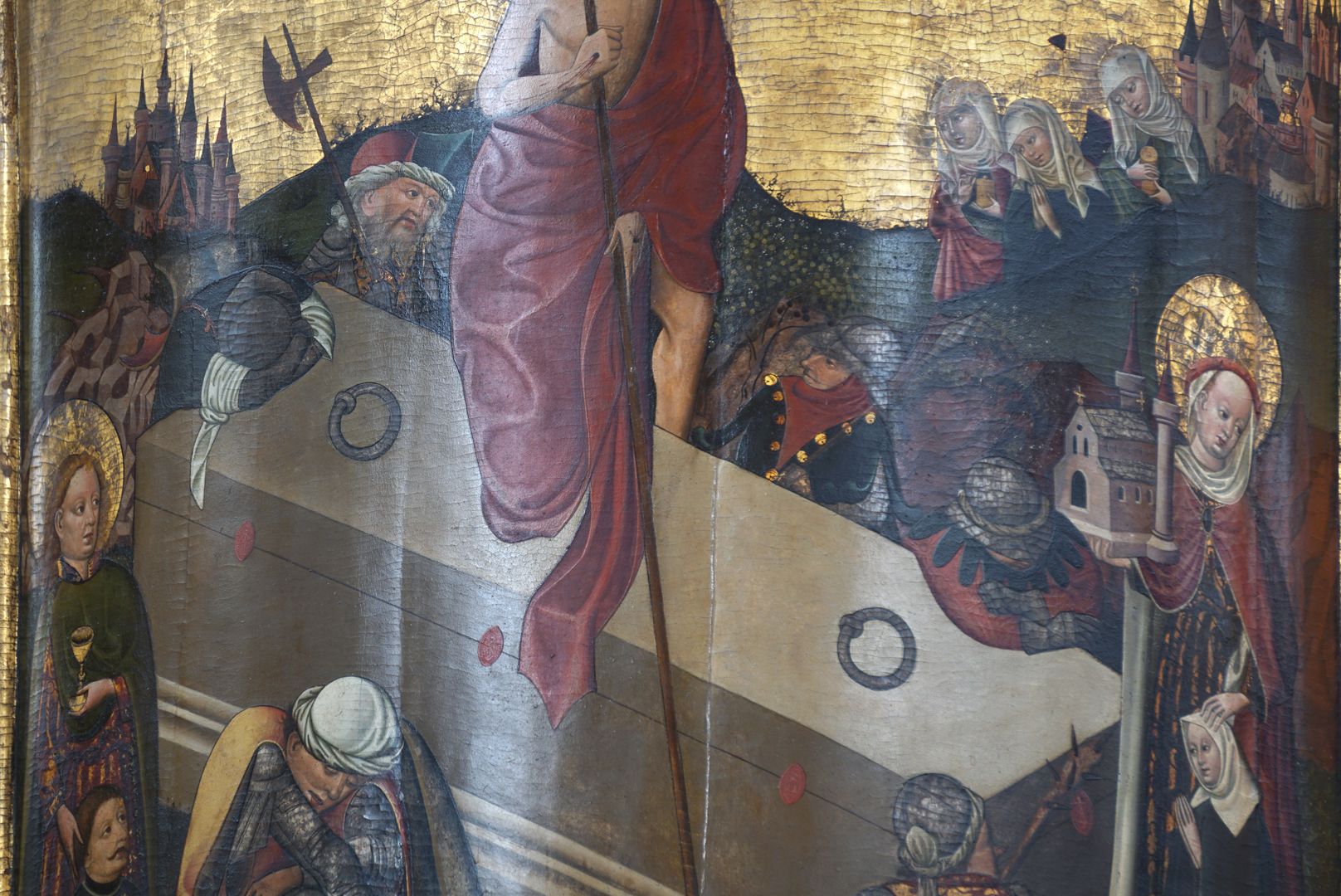
Resurrection of Christ
around 1445
Detail view
With the adoring donor couple, along with their patron saint Johannes Ev. and Empress Kunigunde (formerly in the Dominican Church) The epitaph was attributed by researchers to a painter's workshop that created the epitaph of Brigitta Deichsler, who died in 1438, today in the Berkshire Museum, Pittsfield (The paintings of the late Middle Ages in the Germanisches Nationalmuseum, Franken 1, 2019, pp. 249-250, note 44 and 47 and p. 320, note 50). This epitaph was also previously located in the Nuremberg Dominican Church (Frank Matthias Kammel: Nuremberg 1420. The Deichsler Altar and the beautiful style, in: Der Deichsler Altar, Nuremberg 2016, pp. 15-16 with illustrations 13 and 14). The donor couple depicted in the scene, but without a coat of arms, was tentatively identified with Hans and Kunigunde Steinlinger. In 1444, Hans Steinlinger ordered that he be buried with his wife Kunigunde in the Dominican monastery (Kammel, p. 15). Hans Steinlinger, who acquired Nuremberg citizenship in 1428 (The Nuremberg Citizens' Books. I. The Parchmentenen New Citizens' Lists 1302-1448, Nuremberg 1974, p. 90, no. 1768), was named in the Greater Council in 1430-1449. In 1441/1442, the highwayman Hans Vogler von Neuenmuhr sued Hans Steinlinger, bailiff of the Nuremberg citizen and bailiff Franz Rummel in Höchstadt, as well as the council and the entire population of Höchstadt at the Femegericht in Westphalia, because they had extradited him to Nuremberg. Vogler was released through the intercession of several princes in exchange for fulfilling the primal feud (a sworn obligation to renounce revenge), whereupon he filed a lawsuit in Westphalia (Ludwig Veit: Nuremberg and the Feme, Nuremberg 1955, p. 163 and p. 241-242, note 1013 ). At the end of October 1459, the death knell was rung for Hans Steinlingerin von Höchstadt in both St. Sebald and St. Lorenz.Feedback gebenSeitenleisten
Location: Nuremberg, Frauenkirche, northern pillar image
photo 2021, Theo Noll
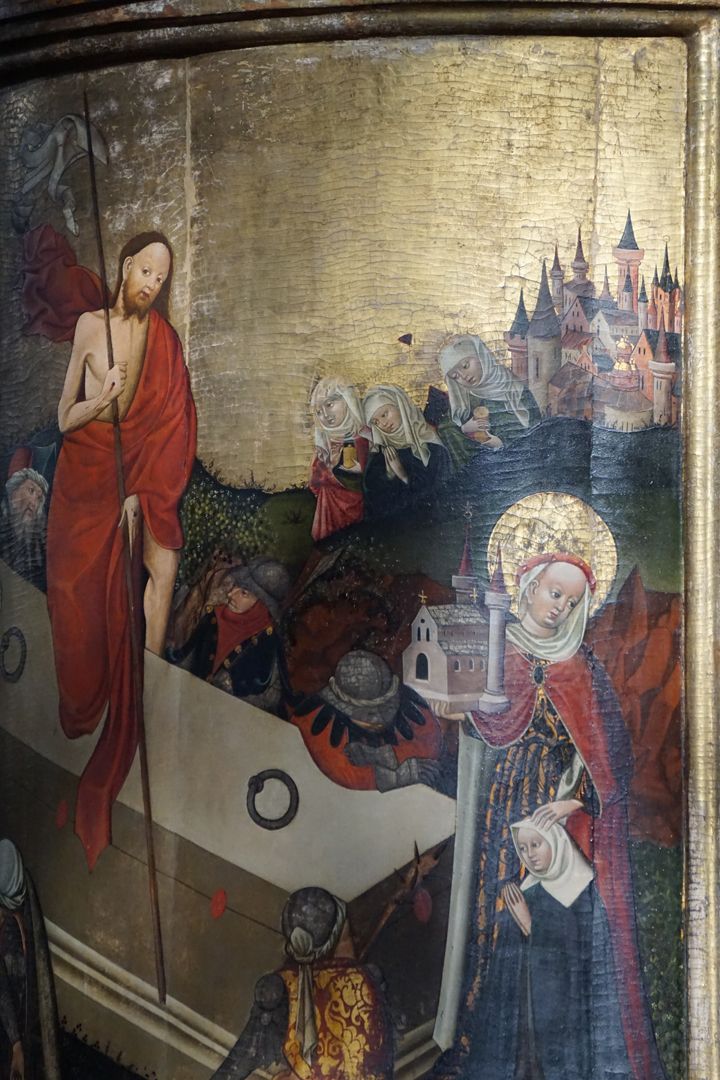
Resurrection of Christ
around 1445
Detail view
With the adoring donor couple, along with their patron saint Johannes Ev. and Empress Kunigunde (formerly in the Dominican Church) The epitaph was attributed by researchers to a painter's workshop that created the epitaph of Brigitta Deichsler, who died in 1438, today in the Berkshire Museum, Pittsfield (The paintings of the late Middle Ages in the Germanisches Nationalmuseum, Franken 1, 2019, pp. 249-250, note 44 and 47 and p. 320, note 50). This epitaph was also previously located in the Nuremberg Dominican Church (Frank Matthias Kammel: Nuremberg 1420. The Deichsler Altar and the beautiful style, in: Der Deichsler Altar, Nuremberg 2016, pp. 15-16 with illustrations 13 and 14). The donor couple depicted in the scene, but without a coat of arms, was tentatively identified with Hans and Kunigunde Steinlinger. In 1444, Hans Steinlinger ordered that he be buried with his wife Kunigunde in the Dominican monastery (Kammel, p. 15). Hans Steinlinger, who acquired Nuremberg citizenship in 1428 (The Nuremberg Citizens' Books. I. The Parchmentenen New Citizens' Lists 1302-1448, Nuremberg 1974, p. 90, no. 1768), was named in the Greater Council in 1430-1449. In 1441/1442, the highwayman Hans Vogler von Neuenmuhr sued Hans Steinlinger, bailiff of the Nuremberg citizen and bailiff Franz Rummel in Höchstadt, as well as the council and the entire population of Höchstadt at the Femegericht in Westphalia, because they had extradited him to Nuremberg. Vogler was released through the intercession of several princes in exchange for fulfilling the primal feud (a sworn obligation to renounce revenge), whereupon he filed a lawsuit in Westphalia (Ludwig Veit: Nuremberg and the Feme, Nuremberg 1955, p. 163 and p. 241-242, note 1013 ). At the end of October 1459, the death knell was rung for Hans Steinlingerin von Höchstadt in both St. Sebald and St. Lorenz.Feedback gebenSeitenleisten
Location: Nuremberg, Frauenkirche, northern pillar image
photo 2021, Theo Noll
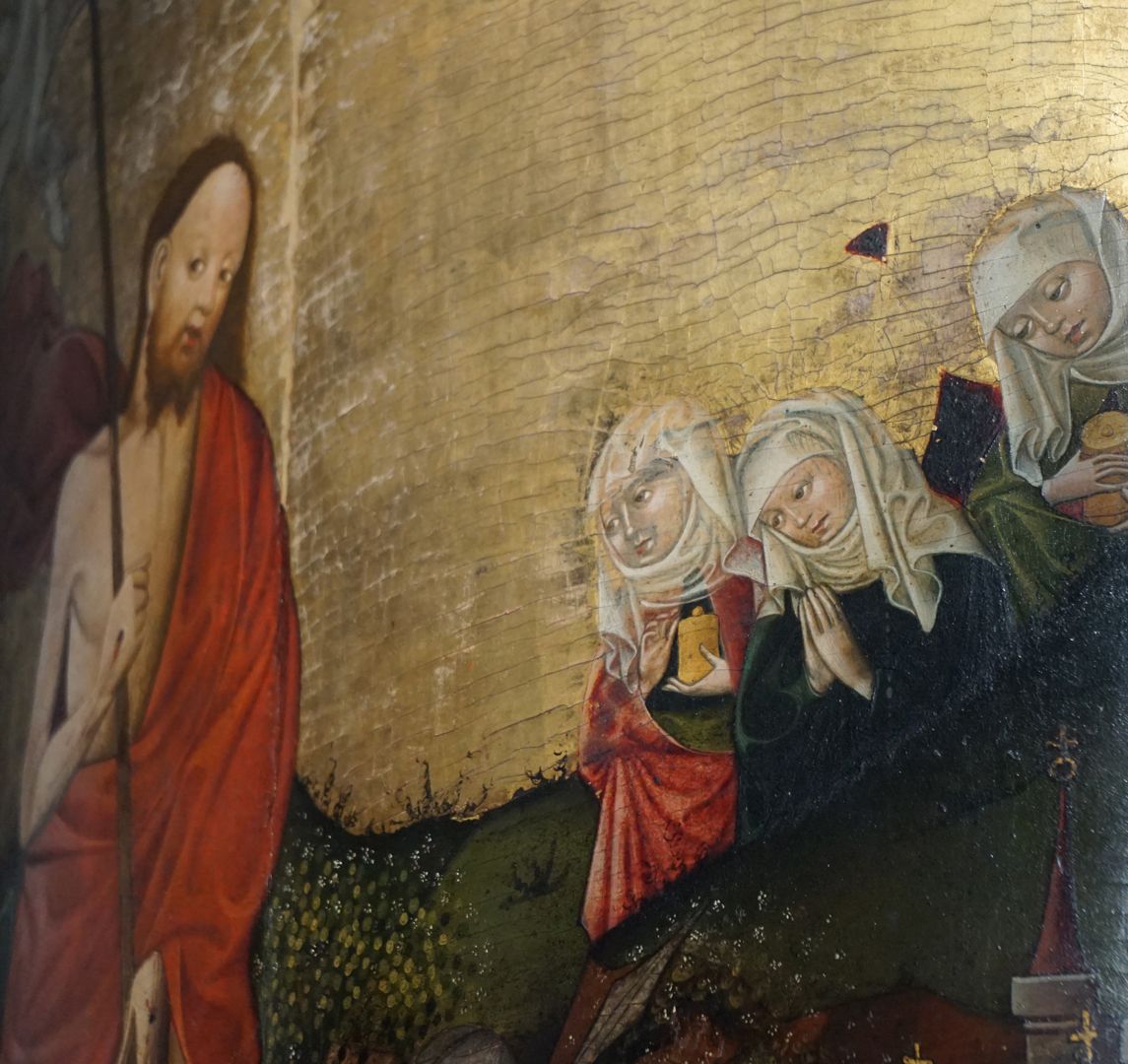
Resurrection of Christ
around 1445
Detail view
With the adoring donor couple, along with their patron saint Johannes Ev. and Empress Kunigunde (formerly in the Dominican Church) The epitaph was attributed by researchers to a painter's workshop that created the epitaph of Brigitta Deichsler, who died in 1438, today in the Berkshire Museum, Pittsfield (The paintings of the late Middle Ages in the Germanisches Nationalmuseum, Franken 1, 2019, pp. 249-250, note 44 and 47 and p. 320, note 50). This epitaph was also previously located in the Nuremberg Dominican Church (Frank Matthias Kammel: Nuremberg 1420. The Deichsler Altar and the beautiful style, in: Der Deichsler Altar, Nuremberg 2016, pp. 15-16 with illustrations 13 and 14). The donor couple depicted in the scene, but without a coat of arms, was tentatively identified with Hans and Kunigunde Steinlinger. In 1444, Hans Steinlinger ordered that he be buried with his wife Kunigunde in the Dominican monastery (Kammel, p. 15). Hans Steinlinger, who acquired Nuremberg citizenship in 1428 (The Nuremberg Citizens' Books. I. The Parchmentenen New Citizens' Lists 1302-1448, Nuremberg 1974, p. 90, no. 1768), was named in the Greater Council in 1430-1449. In 1441/1442, the highwayman Hans Vogler von Neuenmuhr sued Hans Steinlinger, bailiff of the Nuremberg citizen and bailiff Franz Rummel in Höchstadt, as well as the council and the entire population of Höchstadt at the Femegericht in Westphalia, because they had extradited him to Nuremberg. Vogler was released through the intercession of several princes in exchange for fulfilling the primal feud (a sworn obligation to renounce revenge), whereupon he filed a lawsuit in Westphalia (Ludwig Veit: Nuremberg and the Feme, Nuremberg 1955, p. 163 and p. 241-242, note 1013 ). At the end of October 1459, the death knell was rung for Hans Steinlingerin von Höchstadt in both St. Sebald and St. Lorenz.Feedback gebenSeitenleisten
Location: Nürnberg, Frauenkirche, nördliches Pfeilerbild
photo 2021, Theo Noll
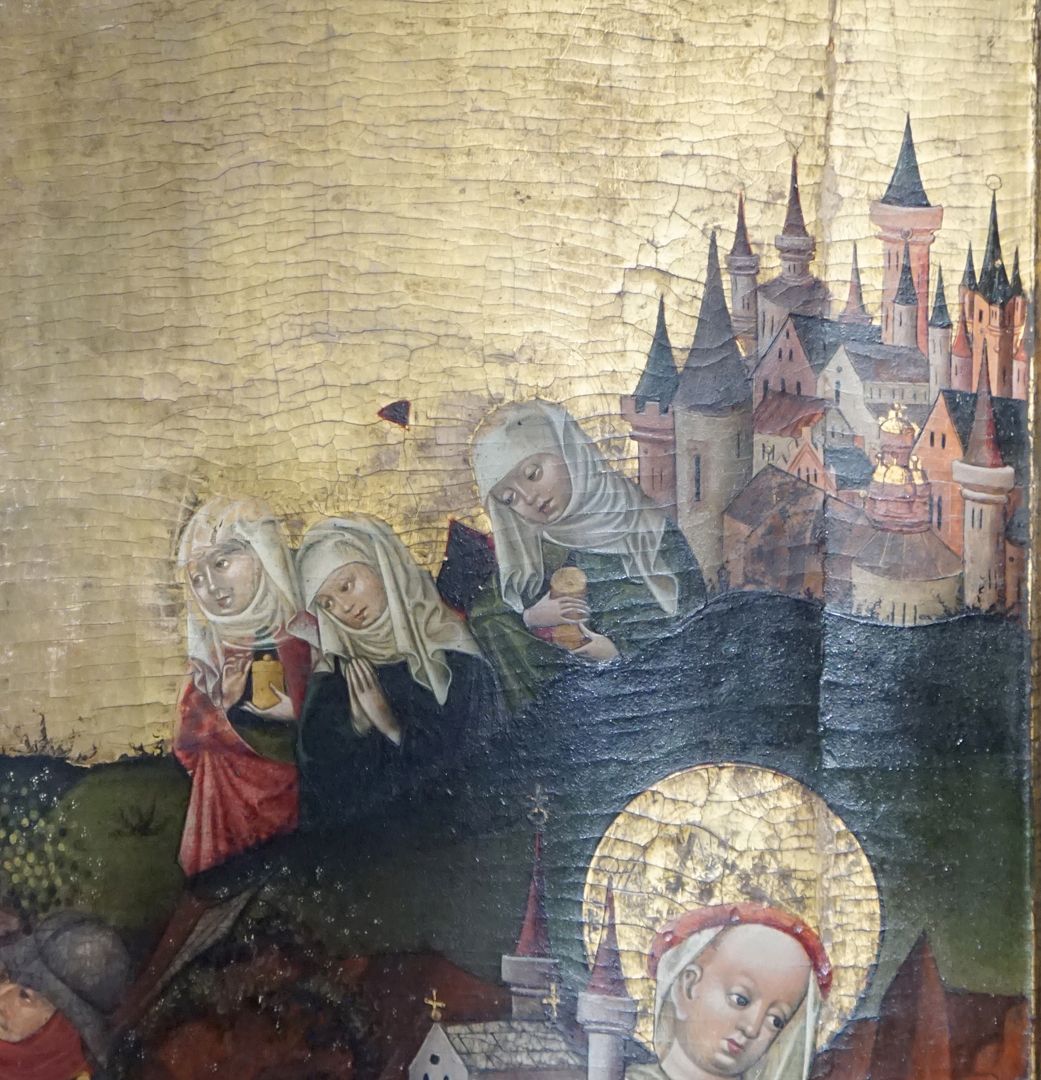
Resurrection of Christ
around 1445
Detailed view, with Jerusalem depicted in the background, Solomon's Temple can be seen in front
With the adoring donor couple, along with their patron saint Johannes Ev. and Empress Kunigunde (formerly in the Dominican Church) The epitaph was attributed by researchers to a painter's workshop that created the epitaph of Brigitta Deichsler, who died in 1438, today in the Berkshire Museum, Pittsfield (The paintings of the late Middle Ages in the Germanisches Nationalmuseum, Franken 1, 2019, pp. 249-250, note 44 and 47 and p. 320, note 50). This epitaph was also previously located in the Nuremberg Dominican Church (Frank Matthias Kammel: Nuremberg 1420. The Deichsler Altar and the beautiful style, in: Der Deichsler Altar, Nuremberg 2016, pp. 15-16 with illustrations 13 and 14). The donor couple depicted in the scene, but without a coat of arms, was tentatively identified with Hans and Kunigunde Steinlinger. In 1444, Hans Steinlinger ordered that he be buried with his wife Kunigunde in the Dominican monastery (Kammel, p. 15). Hans Steinlinger, who acquired Nuremberg citizenship in 1428 (The Nuremberg Citizens' Books. I. The Parchmentenen New Citizens' Lists 1302-1448, Nuremberg 1974, p. 90, no. 1768), was named in the Greater Council in 1430-1449. In 1441/1442, the highwayman Hans Vogler von Neuenmuhr sued Hans Steinlinger, bailiff of the Nuremberg citizen and bailiff Franz Rummel in Höchstadt, as well as the council and the entire population of Höchstadt at the Femegericht in Westphalia, because they had extradited him to Nuremberg. Vogler was released through the intercession of several princes in exchange for fulfilling the primal feud (a sworn obligation to renounce revenge), whereupon he filed a lawsuit in Westphalia (Ludwig Veit: Nuremberg and the Feme, Nuremberg 1955, p. 163 and p. 241-242, note 1013 ). At the end of October 1459, the death knell was rung for Hans Steinlingerin von Höchstadt in both St. Sebald and St. Lorenz.Feedback gebenSeitenleisten
Location: Nuremberg, Frauenkirche, northern pillar image
photo 2021, Theo Noll
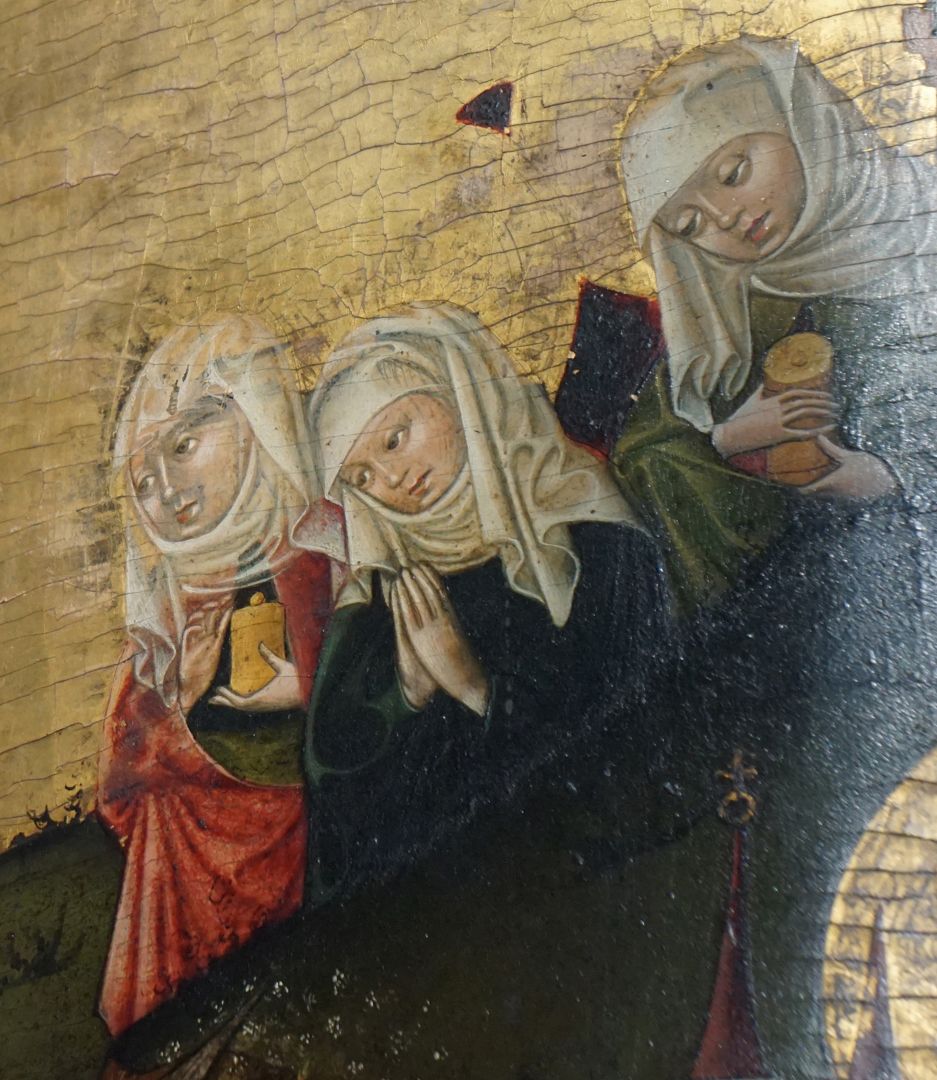
Resurrection of Christ
around 1445
Detailed view with the Three Marys at the tomb
With the adoring donor couple, along with their patron saint Johannes Ev. and Empress Kunigunde (formerly in the Dominican Church) The epitaph was attributed by researchers to a painter's workshop that created the epitaph of Brigitta Deichsler, who died in 1438, today in the Berkshire Museum, Pittsfield (The paintings of the late Middle Ages in the Germanisches Nationalmuseum, Franken 1, 2019, pp. 249-250, note 44 and 47 and p. 320, note 50). This epitaph was also previously located in the Nuremberg Dominican Church (Frank Matthias Kammel: Nuremberg 1420. The Deichsler Altar and the beautiful style, in: Der Deichsler Altar, Nuremberg 2016, pp. 15-16 with illustrations 13 and 14). The donor couple depicted in the scene, but without a coat of arms, was tentatively identified with Hans and Kunigunde Steinlinger. In 1444, Hans Steinlinger ordered that he be buried with his wife Kunigunde in the Dominican monastery (Kammel, p. 15). Hans Steinlinger, who acquired Nuremberg citizenship in 1428 (The Nuremberg Citizens' Books. I. The Parchmentenen New Citizens' Lists 1302-1448, Nuremberg 1974, p. 90, no. 1768), was named in the Greater Council in 1430-1449. In 1441/1442, the highwayman Hans Vogler von Neuenmuhr sued Hans Steinlinger, bailiff of the Nuremberg citizen and bailiff Franz Rummel in Höchstadt, as well as the council and the entire population of Höchstadt at the Femegericht in Westphalia, because they had extradited him to Nuremberg. Vogler was released through the intercession of several princes in exchange for fulfilling the primal feud (a sworn obligation to renounce revenge), whereupon he filed a lawsuit in Westphalia (Ludwig Veit: Nuremberg and the Feme, Nuremberg 1955, p. 163 and p. 241-242, note 1013 ). At the end of October 1459, the death knell was rung for Hans Steinlingerin von Höchstadt in both St. Sebald and St. Lorenz.Feedback gebenSeitenleisten
Location: Nuremberg, Frauenkirche, northern pillar imag
photo 2021, Theo Noll
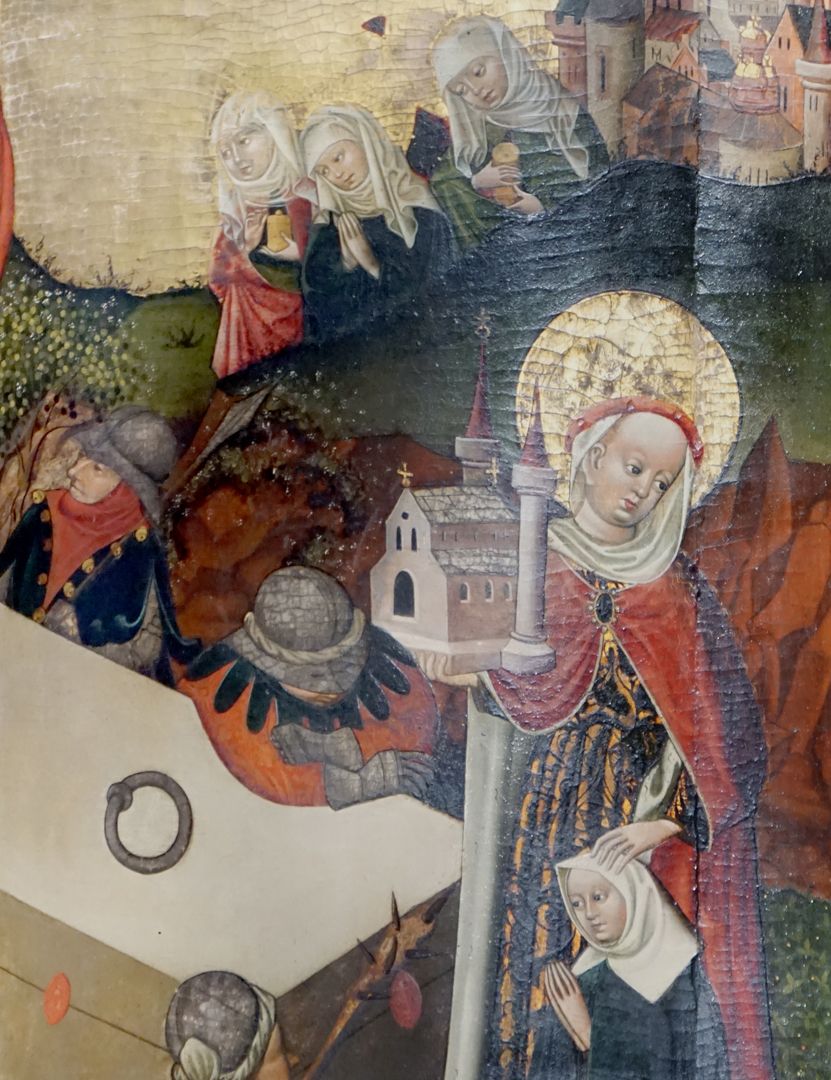
Resurrection of Christ
around 1445
Kunigunde with donor
With the adoring donor couple, along with their patron saint Johannes Ev. and Empress Kunigunde (formerly in the Dominican Church) The epitaph was attributed by researchers to a painter's workshop that created the epitaph of Brigitta Deichsler, who died in 1438, today in the Berkshire Museum, Pittsfield (The paintings of the late Middle Ages in the Germanisches Nationalmuseum, Franken 1, 2019, pp. 249-250, note 44 and 47 and p. 320, note 50). This epitaph was also previously located in the Nuremberg Dominican Church (Frank Matthias Kammel: Nuremberg 1420. The Deichsler Altar and the beautiful style, in: Der Deichsler Altar, Nuremberg 2016, pp. 15-16 with illustrations 13 and 14). The donor couple depicted in the scene, but without a coat of arms, was tentatively identified with Hans and Kunigunde Steinlinger. In 1444, Hans Steinlinger ordered that he be buried with his wife Kunigunde in the Dominican monastery (Kammel, p. 15). Hans Steinlinger, who acquired Nuremberg citizenship in 1428 (The Nuremberg Citizens' Books. I. The Parchmentenen New Citizens' Lists 1302-1448, Nuremberg 1974, p. 90, no. 1768), was named in the Greater Council in 1430-1449. In 1441/1442, the highwayman Hans Vogler von Neuenmuhr sued Hans Steinlinger, bailiff of the Nuremberg citizen and bailiff Franz Rummel in Höchstadt, as well as the council and the entire population of Höchstadt at the Femegericht in Westphalia, because they had extradited him to Nuremberg. Vogler was released through the intercession of several princes in exchange for fulfilling the primal feud (a sworn obligation to renounce revenge), whereupon he filed a lawsuit in Westphalia (Ludwig Veit: Nuremberg and the Feme, Nuremberg 1955, p. 163 and p. 241-242, note 1013 ). At the end of October 1459, the death knell was rung for Hans Steinlingerin von Höchstadt in both St. Sebald and St. Lorenz.Feedback gebenSeitenleisten
Location: Nuremberg, Frauenkirche, northern pillar image
photo 2021, Theo Noll
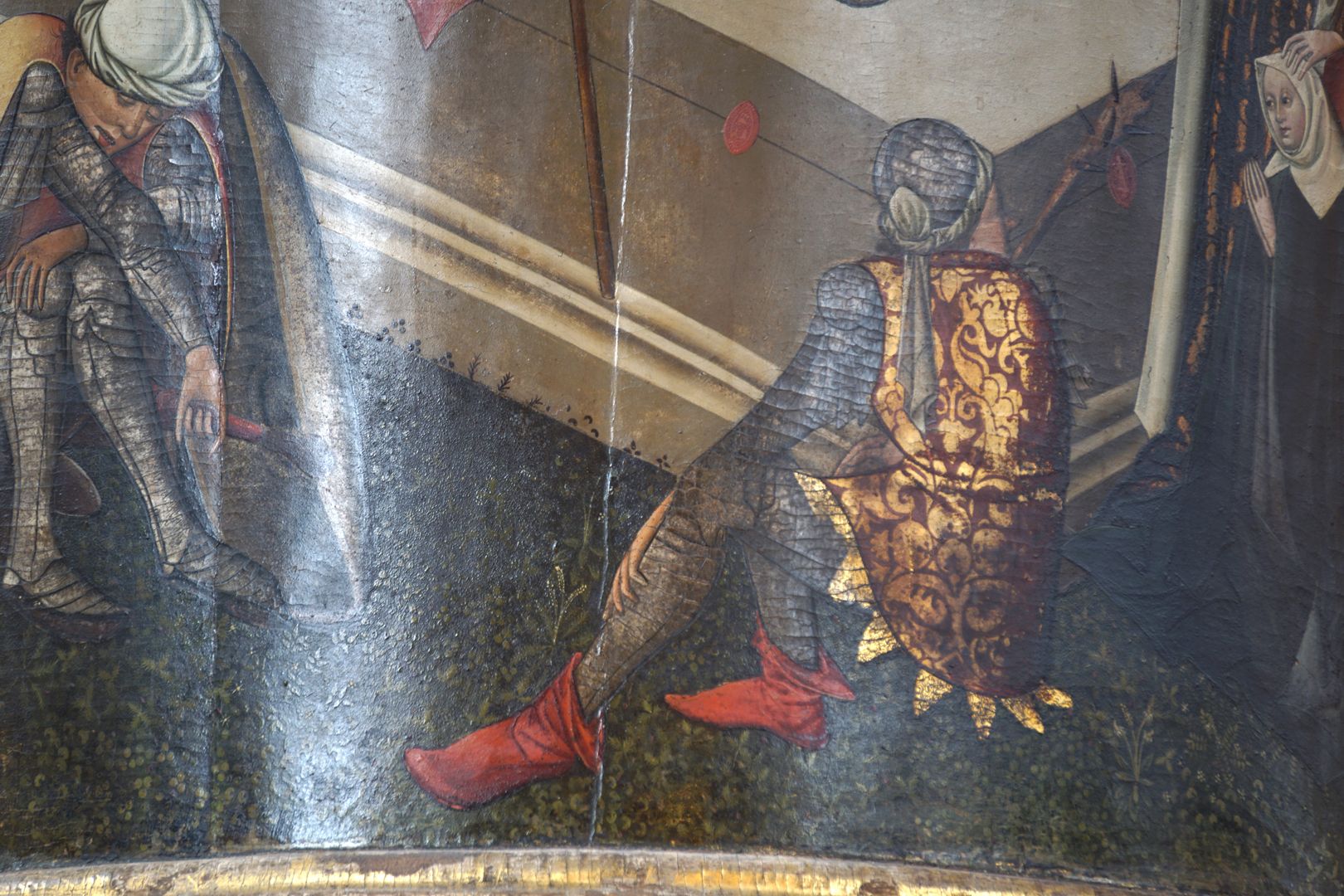
Resurrection of Christ
around 1445
Detail view
With the adoring donor couple, along with their patron saint Johannes Ev. and Empress Kunigunde (formerly in the Dominican Church) The epitaph was attributed by researchers to a painter's workshop that created the epitaph of Brigitta Deichsler, who died in 1438, today in the Berkshire Museum, Pittsfield (The paintings of the late Middle Ages in the Germanisches Nationalmuseum, Franken 1, 2019, pp. 249-250, note 44 and 47 and p. 320, note 50). This epitaph was also previously located in the Nuremberg Dominican Church (Frank Matthias Kammel: Nuremberg 1420. The Deichsler Altar and the beautiful style, in: Der Deichsler Altar, Nuremberg 2016, pp. 15-16 with illustrations 13 and 14). The donor couple depicted in the scene, but without a coat of arms, was tentatively identified with Hans and Kunigunde Steinlinger. In 1444, Hans Steinlinger ordered that he be buried with his wife Kunigunde in the Dominican monastery (Kammel, p. 15). Hans Steinlinger, who acquired Nuremberg citizenship in 1428 (The Nuremberg Citizens' Books. I. The Parchmentenen New Citizens' Lists 1302-1448, Nuremberg 1974, p. 90, no. 1768), was named in the Greater Council in 1430-1449. In 1441/1442, the highwayman Hans Vogler von Neuenmuhr sued Hans Steinlinger, bailiff of the Nuremberg citizen and bailiff Franz Rummel in Höchstadt, as well as the council and the entire population of Höchstadt at the Femegericht in Westphalia, because they had extradited him to Nuremberg. Vogler was released through the intercession of several princes in exchange for fulfilling the primal feud (a sworn obligation to renounce revenge), whereupon he filed a lawsuit in Westphalia (Ludwig Veit: Nuremberg and the Feme, Nuremberg 1955, p. 163 and p. 241-242, note 1013 ). At the end of October 1459, the death knell was rung for Hans Steinlingerin von Höchstadt in both St. Sebald and St. Lorenz.Feedback gebenSeitenleisten
Location: Nuremberg, Frauenkirche, northern pillar imag
photo 2021, Theo Noll
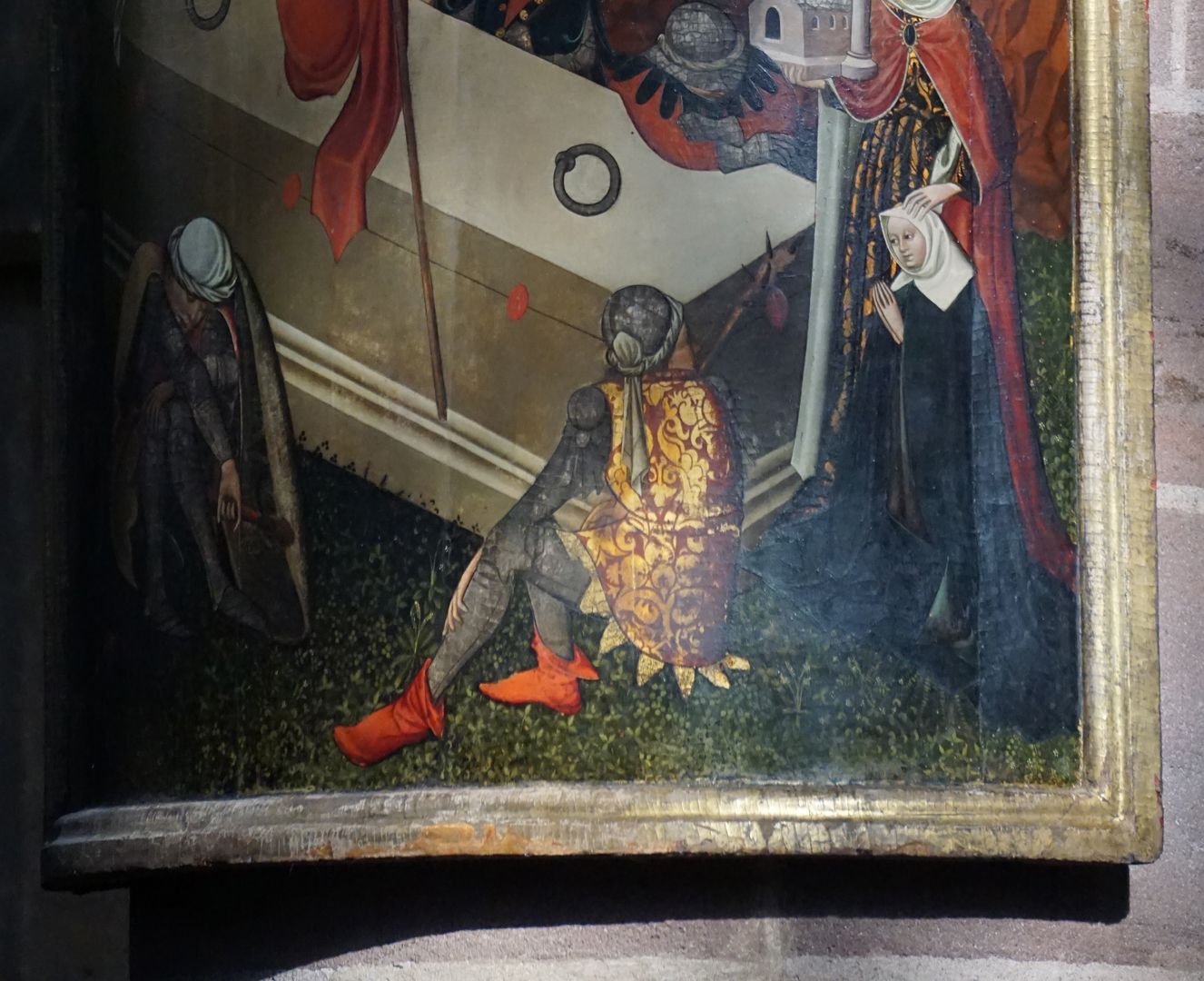
Resurrection of Christ
around 1445
Detailansicht
With the adoring donor couple, along with their patron saint Johannes Ev. and Empress Kunigunde (formerly in the Dominican Church) The epitaph was attributed by researchers to a painter's workshop that created the epitaph of Brigitta Deichsler, who died in 1438, today in the Berkshire Museum, Pittsfield (The paintings of the late Middle Ages in the Germanisches Nationalmuseum, Franken 1, 2019, pp. 249-250, note 44 and 47 and p. 320, note 50). This epitaph was also previously located in the Nuremberg Dominican Church (Frank Matthias Kammel: Nuremberg 1420. The Deichsler Altar and the beautiful style, in: Der Deichsler Altar, Nuremberg 2016, pp. 15-16 with illustrations 13 and 14). The donor couple depicted in the scene, but without a coat of arms, was tentatively identified with Hans and Kunigunde Steinlinger. In 1444, Hans Steinlinger ordered that he be buried with his wife Kunigunde in the Dominican monastery (Kammel, p. 15). Hans Steinlinger, who acquired Nuremberg citizenship in 1428 (The Nuremberg Citizens' Books. I. The Parchmentenen New Citizens' Lists 1302-1448, Nuremberg 1974, p. 90, no. 1768), was named in the Greater Council in 1430-1449. In 1441/1442, the highwayman Hans Vogler von Neuenmuhr sued Hans Steinlinger, bailiff of the Nuremberg citizen and bailiff Franz Rummel in Höchstadt, as well as the council and the entire population of Höchstadt at the Femegericht in Westphalia, because they had extradited him to Nuremberg. Vogler was released through the intercession of several princes in exchange for fulfilling the primal feud (a sworn obligation to renounce revenge), whereupon he filed a lawsuit in Westphalia (Ludwig Veit: Nuremberg and the Feme, Nuremberg 1955, p. 163 and p. 241-242, note 1013 ). At the end of October 1459, the death knell was rung for Hans Steinlingerin von Höchstadt in both St. Sebald and St. Lorenz.Feedback gebenSeitenleisten
Location: Nuremberg, Frauenkirche, northern pillar imag
photo 2021, Theo Noll
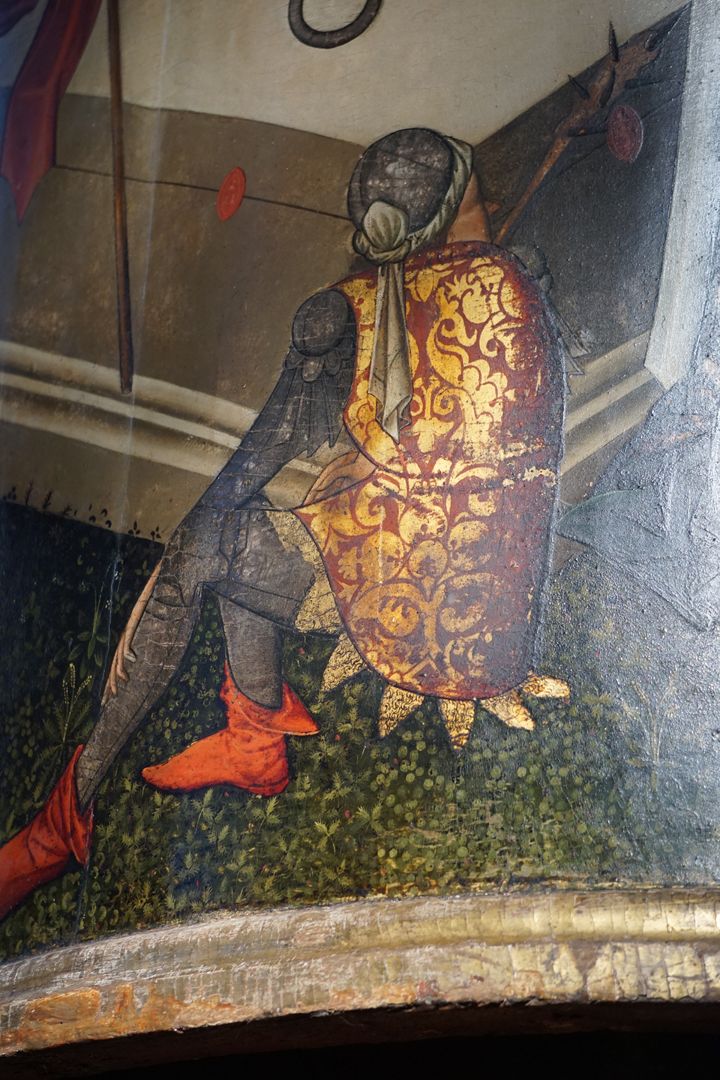
Resurrection of Christ
around 1445
Detailansicht
With the adoring donor couple, along with their patron saint Johannes Ev. and Empress Kunigunde (formerly in the Dominican Church) The epitaph was attributed by researchers to a painter's workshop that created the epitaph of Brigitta Deichsler, who died in 1438, today in the Berkshire Museum, Pittsfield (The paintings of the late Middle Ages in the Germanisches Nationalmuseum, Franken 1, 2019, pp. 249-250, note 44 and 47 and p. 320, note 50). This epitaph was also previously located in the Nuremberg Dominican Church (Frank Matthias Kammel: Nuremberg 1420. The Deichsler Altar and the beautiful style, in: Der Deichsler Altar, Nuremberg 2016, pp. 15-16 with illustrations 13 and 14). The donor couple depicted in the scene, but without a coat of arms, was tentatively identified with Hans and Kunigunde Steinlinger. In 1444, Hans Steinlinger ordered that he be buried with his wife Kunigunde in the Dominican monastery (Kammel, p. 15). Hans Steinlinger, who acquired Nuremberg citizenship in 1428 (The Nuremberg Citizens' Books. I. The Parchmentenen New Citizens' Lists 1302-1448, Nuremberg 1974, p. 90, no. 1768), was named in the Greater Council in 1430-1449. In 1441/1442, the highwayman Hans Vogler von Neuenmuhr sued Hans Steinlinger, bailiff of the Nuremberg citizen and bailiff Franz Rummel in Höchstadt, as well as the council and the entire population of Höchstadt at the Femegericht in Westphalia, because they had extradited him to Nuremberg. Vogler was released through the intercession of several princes in exchange for fulfilling the primal feud (a sworn obligation to renounce revenge), whereupon he filed a lawsuit in Westphalia (Ludwig Veit: Nuremberg and the Feme, Nuremberg 1955, p. 163 and p. 241-242, note 1013 ). At the end of October 1459, the death knell was rung for Hans Steinlingerin von Höchstadt in both St. Sebald and St. Lorenz.Feedback gebenSeitenleisten
Location: Nürnberg, Frauenkirche, nördliches Pfeilerbild
photo 2021, Theo Noll