Johannes
Regiomontanus (Müller)
printer, ,
born Königsberg in Unterfranken (Unfinden?), 06. Jun 1436
died Rom, 06. Jul 1476
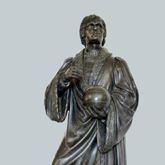
Sohn eines Müllers. 1448 wurde er mit elf Jahren als Student an der Universität Leipzig eingeschrieben, wo er Mathematik und Astronomie, Philologie und Philosophie studierte. Für 1448 errechnete er sein erstes astronomisches Jahrbuch, das an Genauigkeit andere Kalender übertraf und Aufsehen erregte. 1450 wurde er Schüler und Mitarbeiter Georg Peurbachs an der Universität Wien, mit dem er sieben Jahre zusammenarbeitete. 1452 wurde er Bakkalaureus, 1457 Magister, 1461 hielt er Vorlesungen in Wien. Es folgten Reisen und Lehrtätigkeit in Italien, 1467-71 war er Professor für Mathematik an der Universität Preßburg/Ungarn. Anfang 1471 schied er aus dem Dienst des Ungarnkönigs Matthias Corvinus aus und kam im Herbst 1471 nach Nürnberg, wo er bis Sommer 1475 blieb. Er verfügte bereits 1471 über eine eigene Druckerei und eine Werkstatt (nach Murr in der Vorderen Kartäusergasse) zur Herstellung astronomischer Schriften und Instrumente. Das Hauptwerk seiner Druckerei waren 1474 die „Ephemeriden“, eine Tabelle mit rund 300.000 Zahlen und Symbolen, nach denen sich auf See mit einfachen Mitteln die Position bestimmen läßt. 1475 ließ er den ersten reinen Antiqua-Druck in Deutschland erscheinen, was für die weitere Entwicklung des Buchdrucks von entscheidender Bedeutung war. Die Lettern hierzu bezog er vermutlich aus Rom. Er trug wesentlich dazu bei, Nürnbergs Ruf als Zentrum mathematischer und astronomischer Gelehrsamkeit zu begründen. 1475 wurde Regiomontanus von Papst Sixtus IV. nach Rom berufen, um an der Verbesserung des Kalenders mitzuwirken, er starb jedoch schon im folgenden Jahr. Sein wichtigster Schüler war Bernhard Walther, der nach Regiomontanus’ Weggang aus Nürnberg die begonnenen Beobachtungsreihen selbständig fortsetzte. Seine Bibliothek und die Instrumente kaufte Walther von den Erben; aus dessen Nachlass wurden sie 1519 vom Rat der Stadt Nürnberg um 200 fl. erworben. Das Inventar vom Oktober 1522 zählte 145 Bücher. Seine 1832 von Jakob Daniel Burgschmiet gegossene Statue befindet sich im Dürer-Gymnasium in Nürnberg. Der Regiomontanusweg in Nürnberg wurde nach ihm benannt. Gedenktafel am Geburtshaus, Salzmarkt 6 in Königsberg i. Bay. Panzer verzeichnete sein Portrait.
Werke: Verz. s. Will, GL III, S. 273-282 und VII, S. 226-234. NÜRNBERG, MStN. –, GNM. –, Dürer-Gymnasium: Bronzestatue, 94 cm, sign. (Jakob Daniel) Burgschmiet, 1832.
Lit.: ADB; Thieme-Becker; Doppelmayr, 1730; Will, Münzbel. Bd. III, S. 30; H. Petz, in: MVGN 7, 1888; E. Zinner, 1968; Abeler, MdU, S. 505; I. Bues, in: Lebensbilder Franken 11, 1984; A. Wingen-Trennhaus, in: MVGN 78, 1991; R. Mett: Regiomontanus, Stuttgart, Leipzig 1996; Stadtlexikon 2000; Hans Gaab: Regiomontanus, Bernhard Walther, Johann Philipp von Wurzelbau und die große nürnbergische Uhr, in: Regiomontanusbote 14, 2001, 1, S. 20-28.
Ausst.: 1907/3; 1957/5; 1968/9; 1970/5, –/7; 1971/3; 1976/9; 1982/4; 1986/7; 2002/1 Nr. 90.
(zitiert aus dem Nürnberger Künstlerlexikon, Herausgegeben von Manfred H. Grieb)
Period: 15th c.