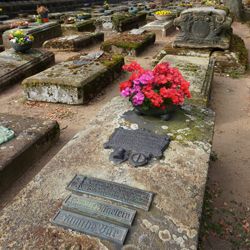
Johann
Pachelbel
,
christened Nürnberg, 01. Sep 1653
buried Nürnberg, 09. Mar 1706
Besuch der Lorenzer Lateinschule, anschließend Besuch von Vorlesungen am Auditorium des Egidiengymnasiums.
Seit den frühen 1660er Jahren Musikausbildung durch Georg Caspar Wecker und Heinrich Schwemmer.
Am 29.6.1669 an der Universität Altdorf immatrikuliert, daneben Organist an der dortigen Laurentiuskirche.
1670-73 Schüler des Gymnasiums poeticum in Regensburg unter Kaspar Prentz.
1673 Vikar am Wiener Stephansdom, auch Hoforganist, Schüler bei Johann Kaspar Kerll.
1677 in Eisenach ein Jahr Musikus und Hoforganist in der Kapelle des Herzogs Johann Georg von Sachsen-Eisenach mit einem Jahresgehalt 40 Talern, das am 1.1.1678 auf 60 Taler erhöht wurde. Seit dieser Zeit auch freundschaftliche Beziehungen zur Familie Bach, am 28.1.1680 war er Taufpate von Johanna Juditha, der jüngsten Tochter des Johann Ambrosius Bach.
Am 19.6.1678 Bestallung als Organist an der Predigerkirche in Erfurt mit einem Gehalt von 60 fl., dazu freie Wohnung und Naturalienbezüge sowie zahlreiche Nebeneinnahmen durch Taufen, Hochzeiten und Beerdigungen. Er blieb zwölf Jahre in Erfurt und war in dieser Zeit Lehrmeister vieler bedeutender Schüler, darunter 1685-88 Johann Christoph III. Bach.
Vom 1.9.1690 bis Herbst 1692 Hofmusikus und -organist in Stuttgart, das er wegen des Pfälzischen Erbfolgekrieges verließ.
Seine Frau ging mit den Kindern nach Nürnberg, während er am 8.11.1692 seinen Dienst als Stadtorganist an der Augustiner- und Margarethenkirche in Gotha antrat. Durch den Tod Weckers wurde in Nürnberg das oberste Organistenamt an St. Sebald frei, das er am 24.6.1695 antrat und bis zu seinem Tod bekleidete. Seine Besoldung betrug 150 fl. und wurde 1696 um 30 fl. erhöht; 1702/03 wurde sie auf 200 fl. angehoben. Auch in Nürnberg bildete er eine größere Zahl Schüler aus, darunter Johann Jakob de Neufville, Maximilian Zeidler und den späteren Stuttgarter Hofkapellmeister Georg Christian Störl. Pachelbel zählt zu den führenden Repräsentanten des fränkisch-mitteldeutschen Musikbarock, dessen Nachleben und Nachwirkung über die Jahrhunderte hinweg kaum je eine Unterbrechung erlitten hat. In Nürnberg wohnte er in der Katharinengasse.
Die Pachelbelstraße in Nürnberg wurde nach ihm benannt.
Werke: Orgel- und Klavierwerke. Verz. siehe MGG 10, 540 und Dupont, 1971. MuS: NÜRNBERG, StadtB. Lit.: ADB; NDB; Doppelmayr, 1730; Will, GL VII, S. 89-91; Brockhaus-Riemann, 1978; Franz Krautwurst, 1971; Ders., in: Fränkische Lebensbilder 12, 1986; Rochuskirchhof, 1989; Herbert Maas, in: MVGN 81, 1994; Stadtlexikon 2000. Ausst.: 1959/8; 1973/10, S. 125; 1996/4.
(zitiert aus dem Nürnberger Künstlerlexikon, Herausgegeben von Manfred H. Grieb)
siehe auch: Traxdorfer Orgel
Style: Baroque