born Bern, 07. Aug 1779
died Nürnberg, 03. May 1836
Son of Balthasar Anton, painter and engraver. He came to Nuremberg in 1800, where he was taken into the home of Johann Friedrich Frauenholz, for whose publishing house he worked for many years as a copyist and colorist. He produced drawings and etchings after older masters (Hendrick de Roos, Joseph Vernet, Jan Baptist Weenix, Franz Edmund Weirotter, Jan Wijnants) and contemporaries (Friedrich Geißler, Martin von Molitor, Johann Christian Reinhart). In 1821, Albert Christoph Reindel appointed him as a drawing teacher at the Nuremberg Art School. Around 1817, he created watercolors and etchings depicting views and costumes of his Swiss homeland, some of them based on other artists (Johann Ludwig Aberli, Johann Jakob Aschmann). After 1820, he also turned to copperplate engraving, frequently producing his own drawings. At the same time, he dabbled in oil painting. His main source of income remained miniature colored drawing copies based on contemporary models (Johann Christoph Erhard, Peter Hess, Johann Adam Klein, Wilhelm von Kobell, and Johann Baptist Seele).
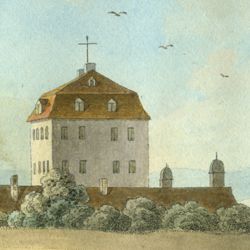
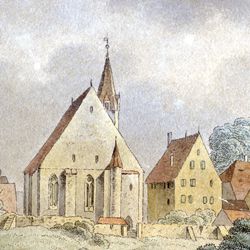
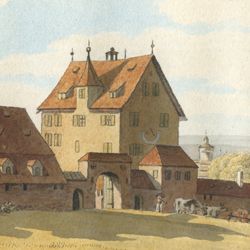
He also colored prints by Friedrich Geißler and Johann Adam Klein, increasing their value. His main works are eight color-printed outline etchings "Prospects from the Surroundings of Nuremberg" after watercolors by J. A. Klein, circa 1820, and the topographical collective image "Views and Ground Plans of the Grounds of Schmausenbuck near Nuremberg," circa 1833.
His large circle of friends included Johann Andreas Boerner, Ambrosius Gabler, Christoph Haller von Hallerstein, Johann Christoph Jakob Wilder, and Gustav Philipp Zwinger. In 1829, he lived at S. 39a (Winklerstraße 3) and finally at S. 897 (Obstmarkt 9). Since 1800 member of the Association of Artists and Art Lovers in Nuremberg, 1804 member of the Academy of Fine Arts
Period: 19th c.