Johann Franciscus
Ermels

painter, draftsman, etcher

born Reilkirch/Mosel, 1641

died Nürnberg, 03. Dec 1693

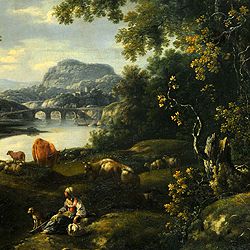
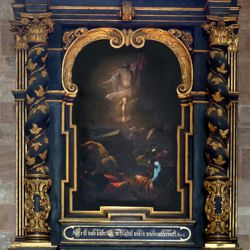
Son of Conrad, winemaker (died/born August 31, 1676 in Enkirch); father of Georg Paul, painter. ∞ I) Wöhrd near Nuremberg September 16, 1661 Susanna (died April 22, 1637 – born June 3, 1669), daughter of Christoph >Halter, painter, six children; ∞II) Nuremberg July 17, 1671 Anna Barbara (* 1635 – born December 26, 1716), daughter of Hans Georg Reger, schoolmate at St. Sebald, childless. Trained as a history painter under Johann Hülsmann in Cologne. While traveling, Ermels trained as a landscape painter in Holland, where he was influenced by Jan Both. In 1660 he came to Nuremberg, where he initially worked as a journeyman. By council resolution of August 20, 1661, he was granted citizenship. On March 5, 1662, he was entered in the citizen's register, for which he paid 4 florins. On October 8, 1661, he became a master with the sample piece "Christ and the Samaritan woman at the well." At first he painted mythological, religious and historical scenes, later he switched to landscape painting. The effect is often enhanced by contrasts; the lovers or shepherd with herd in the foreground are contrasted by a ruin in the background, which reminds us of the transience of happiness and all earthly things. He sometimes painted the staffage for Wilhelm von Bemmel's landscapes, and joint works with Johann Heinrich Roos are also known. He also occasionally painted portraits. In addition to oil paintings, a large number of drawings have survived. He had the painters Gottfried Wilhelm Röder and Georg Blendinger as students, as well as the Swiss Felix Meyer. His gout affected his work from 1671 onwards. Daniel Preißler and Daniel de Savoye painted his portrait. Panzer drew his portrait, engraved by Valentin Daniel Preißler. In 1669 he lived with his family on Bonersberg (Paniersplatz), where his deceased father-in-law had also lived, later he moved to Hirschelgasse

Style: Baroque

Period: 17th c.