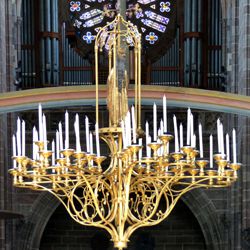
died Nürnberg, Jul 1541
In 1497 he was granted citizenship, and was designated as a clockmaker. In 1498 he became a master locksmith; he was also a ball-and-socket maker. He supplied various clock and musical instruments to foreign princes, including Emperor Charles V and his brother King Ferdinand. By council resolution of April 20, 1513 and October 13, 1513, Bulmann was allowed to temporarily employ two additional journeymen outside of the trade regulations; by resolution of December 6, 1523, he was again granted five, and in 1528 two additional journeymen. Exceptions to the trade regulations were also made in 1517 and 1529, which indicates that he had to carry out larger orders for high-ranking people. Bulmann made high-speed scales for large loads and wagons, including two hay scales in 1503, for which he received 40 fl. In 1521 he installed a model in the flour scales on the island of Schütt. In 1518, Christoph Scheurl the Elder commissioned him to make a chest lock, which cost 25 fl. Bulmann was also mentioned as a maker of walking male and female figures that could play the lute or beat the drum. On October 23, 1535, Bulmann's wife Anna signed the remaining payment for a "walking image of a virgin". Since at least 1503, he lived "above S. Kathrinenn" or on the Katharinengraben. He was the street captain; his neighbor was the locksmith Jörg Heuß. In 1534, Bulmann sold the house at Obere Schmiedgasse 20 to his son Melchior for 250 fl. Bulmannstrasse was named after him.
Style: Late Gothic
Period: 16th c.