born 1545/50
died after Prag (?), 14. Oct 1591
The first archival evidence of Hans Hoffmann is the baptism of his son Matthes (Mathias) in St. Sebaldus on December 8, 1572. The painter's wife's first name was Eva. The couple had two more children: Benedictus, baptized on August 14, 1575, and Anna, baptized on February 12, 1582. The long intervals between the baptisms suggest that Hans Hoffmann traveled extensively. In a council decree dated June 30, 1576, he was described as a citizen of Nuremberg. He was required to answer debts for interest and jewelry (ring and clainet) owed to the furrier Hans Uhrmacher in Prague's New Town, which suggests a longer stay in Prague. One of Hofmann's early works is the 1573 portrait of Barbara Möringer, wife of the jeweler (dealer in goldsmith's work) Wolf Möringer, now in the Franconian Gallery in Kronach. Möringer, who was among the 100 richest citizens of Nuremberg in 1579, regularly attended the Frankfurt trade fairs and also supplied works to Emperor Maximilian II, who resided in Prague. Hoffmann worked for patricians and wealthy Nuremberg residents, including Franz Tucher, for whom and for whose wife he painted a family tree, Willibald Imhoff, and Paulus Praun. His last known work is the portrait of Paul Pfinzing the Elder, a chalk drawing dated 1591, now in the Germanisches Nationalmuseum in Nuremberg. According to the court numerary accounts, Hans Hoffmann received 15 guilders, 55 shillings, and another 24 guilders for travel expenses to Munich in 1584, as well as a "reward" of 20 guilders for unspecified services to Duke William V of Bavaria. From July 1, 1585, Hoffmann was court painter to Emperor Rudolf II in Prague, where he likely also served as an advisor to the imperial art collection. He received a salary of 100 thalers annually; commissions for the emperor were paid separately. In November 1585, he requested from Prague that his Nuremberg citizenship be retained, which was granted to him for three years by council decree of December 3, 1585, subject to payment of the annual token. This privilege was extended for two years in 1588 and for a further three years by council decree of July 18, 1590. Hoffmann left his children in Nuremberg, who, after his death, were placed under the guardianship of the goldsmiths Conrad Königsmüller and Barthel Jamnitzer. Of the commissions of 100 guilders annually granted to each of the children of the deceased court painter Hans Hoffmann by imperial decree for six years, one installment, calculated for one and a half years, was paid to his son Mathias by the end of October 1592.
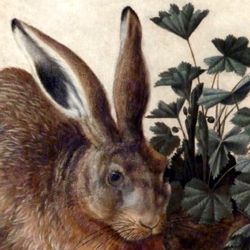
Hans Hoffmann's widow received the final installment of these commissions on May 31, 1609. As a painter in the Nuremberg period after Dürer, Hans Hoffmann is an important representative of a "Dürer Renaissance," during which copies of Dürer's works were also created. His only known pupil in Nuremberg was Georg Karl (Carl), who later moved to Munich, where he worked for the Bavarian duke from at least 1590. In 1593, he acquired the right of master craftsman; He was still alive in 1611.
References: Yasmin Doosry (ed.): Hans Hoffmann. A European Artist of the Renaissance. Companion volume to the exhibition at the Germanisches Nationalmuseum from May 12 to August 21, 2022, Nuremberg 2022.
Kurt Pilz: Hans Hoffmann. A Nuremberg Dürer Imitator from the Second Half of the 16th Century, in: Mitteilungen des Verein für Geschichte der Stadt Nürnberg 51 (1962), pp. 236-272.
Wendelin Boeheim: Documents and Registers from the Imperial and Royal Court Library, in: Jahrbuch der Kunsthistorischen Sammlungen des Allerhöchsten Kaiserhaus 7 (1888), pp. XCI-CCCXV, here p. CCXXIII, no. 5514 and p. CCXXIV, no. 5521.
Style: Manierism
Period: 16th c.