Bartholomäus
Wittig

painter, draftsman

born wohl Breslau, 1613/14

buried Nürnberg, 24. Mar 1684

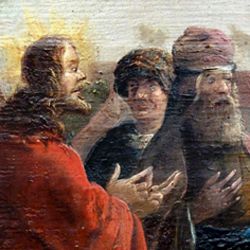
Son of Noah, a merchant in Oels, he remained unmarried. From 1629 to 1634, he trained under Michael Duquesne in Breslau, followed by study trips to Holland and Italy. He entered his name in the artist Ruprecht Hauer's family register, stating that he had been a member of the Bentvueghels in Rome and had been nicknamed "House Mouse." He can be traced back to Nuremberg since 1642; the painting "The Disciples Pluck Ears of Grain on the Sabbath," which is now located in St. John's Church, was created in that year. In 1647, Wittig had a dispute with the Nuremberg painting trade, reporting to the council that he had previously only painted small copper plates, which he mostly sold to Italy and the Netherlands, thus not harming local painters. In 1648, he received two more years of city protection and permission to pursue his art. In 1654, the council noticed that Wittig had been staying in Nuremberg for some time, earning a lot of money, but paying neither a token nor a protection fee. He was encouraged to apply for citizenship, which he never obtained. In 1660, the painters again attempted to subject Wittig to the painters' regulations. By decree of March 2, 1660, the council decided to exempt him from the painters' regulations and exempt him from the test piece and the carrying of a body, but he was required to pay a certain amount into the painters' coffers. In 1665, the secretary to the Danish king, Hermann Uhlich, praised the quality of Wittich's paintings, which he claimed were available at reasonable prices. His subject matter was broad: Wittich painted religious and allegorical scenes, historical paintings and genre scenes, flowers and nocturnes. Panzer recorded the portrait of Hieronymus Widmann, which was used as an engraving model. His most famous painting was created in 1649 and depicts the folk festival in front of Nuremberg City Hall during the Peace Banquet. The image served as the model for a copperplate engraving by Johann Wilhelm Stör, based on a drawing by Georg Daniel Heumann. Wittig last lived on Zotenberg (Dötschmannsplatz).

His brother Caspar, who acquired citizenship in 1635, owned the Kugelapotheke (a pharmacy) in Nuremberg and was married to Barbara, the daughter of Basilius Besler.

Reference: Grieb, Nuremberg Artists' Encyclopedia

Style: Baroque